Why Your Dissertation Lacks Critical Thinking
Introduction
One of the most common reasons students receive lower dissertation marks is not poor research, weak writing, or insufficient references—it is a lack of critical thinking.
Many students spend months collecting journal articles, reading textbooks, and analysing data. Yet when their dissertation is assessed, examiners often comment that the work is "too descriptive," "lacks critical evaluation," or "needs deeper analysis."
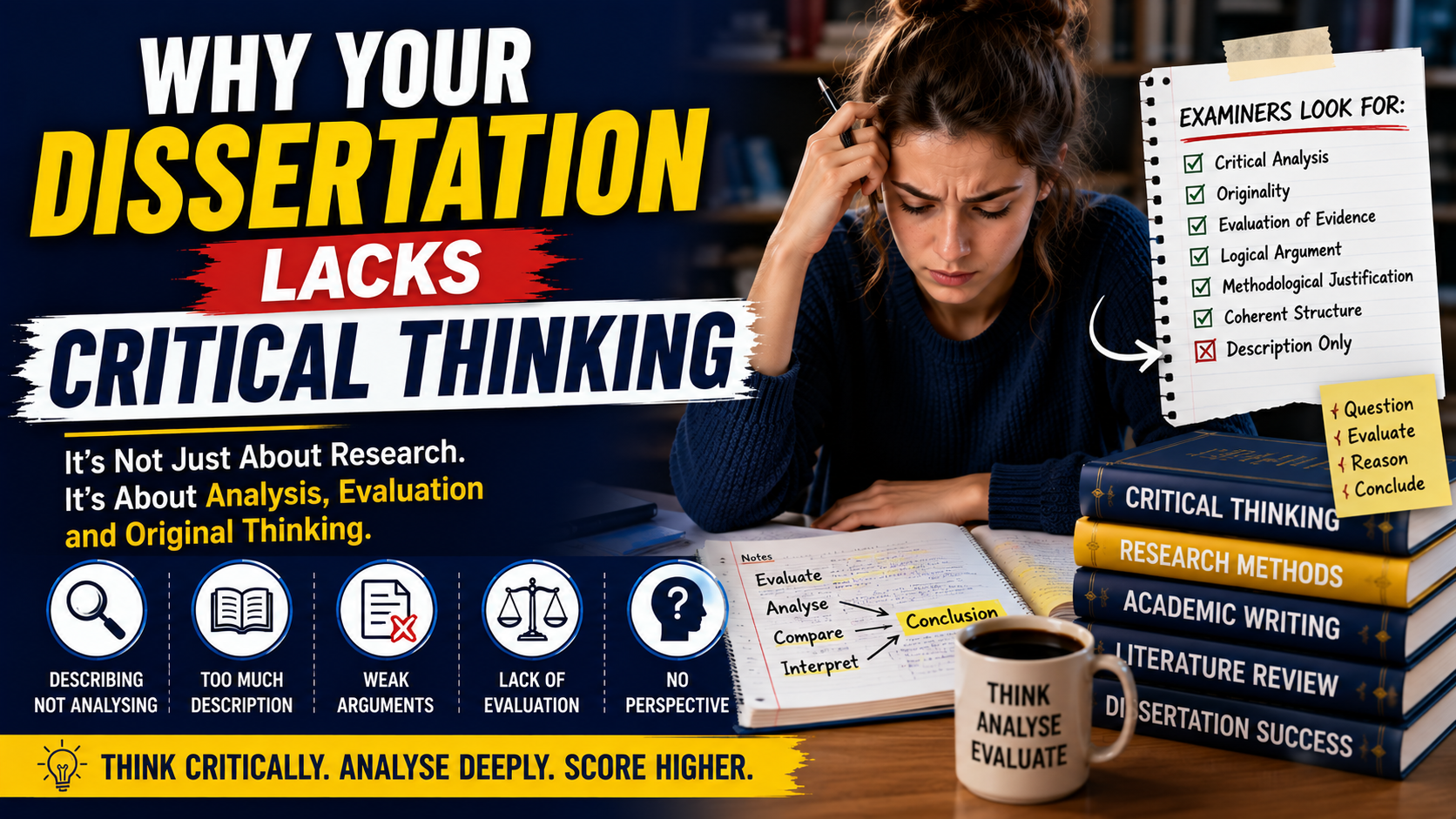
This feedback can be frustrating because students often believe they have already worked hard. However, university dissertations are designed to assess more than knowledge. They evaluate your ability to question evidence, compare viewpoints, justify decisions, and develop original conclusions.
Understanding what critical thinking actually means—and how to demonstrate it—can significantly improve the quality of your dissertation.
What Is Critical Thinking in a Dissertation?
Critical thinking means evaluating information rather than simply presenting it.
Instead of asking:
"What does this study say?"
Ask questions such as:
Why is this evidence important?
How reliable is the research?
What are the limitations?
Are there alternative explanations?
Does another study disagree?
Which conclusion is better supported?
Critical thinking transforms information into academic argument.
Why Many Dissertations Lack Critical Thinking
1. Too Much Description
Many students summarise article after article without evaluating them.
For example:
Researcher A found...
Researcher B argued...
Researcher C suggested...
This becomes a literature summary rather than an academic discussion.
2. Fear of Challenging Published Research
Students often assume published authors cannot be questioned.
In reality, academic research develops through constructive evaluation.
You can respectfully discuss:
Methodological limitations
Sample size issues
Bias
Conflicting findings
Research gaps
Academic critique is encouraged when supported by evidence.
3. Overreliance on Quotations
Using many quotations often reduces opportunities to demonstrate your own thinking.
Instead:
Paraphrase scholarly ideas.
Compare multiple sources.
Explain their significance.
Develop your own evidence-based interpretation.
Your voice should guide the discussion.
4. Weak Research Questions
Broad research questions often produce broad, descriptive dissertations.
Focused research questions encourage deeper analysis because they require specific evidence and well-supported conclusions.
5. No Comparison Between Studies
Strong dissertations rarely discuss one study at a time.
Instead, they compare:
Similar findings
Contradictory conclusions
Different research methods
Diverse theoretical perspectives
Comparison demonstrates analytical ability.
6. Ignoring Research Limitations
Every study has limitations.
High-quality dissertations discuss:
Sample size
Data quality
Methodological constraints
Generalisability
Potential bias
Acknowledging limitations strengthens credibility.
7. Weak Discussion Chapters
Many discussion chapters simply repeat results.
Instead, ask:
Why do these findings matter?
How do they compare with previous research?
What practical implications exist?
What future research is needed?
The discussion chapter is where critical thinking is most visible.
What Examiners Expect
University examiners typically look for students who can:
Evaluate evidence.
Explain strengths and weaknesses.
Compare scholarly perspectives.
Justify research choices.
Draw balanced conclusions.
Link every chapter to the research question.
Critical thinking is demonstrated throughout the dissertation—not just in one section.
Description vs Critical Thinking
Descriptive Writing
"Several studies concluded that social media influences student engagement."
Critical Thinking
"Although numerous studies report positive effects of social media on student engagement, many rely on short-term surveys and self-reported behaviour. Other research suggests that excessive social media use may reduce academic performance, indicating that its educational impact depends on context and usage patterns."
The second example evaluates evidence and acknowledges complexity.
Practical Ways to Improve Critical Thinking
Ask Better Questions
While writing, ask yourself:
Why?
How?
Compared with what?
According to whom?
What evidence supports this?
What evidence contradicts it?
These questions naturally deepen analysis.
Compare Rather Than Summarise
Instead of discussing one article at a time:
Compare methodologies.
Compare findings.
Compare theoretical approaches.
Explain disagreements.
Explain Your Judgement
Don't leave evidence unexplained.
State:
Which argument is stronger.
Why it is more convincing.
What evidence supports your conclusion.
Connect Every Chapter
Ensure your:
Literature review
Methodology
Results
Discussion
Conclusion
all contribute directly to answering your research question.
Justify Methodological Decisions
Rather than simply describing methods, explain why they were appropriate for your research objectives.
Reflect on Limitations
Every dissertation has limitations.
Discussing them demonstrates maturity and academic integrity.
Common Signs Your Dissertation Needs Stronger Critical Thinking
Chapters mainly summarise literature.
Few comparisons between studies.
Little evaluation of evidence.
Minimal discussion of limitations.
Conclusions repeat earlier chapters.
Weak links to the research question.
Unsupported recommendations.
Recognising these signs early gives you time to improve before submission.
Self-Assessment Checklist
Before submitting your dissertation, ask yourself:
✅ Have I evaluated evidence instead of describing it?
✅ Have I compared multiple viewpoints?
✅ Have I justified my conclusions?
✅ Have I discussed research limitations?
✅ Have I explained why my findings matter?
✅ Have I linked every chapter to my research question?
If several answers are "no," additional revision may strengthen your dissertation.
Why Feedback Helps
It is often difficult to identify weaknesses in your own writing after months of work.
Constructive feedback can highlight:
Descriptive sections.
Weak arguments.
Poor transitions.
Limited evaluation.
Referencing issues.
Missed opportunities for deeper analysis.
Making these improvements before submission can strengthen the overall quality of your dissertation.
Maintaining Academic Integrity
Universities generally allow students to receive guidance on:
Academic writing
Structure
Referencing
Grammar
Formatting
Presentation
Students remain responsible for all original research, data collection, analysis, interpretations, and conclusions. Any support should comply with institutional academic integrity policies.
Final Thoughts
Critical thinking is one of the defining characteristics of a high-quality dissertation. It goes beyond summarising sources or presenting facts. Instead, it involves evaluating evidence, questioning assumptions, comparing perspectives, and developing well-supported conclusions.
If your dissertation currently feels descriptive, don't assume you need entirely new research. In many cases, strengthening your analysis, improving chapter connections, and explaining the significance of your findings can have a much greater impact than adding more references.
Developing critical thinking takes practice, but it is one of the most valuable academic skills you will gain—not only for your dissertation but also for future research, professional decision-making, and lifelong learning.
Frequently Asked Questions
Everything you need to know about our services
Related Posts

The Difference Between a Merit and a Distinction Dissertation

What Distinction-Level Dissertations Do Differently
