Why Critical Analysis Matters More Than Word Count
Introduction
Many students approach dissertation writing with one major concern: reaching the required word count. While staying within your university's prescribed word limit is important, simply writing more words does not automatically lead to better grades. In fact, many dissertations lose marks because they prioritise quantity over quality.
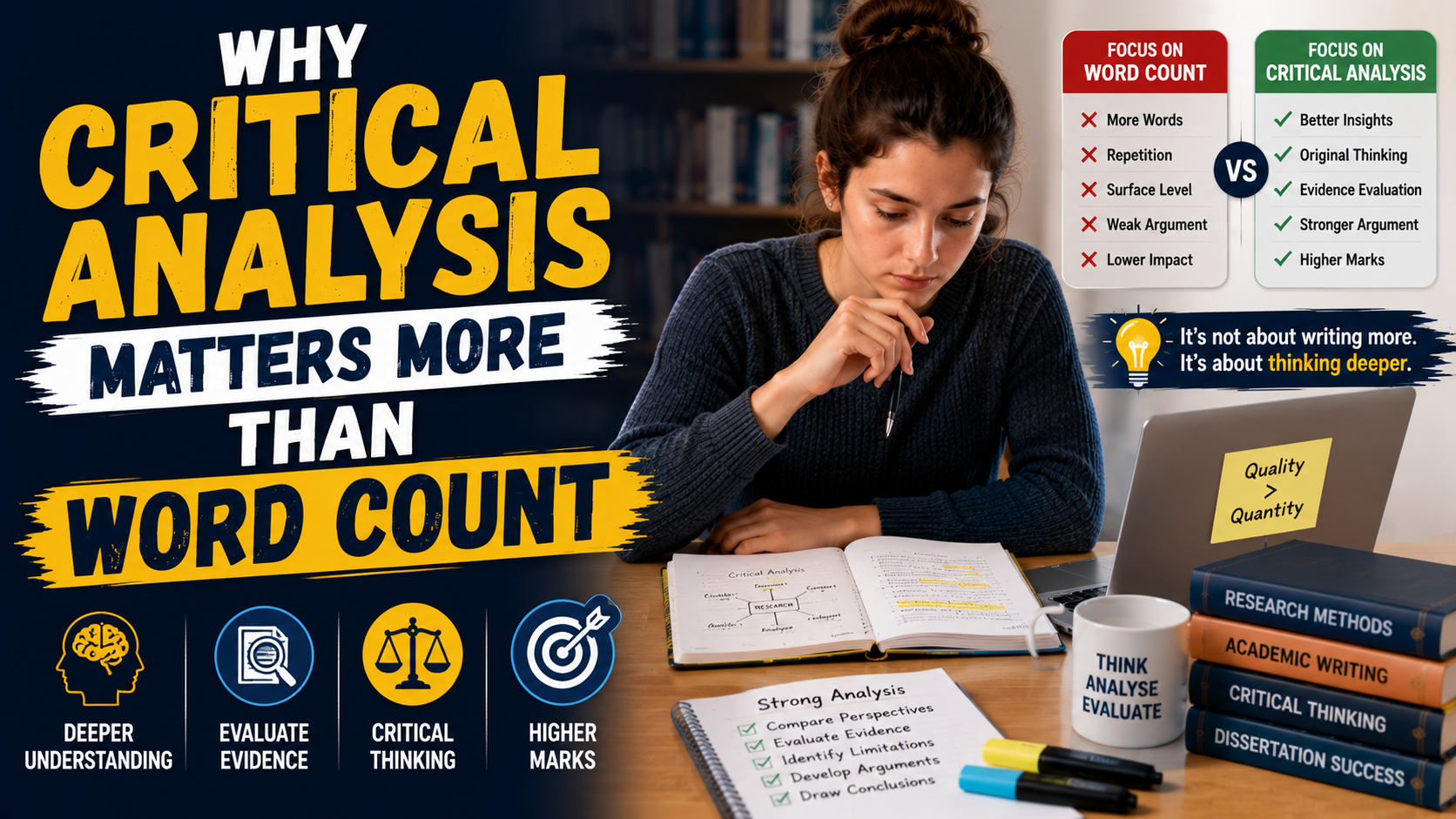
University examiners are primarily interested in how you think, not how many words you write. A concise dissertation that demonstrates excellent critical analysis, logical reasoning, and original interpretation is often rewarded more highly than a lengthy dissertation filled with description and repetition.
Understanding the importance of critical analysis can help you focus your efforts where they matter most. Rather than aiming to write more, you should aim to write better.
What Is Critical Analysis?
Critical analysis involves evaluating information rather than simply describing it.
Instead of accepting research findings at face value, critical analysis requires you to ask questions such as:
How reliable is this evidence?
What assumptions does this study make?
Are there alternative viewpoints?
What are the strengths and weaknesses of this research?
How does this evidence relate to my research question?
Critical analysis demonstrates independent thinking and academic maturity.
Why Word Count Alone Doesn't Improve Marks
Universities set word limits to ensure students have enough space to develop their arguments—not to encourage unnecessary writing.
Simply adding more paragraphs may result in:
Repetition
Irrelevant discussion
Weaker focus
Reduced clarity
Less persuasive arguments
Examiners generally reward well-supported arguments rather than longer dissertations.
What Examiners Actually Assess
Although marking criteria vary between universities, dissertations are commonly assessed on:
Research quality
Critical analysis
Originality
Methodology
Logical organisation
Academic writing
Evidence-based conclusions
Referencing accuracy
Notice that word count itself is rarely a marking criterion.
Description vs Critical Analysis
Many students summarise academic literature without evaluating it.
Descriptive Writing
Smith (2023) found that flexible working improved employee productivity.
This tells the reader what happened.
Critical Analysis
Although Smith (2023) reported improved productivity, the study focused exclusively on technology firms with remote-first cultures. This may limit the wider applicability of the findings to industries requiring physical collaboration.
This explains why the evidence should be interpreted carefully.
Characteristics of Strong Critical Analysis
High-quality dissertations typically:
Compare Multiple Perspectives
Rather than relying on one source, compare different viewpoints and explain why they agree or disagree.
Evaluate Evidence
Discuss the quality, reliability, and limitations of studies instead of treating every source equally.
Justify Decisions
Explain why you selected particular theories, research methods, datasets, or analytical approaches.
Connect Literature to Your Research
Demonstrate how previous research supports—or challenges—your own findings.
Acknowledge Limitations
Recognising the limitations of your research shows intellectual honesty and strengthens credibility.
Signs Your Dissertation Needs More Analysis
Your dissertation may rely too heavily on description if:
Most paragraphs begin with "According to..."
You summarise numerous studies without comparing them.
You rarely explain why evidence is convincing.
You present findings without interpretation.
Your discussion chapter repeats results instead of evaluating them.
These are common issues identified during dissertation reviews.
Practical Ways to Improve Critical Analysis
Ask "Why?" More Often
After presenting evidence, explain:
Why is it important?
Why is it reliable?
Why does it support your argument?
Compare Sources
Instead of discussing studies individually, analyse relationships between them.
For example:
Areas of agreement
Conflicting findings
Differences in methodology
Strength of evidence
Use Evidence to Support Your Own Argument
Avoid allowing sources to dominate your writing.
Your dissertation should present your academic voice, supported by credible evidence.
Challenge Existing Ideas
Where appropriate, discuss:
Alternative explanations
Research limitations
Conflicting theories
Remaining knowledge gaps
Common Mistakes Students Make
Avoid:
Writing long descriptive paragraphs
Adding unnecessary words to reach the word limit
Repeating the same evidence
Overusing direct quotations
Ignoring contradictory research
Presenting unsupported opinions
Quality consistently outweighs quantity.
Balancing Word Count and Analysis
A strong dissertation:
Focuses On | Avoids |
|---|---|
Clear arguments | Word count padding |
Critical evaluation | Repetition |
Evidence-based discussion | Unsupported claims |
Logical structure | Irrelevant content |
Original interpretation | Excessive summary |
Meeting the required word count is important, but every paragraph should contribute meaningfully to your research question.
How Feedback Can Improve Analysis
Constructive feedback often identifies areas where:
Arguments need stronger justification.
Evidence requires deeper evaluation.
Chapters lack logical connections.
Conclusions need greater support.
Critical discussion can be expanded.
Receiving feedback before submission allows time to strengthen analytical depth.
Maintaining Academic Integrity
Critical analysis involves developing your own interpretation of existing research—not copying or rewriting the work of others.
Many universities allow students to receive guidance on:
Structure
Academic writing
Referencing
Grammar
Formatting
Clarity
Students remain responsible for all original research, analysis, and conclusions. Any support should comply with institutional academic integrity policies.
Final Thoughts
While achieving the required word count is necessary, it should never become the primary goal of your dissertation. Examiners are far more interested in your ability to analyse evidence, evaluate competing viewpoints, justify decisions, and demonstrate independent academic thinking.
Rather than asking, "How can I write more?", ask "How can I think more critically?" That shift in approach often leads to stronger arguments, better organisation, and a dissertation that aligns more closely with university marking criteria.
By prioritising critical analysis over unnecessary length, you can produce a dissertation that is both academically rigorous and more likely to achieve higher marks.
Frequently Asked Questions
Everything you need to know about our services


