Why Fresh Eyes Can Improve a Dissertation Draft
Introduction
After spending months researching, writing, revising, and editing your dissertation, it's natural to feel confident that you've caught every mistake. After all, you've probably read each chapter dozens of times.
Ironically, that's exactly why important issues often go unnoticed.
The more familiar you become with your own writing, the more difficult it becomes to spot unclear explanations, weak arguments, repetitive sections, inconsistent formatting, or missing evidence. Your brain begins to "fill in the gaps" because it already knows what you intended to say.
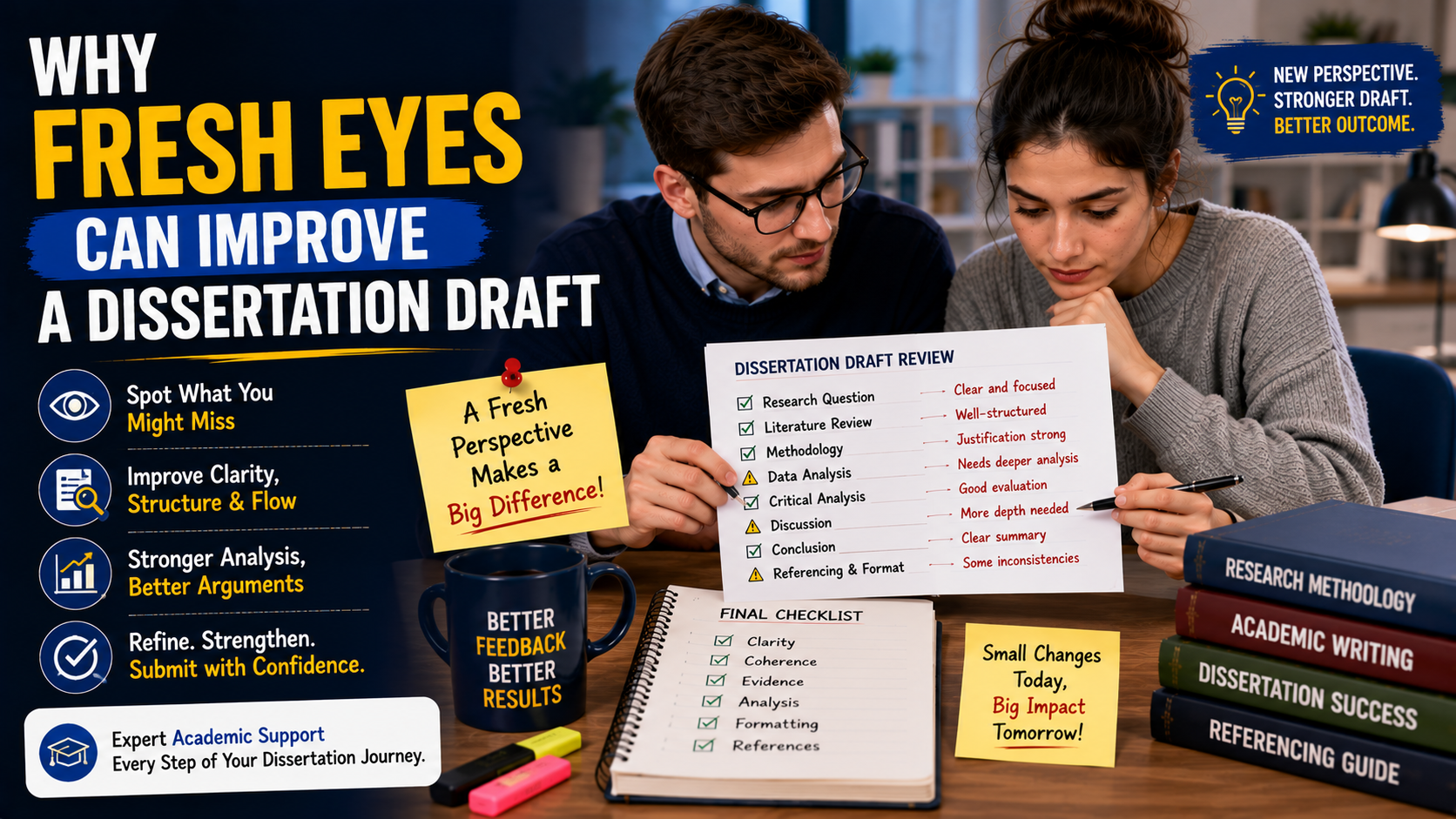
This is why many successful postgraduate students seek a fresh perspective before submitting their dissertation. Whether it's constructive feedback from a supervisor, university writing centre, or ethical academic reviewer, a new set of eyes can identify improvements that the original writer may no longer notice.
In this guide, we'll explore why fresh feedback is valuable, what reviewers commonly identify, and how ethical academic guidance can help strengthen your dissertation while ensuring the work remains your own.
Why It's Difficult to Review Your Own Dissertation
When you work on one document for several months, familiarity becomes both a strength and a weakness.
You understand:
Your research.
Your arguments.
Your methodology.
Your findings.
Your intended message.
Unfortunately, readers—including examiners—do not have that same background knowledge.
As a result, they evaluate only what is clearly written on the page, not what you intended to communicate.
The Psychology Behind "Fresh Eyes"
Cognitive psychologists describe a phenomenon known as familiarity bias.
When you repeatedly read the same text, your brain begins predicting the content instead of processing every sentence carefully.
This makes it easier to overlook:
Missing words.
Repeated ideas.
Weak transitions.
Logical gaps.
Inconsistent terminology.
Formatting errors.
A first-time reader is much more likely to notice these issues immediately.
What Fresh Reviewers Usually Notice
A reviewer approaching your dissertation for the first time may identify problems such as:
Unclear Research Question
Is the purpose of the study obvious from the introduction?
Weak Chapter Structure
Do chapters flow naturally from one to the next?
Repetition
Are the same ideas repeated across multiple chapters?
Unsupported Claims
Are important arguments supported by evidence and references?
Weak Critical Analysis
Does the dissertation evaluate previous research rather than simply describing it?
Referencing Issues
Are citations complete and consistently formatted?
Formatting Inconsistencies
Small presentation issues can reduce professionalism, including:
Heading styles.
Table formatting.
Figure numbering.
Page layout.
Reference formatting.
Why Students Often Miss These Problems
Students usually focus on larger concerns:
Completing the research.
Analysing data.
Meeting deadlines.
Responding to supervisor comments.
As submission approaches, fatigue increases.
This makes it harder to identify smaller issues that collectively influence the quality of the final dissertation.
Supervisor Feedback Isn't Always Enough
Supervisors provide valuable academic guidance, but they often face practical limitations.
They may have:
Limited meeting time.
Departmental workload.
Restrictions on reviewing multiple drafts.
Limited opportunities to provide detailed editing comments.
An additional independent review can complement—not replace—supervisor feedback.
The Best Time for Fresh Feedback
Many students wait until the night before submission.
Unfortunately, that leaves little opportunity to improve the dissertation.
Instead, consider seeking feedback after:
Completing the first full draft.
Finishing the literature review.
Completing the methodology.
Writing the discussion.
Preparing the final submission version.
Earlier feedback provides time to implement meaningful improvements.
Can AI Provide a Fresh Perspective?
AI tools can help with:
Grammar.
Readability.
Sentence clarity.
Writing suggestions.
Basic organisation.
However, AI cannot fully determine:
Whether your argument is persuasive.
If your critical analysis is sufficiently developed.
Whether your discussion answers the research question.
How effectively your dissertation aligns with university marking criteria.
AI should therefore complement—not replace—careful academic review.
What Ethical Dissertation Feedback Looks Like
Ethical academic support focuses on helping students improve their own original work.
Examples include:
Dissertation feedback.
Academic editing.
Proofreading.
Referencing guidance.
Methodology suggestions.
Literature review feedback.
Formatting checks.
Constructive comments.
The student remains responsible for all research, analysis, writing, and final submission.
How AssignmentCart Can Help
AssignmentCart provides ethical academic support designed to help students strengthen their dissertations before submission.
Our services include:
Dissertation feedback.
Dissertation editing.
Professional proofreading.
Literature review guidance.
Research methodology support.
Critical analysis suggestions.
Referencing checks (Harvard, APA, OSCOLA, MLA, Chicago & IEEE).
Formatting review.
Chapter-by-chapter academic guidance.
Confidential student support.
Our objective is to help students communicate their own research more effectively while respecting university academic integrity policies.
Why a Final Review Can Be One of Your Best Decisions
A dissertation often represents months of hard work. Investing time in a final independent review can help ensure that your research is presented as clearly and professionally as possible.
Fresh feedback does not replace your own knowledge—it helps reveal opportunities for improvement that familiarity may have hidden.
If you'd like constructive academic feedback before your submission deadline, AssignmentCart's Dissertation Help service provides ethical guidance to help you strengthen your dissertation with confidence.
Why Students Choose AssignmentCart
Experienced dissertation specialists.
Ethical academic guidance.
Editing and proofreading experts.
Research methodology support.
Referencing assistance.
Confidential communication.
Fast turnaround options for eligible requests.
👉 Visit our services page today and request expert dissertation feedback before your final submission.
Final Thoughts
One of the simplest ways to improve a dissertation is to allow someone who hasn't been immersed in the project to review it objectively. Fresh eyes often notice what familiarity overlooks—from structural issues to unclear arguments and overlooked referencing errors.
Combining your own careful revisions, supervisor guidance, and ethical academic feedback can help you submit a dissertation that communicates your research with greater clarity, coherence, and confidence.
Frequently Asked Questions
Everything you need to know about our services
Related Posts

Why Most Dissertation Conclusions Cost Students Marks (And How to Avoid It)

Why Your Literature Review Isn't Strong Enough (And How to Fix It)
