Why Your Literature Review Isn't Strong Enough (And How to Fix It)
Introduction
You've spent weeks reading journal articles, highlighting key points, and writing pages of notes. Yet when your supervisor reviews your literature review, the feedback sounds frustratingly familiar:
"This is too descriptive."
"Where is your critical analysis?"
"Your argument isn't clear."
"You need to engage with the literature."
If this sounds familiar, you're not alone.
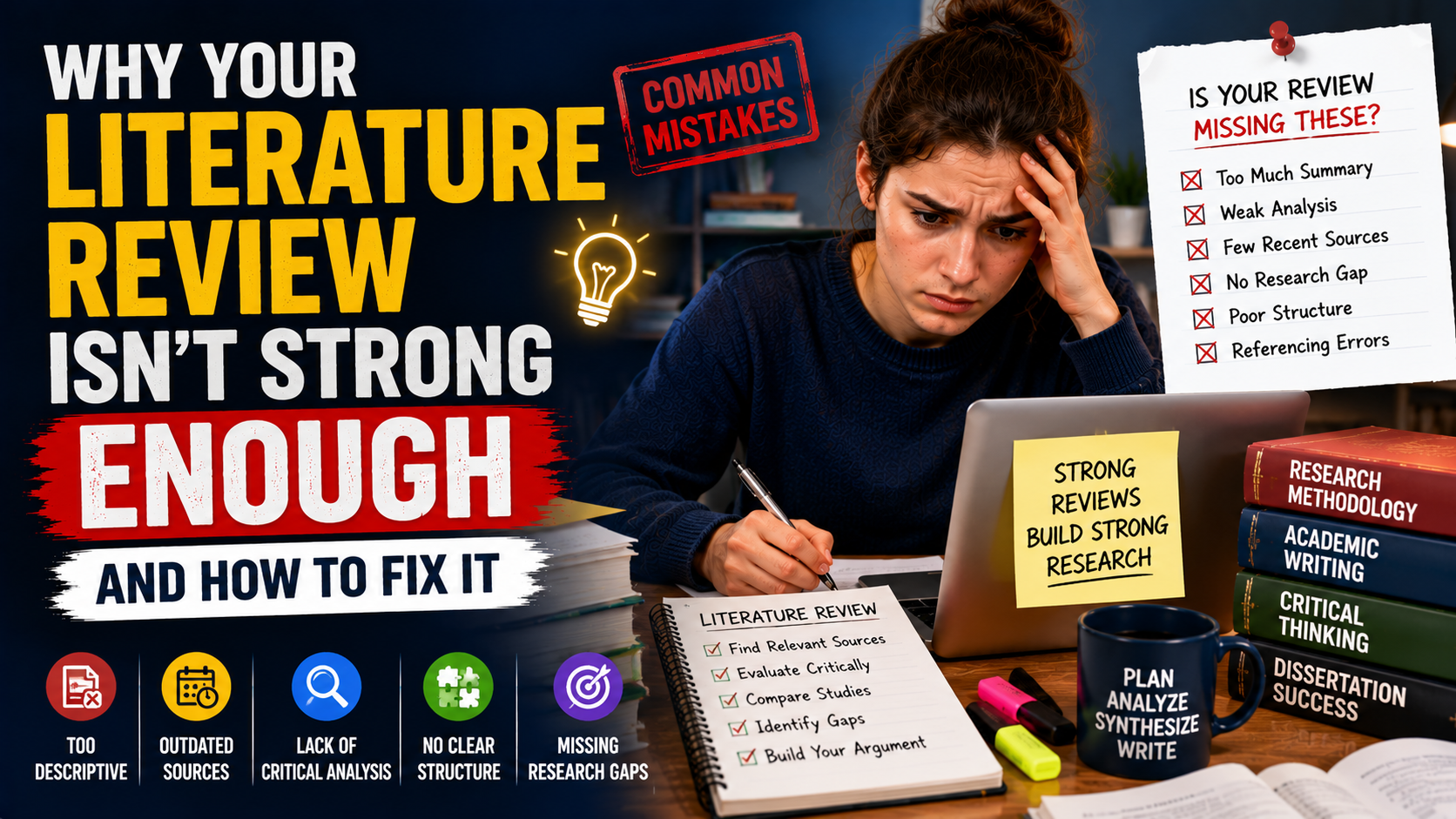
One of the biggest reasons UK Master's dissertations lose marks is a weak literature review. Many students believe that collecting lots of sources is enough, but examiners are looking for something very different: critical thinking, synthesis, and a clear academic argument.
The good news is that most literature review weaknesses can be corrected before submission.
In this guide, you'll discover why literature reviews often receive poor feedback, how to strengthen yours, and when ethical academic guidance can help you produce a more convincing dissertation.
What Is a Literature Review?
A literature review is not simply a summary of previous studies.
Instead, it demonstrates that you understand:
What researchers already know.
Where experts disagree.
Which theories are most relevant.
What research gaps remain.
How your own study contributes to existing knowledge.
Think of it as joining an ongoing academic conversation—not simply repeating what others have written.
What Examiners Expect
A strong literature review should:
Answer your research question.
Evaluate existing evidence.
Compare different viewpoints.
Explain key theories.
Identify strengths and weaknesses of previous studies.
Highlight research gaps.
Build a logical foundation for your methodology.
If your review doesn't achieve these objectives, it may lose marks.
1. You're Summarising Instead of Analysing
This is the most common problem.
Many students write paragraphs like:
"Smith (2023) found..."
followed by
"Jones (2024) concluded..."
and then
"Brown (2025) suggested..."
Although factually correct, this approach simply lists research.
What You Should Do Instead
Compare authors.
Ask questions such as:
Do these findings agree?
Why do they differ?
Which study is stronger?
What limitations exist?
What remains unanswered?
Analysis demonstrates critical thinking.
2. Your Sources Are Outdated
While classic studies remain important, many subjects—particularly technology, business, healthcare, and AI—change rapidly.
Use recent peer-reviewed research whenever appropriate while retaining foundational studies where necessary.
3. You're Using Too Few High-Quality Sources
A strong literature review typically relies on:
Peer-reviewed journals
Academic books
Government reports
Professional organisations
Reputable research institutions
Avoid relying heavily on blogs or unverified websites.
4. Your Literature Review Has No Clear Structure
Readers should easily follow your discussion.
Common structures include:
Chronological
Research organised over time.
Thematic
Research grouped by themes.
Methodological
Studies organised according to research methods.
Theoretical
Research organised around major theories or frameworks.
Choose the structure that best supports your research question.
5. You Don't Explain Research Gaps
Examiners want to know:
Why does your research matter?
Your literature review should explain:
What previous researchers have overlooked.
Where evidence is limited.
Which populations remain under-researched.
Why your study contributes something valuable.
Without a research gap, your dissertation may appear unnecessary.
6. You Ignore Contradictory Evidence
Strong researchers don't hide conflicting evidence.
Instead, they discuss:
Different findings
Alternative explanations
Methodological limitations
Areas of disagreement
Balanced evaluation strengthens academic credibility.
7. Your Writing Sounds Like Notes
A literature review should read like a coherent academic discussion—not a collection of disconnected summaries.
Improve flow by:
Using topic sentences.
Creating transitions between themes.
Linking paragraphs logically.
Referring back to your research question.
8. You Haven't Linked the Review to Your Methodology
Your literature review should naturally lead readers toward your research design.
Ask yourself:
Why is this methodology appropriate?
How did previous studies influence your approach?
Which limitations are you addressing?
This connection strengthens the overall dissertation.
9. Referencing Is Inconsistent
Incorrect citations can reduce the professionalism of your work.
Check carefully for:
Missing in-text citations
Incorrect formatting
Incomplete references
Mismatched reference lists
Inconsistent citation style
Always follow your university's required referencing system.
10. You Wrote Everything at Once
Many students complete the literature review early and never revisit it.
However, your understanding evolves as your research develops.
Before submission:
Remove irrelevant sources.
Add recent research.
Improve analysis.
Clarify arguments.
Update references.
Revision is an essential part of the writing process.
A Literature Review Self-Assessment Checklist
Ask yourself:
Does every section relate to my research question?
Am I analysing rather than summarising?
Have I compared different viewpoints?
Have I identified research gaps?
Is my structure logical?
Are my sources reliable and current?
Is my referencing consistent?
Does my review justify my methodology?
If you answered "No" to several questions, your literature review likely needs further development.
Can AI Help Improve a Literature Review?
AI tools can support students by:
Suggesting clearer wording.
Improving readability.
Explaining complex concepts.
Generating revision checklists.
Identifying repetitive phrasing.
However:
AI should not replace independent literature searching.
Always verify AI-generated information with peer-reviewed sources.
Follow your university's AI policy.
Ensure all submitted work reflects your own understanding and critical thinking.
How AssignmentCart Can Help
If your supervisor keeps asking you to strengthen your literature review, ethical academic support can help you understand what needs improvement.
AssignmentCart provides:
Literature review guidance
Research gap identification support
Critical analysis improvement
Research methodology guidance
Academic editing
Professional proofreading
Referencing checks (Harvard, APA, OSCOLA, MLA, Chicago & IEEE)
Formatting reviews
Chapter-by-chapter feedback
Confidential student support
Our services are designed to help students improve their own original work while maintaining academic integrity.
Turn Your Literature Review into One of Your Strongest Chapters
A weak literature review doesn't mean your dissertation is beyond improvement. In most cases, the issues involve structure, analysis, and presentation rather than the underlying research itself.
With careful revision—and, where needed, ethical academic guidance—you can transform your literature review into a chapter that demonstrates critical thinking and supports the rest of your dissertation.
If you're struggling to respond to supervisor feedback or want expert guidance before submission, AssignmentCart's Dissertation Help service is here to support your academic journey.
Why Students Choose AssignmentCart
Experienced academic experts
Ethical academic guidance
Literature review specialists
Editing and proofreading support
Methodology assistance
Referencing expertise
Confidential communication
Fast turnaround options for eligible requests
👉 Visit our services page today and place your order to receive personalised academic support before your submission deadline.
Final Thoughts
A literature review is much more than a collection of sources. It demonstrates your ability to evaluate evidence, identify research gaps, and build the academic foundation for your own study.
If your supervisor has suggested that your literature review needs improvement, treat it as an opportunity rather than a setback. By focusing on critical analysis, logical organisation, and careful revision, you can significantly strengthen one of the most important chapters of your dissertation.
Remember, the strongest literature reviews don't simply describe research—they explain why it matters.
Frequently Asked Questions
Everything you need to know about our services
Related Posts

Why Your Supervisor Keeps Asking You to Rewrite Dissertation Chapters

10 Warning Signs Your Dissertation Is Not Ready for Submission
