Why Your Supervisor Keeps Asking You to Rewrite Dissertation Chapters
Introduction
You've spent weeks writing your dissertation chapter, carefully formatted every reference, and finally submitted it to your supervisor. A few days later, the feedback arrives:
"Please rewrite this section."
"Your argument isn't clear."
"This chapter needs significant revision."
"Expand your critical analysis."
If this sounds familiar, you're not alone.
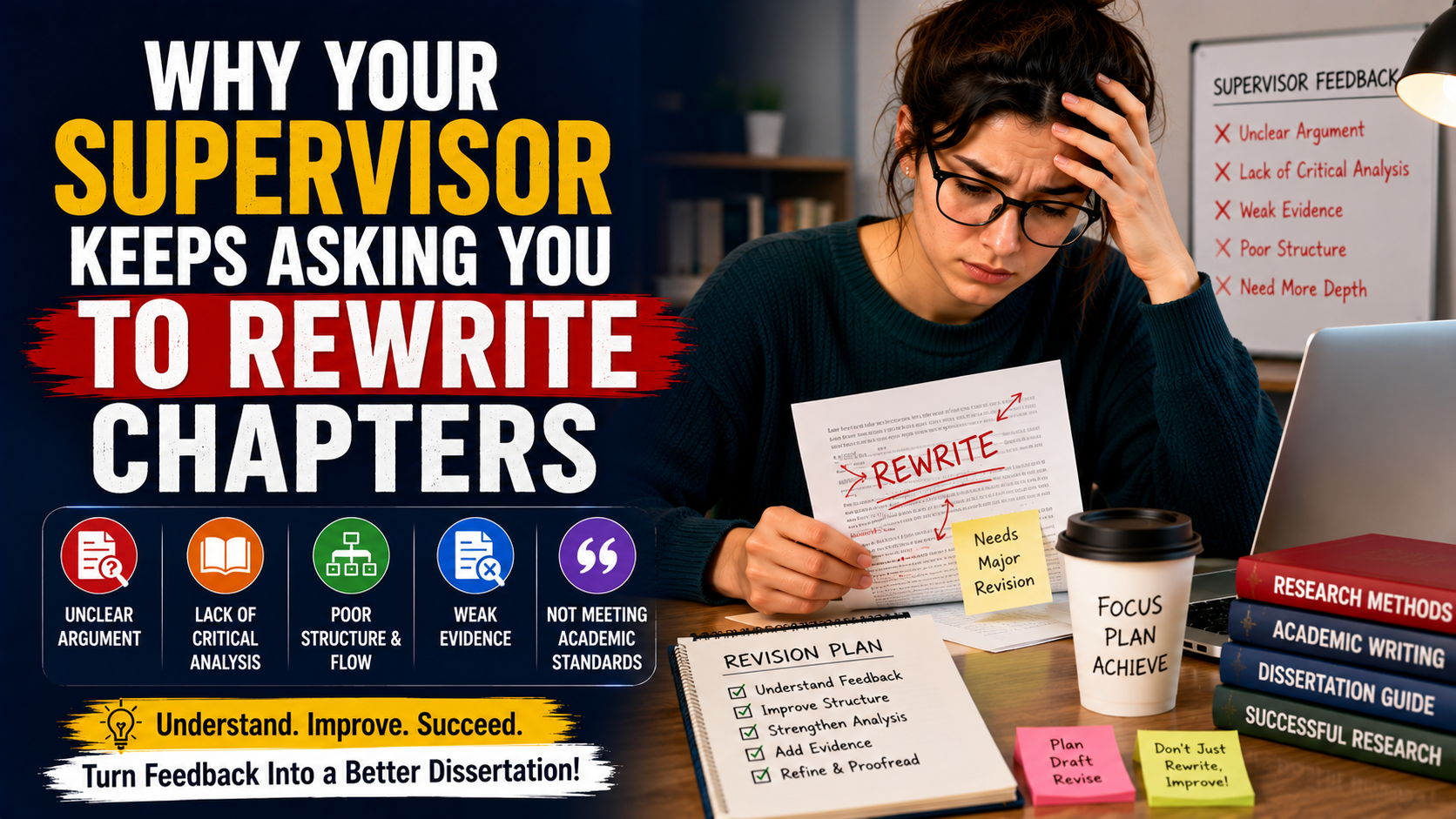
Most postgraduate students rewrite parts of their dissertation several times before submitting the final version. In many cases, repeated revisions are a normal part of the research process—not a sign that you're failing. Supervisors are helping you strengthen your work by identifying areas that need more clarity, evidence, or critical analysis.
In this guide, we'll explain the most common reasons supervisors request chapter rewrites, how to address their feedback effectively, and how ethical academic support can help you improve your dissertation before submission.
Rewriting Is a Normal Part of Dissertation Writing
A dissertation is not expected to be perfect in its first draft.
Supervisors review drafts to help students:
Clarify arguments
Improve research quality
Strengthen methodology
Develop critical thinking
Improve academic writing
Ensure the dissertation meets university standards
Revision is a core part of postgraduate research.
1. Your Argument Is Not Clear
One of the most common comments is:
"What exactly are you trying to argue?"
This usually happens when chapters describe information without presenting a clear position.
How to Improve
State your main argument early.
Link every section to your research question.
Explain why your findings matter.
Use topic sentences to guide readers.
Every paragraph should contribute to your overall argument.
2. You're Describing Instead of Analysing
Many students summarise journal articles instead of critically evaluating them.
For example:
❌ Smith (2023) found that AI improves productivity.
Better:
✅ Although Smith (2023) reports improved productivity, the study focuses on large organisations, limiting its applicability to SMEs. This limitation supports the need for further research within smaller business environments.
Critical analysis demonstrates higher-level academic thinking.
3. Your Literature Review Lacks Structure
A strong literature review should organise research into themes—not simply summarise one article after another.
Instead of writing:
Author A…
Author B…
Author C…
Group studies by:
Themes
Theories
Methodologies
Agreements
Contradictions
Research gaps
This approach creates a coherent narrative.
4. Your Research Question Is Too Broad
A broad research question often leads to unfocused chapters.
For example:
❌ How does technology affect education?
Better:
✅ How has artificial intelligence influenced formative assessment practices in UK higher education?
A focused question makes writing more precise.
5. Your Methodology Needs Stronger Justification
Supervisors often ask:
Why did you choose qualitative research?
Why this sample size?
Why these participants?
Why this analytical method?
Simply describing your methodology isn't enough.
Explain why your chosen methods best address your research objectives.
6. Your Evidence Doesn't Support Your Claims
Every significant claim should be supported by reliable evidence.
Use:
Peer-reviewed journal articles
Academic books
Government reports
Professional organisations
Avoid unsupported opinions or outdated sources where more current evidence is available.
7. Your Chapter Lacks Logical Flow
Sometimes chapters contain good information but poor organisation.
Check whether:
Ideas follow a logical sequence.
Paragraphs transition smoothly.
Headings reflect the content.
Each section builds on the previous one.
Clear structure improves readability.
8. Referencing Is Inconsistent
Incorrect referencing is a frequent reason for revisions.
Check:
In-text citations
Reference list formatting
Citation style consistency
Missing page numbers (where required)
Always follow your university's preferred referencing style.
9. Your Writing Isn't Academic Enough
Academic writing should be:
Clear
Objective
Formal
Precise
Evidence-based
Avoid conversational language, unsupported generalisations, and unnecessary repetition.
10. You Didn't Fully Address the Feedback
Many students rewrite chapters without responding directly to supervisor comments.
Instead:
Read every comment carefully.
Create a checklist.
Revise systematically.
Explain any changes during your next meeting if appropriate.
Showing that you've engaged thoughtfully with feedback demonstrates professionalism.
How to Respond to Supervisor Feedback
When you receive comments:
Don't Panic
Critical feedback is intended to improve your dissertation.
Prioritise Major Issues
Address structural problems before correcting grammar.
Ask Questions
If feedback is unclear, discuss it during your supervision meeting.
Keep Draft Versions
Save previous drafts so you can track changes and restore earlier content if needed.
A Dissertation Revision Checklist
Before resubmitting a chapter, ask yourself:
Is my research question clearly addressed?
Have I strengthened critical analysis?
Is every claim supported by evidence?
Does the chapter flow logically?
Have I justified my methodology?
Are references accurate and consistent?
Have I responded to every supervisor comment?
Have I proofread thoroughly?
A systematic review often prevents additional revisions.
Can AI Help with Dissertation Revisions?
AI tools can support students by:
Explaining supervisor feedback
Suggesting clearer wording
Improving grammar
Enhancing readability
Organising ideas
Creating revision checklists
However, students should:
Verify all AI-generated information.
Review original academic sources.
Follow university AI policies.
Make independent research decisions.
Ensure submitted work reflects their own understanding.
AI should support the revision process—not replace academic judgement.
Feeling Stuck? Here's When Expert Dissertation Guidance Can Help
Sometimes repeated rewrites happen because the underlying issue hasn't been identified. If you're receiving the same feedback repeatedly—such as "be more critical," "improve your structure," or "justify your methodology"—an independent academic review can help you understand what needs to change.
AssignmentCart provides ethical academic support for students who need help with:
Understanding supervisor feedback
Improving chapter structure
Strengthening critical analysis
Refining literature reviews
Enhancing research methodology sections
Academic editing and proofreading
Referencing checks
Grammar and academic language improvements
Our support is designed to help you improve your own dissertation, not replace your work.
Why Students Choose AssignmentCart
Thousands of postgraduate students seek additional academic guidance when working on their dissertations because supervisor meetings are often limited.
With AssignmentCart, you can receive support with:
Dissertation proposal review
Chapter-by-chapter feedback
Literature review guidance
SPSS and qualitative analysis support
Editing and proofreading
Referencing assistance
Formatting review
Confidential communication
Fast turnaround options
Whether you're revising one chapter or preparing your final submission, our experts help you present your research more clearly and professionally.
Ready to Improve Your Dissertation?
Don't let repeated revisions delay your submission or affect your confidence.
👉 Visit our services page today to explore our ethical academic support services and place your order for professional dissertation guidance.
Get Expert Dissertation Support from Assignment Cart
Final Thoughts
Receiving requests to rewrite dissertation chapters can be frustrating, but it is also an opportunity to improve the quality of your research. Most revisions focus on strengthening arguments, improving critical analysis, clarifying methodology, and presenting evidence more effectively.
By understanding the reasons behind your supervisor's feedback and responding systematically, you can produce a stronger dissertation and approach your final submission with greater confidence.
If you need additional support interpreting feedback or refining your dissertation, Assignment Cart's Dissertation Help Service offers ethical academic guidance designed to help you strengthen your work while maintaining originality and academic integrity.
Frequently Asked Questions
Everything you need to know about our services
Related Posts

Quantitative Dissertation Help: A Complete Guide for University Students

Qualitative Data Analysis Help: A Complete Guide for Dissertation Students
