Why Most Dissertation Conclusions Cost Students Marks (And How to Avoid It)
Introduction
After months of researching, writing, analysing data, and responding to supervisor feedback, many students treat the conclusion as the easiest chapter of their dissertation. They assume it's simply a place to repeat what they've already written.
Unfortunately, this is one of the biggest reasons dissertations lose valuable marks.
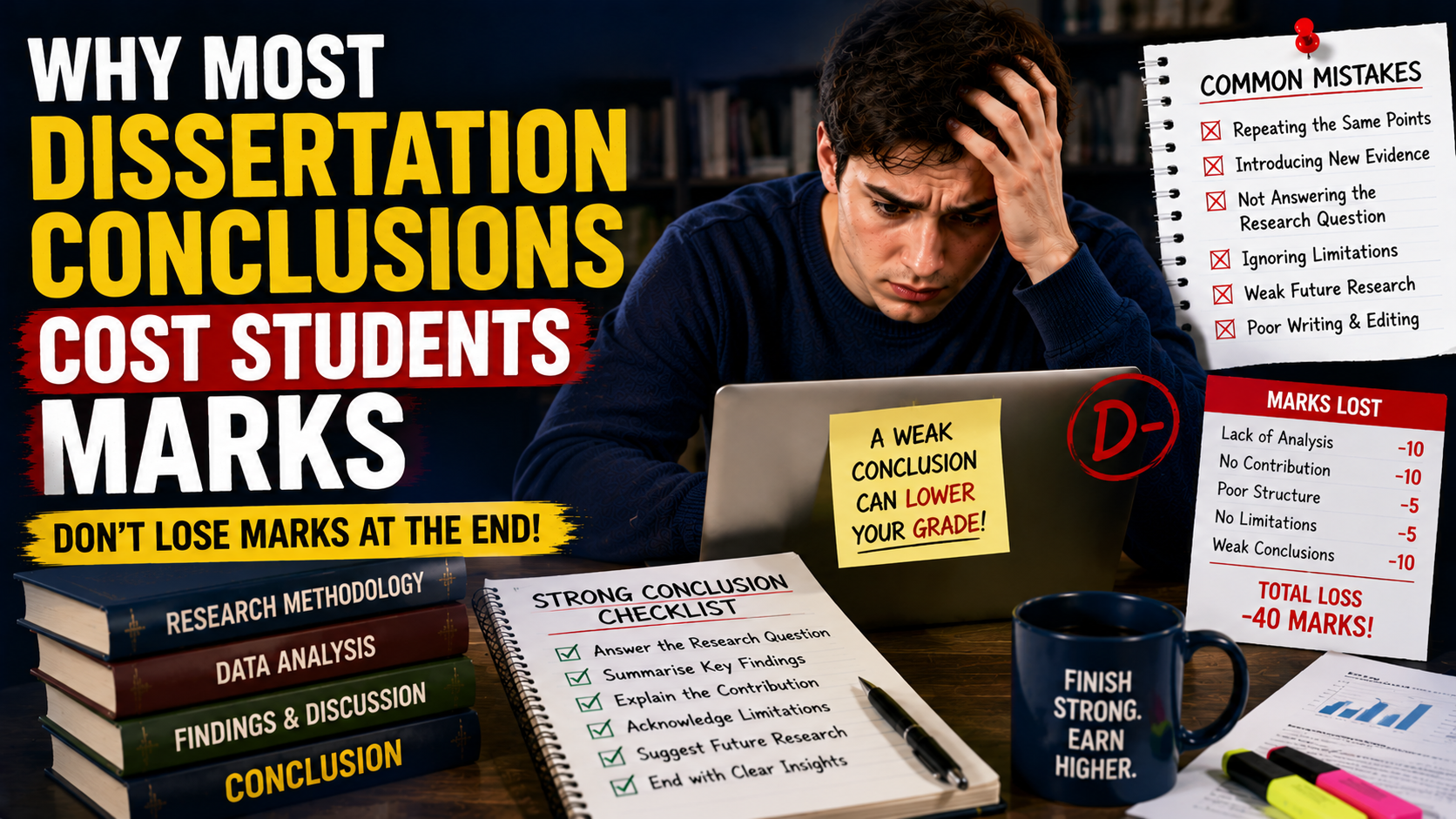
Your conclusion is the last impression an examiner has of your research. A weak ending can make an otherwise strong dissertation feel incomplete, while a well-written conclusion reinforces your findings, demonstrates critical thinking, and highlights the value of your research.
The good news is that most conclusion-related mistakes are entirely avoidable.
In this guide, you'll learn why dissertation conclusions often receive poor feedback, what examiners expect, and how to write a conclusion that strengthens your overall dissertation. You'll also discover when ethical academic guidance can help refine your work before submission.
Why the Conclusion Matters
Although it is usually one of the shortest chapters, the conclusion plays a crucial role in your dissertation.
A strong conclusion should:
Answer the original research question.
Summarise the key findings without repeating entire sections.
Demonstrate how your objectives were achieved.
Explain the contribution of your research.
Acknowledge limitations.
Suggest areas for future research.
End with a clear academic message.
A conclusion is not just a summary—it is your final academic argument.
What Examiners Expect
Most university marking criteria assess whether your conclusion:
Directly addresses the research aim.
Is supported by evidence presented in earlier chapters.
Demonstrates critical reflection.
Avoids introducing unrelated ideas.
Shows awareness of limitations.
Explains the significance of the findings.
Meeting these expectations helps create a coherent dissertation.
1. You Simply Repeat Earlier Chapters
One of the most common mistakes is copying sentences from previous chapters.
Examiners have already read your dissertation.
Instead of repeating information, explain:
What your findings mean.
Why they matter.
How they answer your research question.
The conclusion should synthesise your work rather than duplicate it.
2. You Introduce New Evidence
The conclusion is not the place to:
Add new journal articles.
Present additional data.
Introduce new theories.
Make unsupported claims.
Every point in your conclusion should be supported by evidence already discussed in the dissertation.
3. You Don't Clearly Answer the Research Question
Many conclusions summarise the project without directly answering the main question.
Ask yourself:
If someone only read my conclusion, would they understand the answer to my research question?
If not, revise your final section.
4. Your Findings Aren't Connected to the Objectives
Every research objective should be reflected in your conclusion.
Show readers:
Which objectives were achieved.
What evidence supports them.
Whether any objectives changed during the research process.
This demonstrates logical consistency.
5. You Ignore the Limitations
Every research project has limitations.
Acknowledging them shows academic maturity.
Examples include:
Small sample size.
Limited timeframe.
Restricted geographical focus.
Data availability.
Methodological constraints.
Rather than weakening your dissertation, a balanced discussion of limitations strengthens credibility.
6. You Don't Explain the Contribution
One of the examiner's key questions is:
"What does this research add?"
Your conclusion should explain:
Theoretical contribution.
Practical implications.
Policy relevance.
Industry applications.
Future academic value.
Without this discussion, your research may appear less significant.
7. Future Research Suggestions Are Too Generic
Avoid vague statements such as:
"More research is needed."
Instead, explain:
Which questions remain unanswered.
Which populations should be studied.
Which methods future researchers could use.
Why further investigation is important.
Specific recommendations demonstrate deeper understanding.
8. The Writing Feels Rushed
Because many students finish writing close to the submission deadline, the conclusion often receives the least attention.
Signs of a rushed conclusion include:
Repetition.
Abrupt ending.
Weak transitions.
Grammar errors.
Inconsistent terminology.
Poor formatting.
Your conclusion deserves careful revision.
9. The Tone Isn't Academic
Avoid emotional statements such as:
"I hope this dissertation was useful."
"I enjoyed writing this research."
"This topic is really interesting."
Maintain an objective academic tone throughout the chapter.
10. You Skip Final Editing
Even a strong conclusion can lose impact because of:
Typographical errors.
Referencing inconsistencies.
Formatting problems.
Awkward sentence structure.
Repetitive language.
Always proofread your conclusion separately before submission.
A Dissertation Conclusion Checklist
Before submitting, ask yourself:
Does my conclusion answer the research question?
Have I addressed every research objective?
Have I avoided introducing new evidence?
Have I explained the significance of my findings?
Have I discussed limitations?
Have I suggested meaningful future research?
Is the writing concise and academic?
Have I edited and proofread carefully?
If you answer "No" to several questions, your conclusion could benefit from further revision.
Can AI Help Improve a Dissertation Conclusion?
AI tools can assist with:
Improving sentence clarity.
Reducing repetition.
Checking grammar.
Enhancing readability.
Suggesting logical flow.
Creating revision checklists.
However:
AI should not generate unsupported conclusions.
Always verify suggestions against your own research findings.
Follow your university's AI policy.
Ensure the final conclusion reflects your own analysis and interpretation.
AI works best as a writing support tool rather than a replacement for academic judgement.
How AssignmentCart Can Help
If your supervisor has commented that your conclusion feels weak or repetitive, ethical academic guidance can help you identify areas for improvement.
AssignmentCart provides:
Dissertation conclusion feedback
Chapter-by-chapter academic review
Critical analysis guidance
Research methodology support
Academic editing
Professional proofreading
Referencing assistance (Harvard, APA, OSCOLA, MLA, Chicago & IEEE)
Formatting review
Dissertation coherence checks
Confidential student support
Our services are designed to help students improve their own original work while maintaining academic integrity.
Finish Your Dissertation with Confidence
A strong conclusion doesn't simply end your dissertation—it reinforces the value of your research and leaves examiners with a clear understanding of your contribution.
By avoiding common mistakes, responding to supervisor feedback, and allowing sufficient time for editing, you can transform your conclusion into one of the strongest parts of your dissertation.
If you'd like expert guidance before submission, AssignmentCart's Dissertation Help service provides ethical academic support to help you refine your dissertation with confidence.
Why Students Choose AssignmentCart
Experienced dissertation specialists
Ethical academic guidance
Editing and proofreading experts
Research methodology support
Referencing assistance
Confidential service
Fast turnaround options for eligible requests
👉 Visit our services page today and place your order for professional academic guidance before your submission deadline.
Final Thoughts
Your dissertation conclusion is far more than a closing paragraph—it is your final opportunity to demonstrate that your research has answered an important question and contributed meaningful insights.
Taking the time to refine this chapter can improve the overall coherence of your dissertation and leave a stronger impression on examiners. With thoughtful revision, careful proofreading, and ethical academic guidance where needed, you can submit your dissertation with greater confidence and clarity.
Frequently Asked Questions
Everything you need to know about our services
Related Posts

The Hidden Reasons UK Students Miss Dissertation Deadlines (And How to Avoid Them)

Why Smart Students Still Fail Their Dissertation
