Why a Failed Dissertation Can Delay Graduation
Introduction
For many university students, the dissertation is the final milestone before graduation. After months of research, writing, and revisions, submitting the dissertation often feels like the last major hurdle. However, if the dissertation does not meet the required academic standard, the consequences can extend far beyond receiving a disappointing grade.
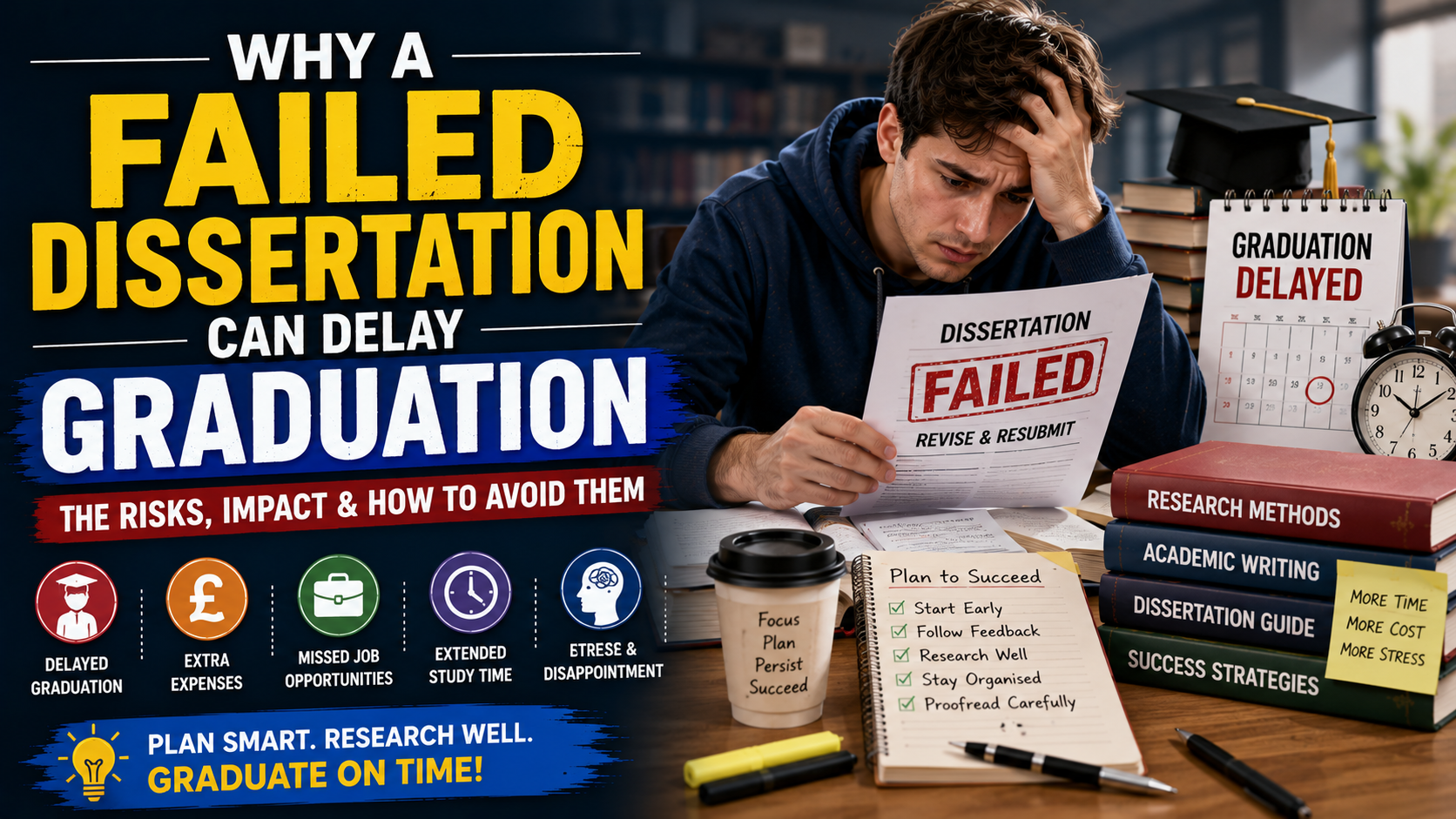
A failed dissertation can delay graduation by several months—or even an entire academic year—depending on your university's assessment policies. This delay may affect your career plans, postgraduate study applications, visa arrangements, finances, and personal goals.
Understanding why dissertations fail and how this impacts graduation can help you avoid common mistakes and complete your degree on schedule.
Why Is the Dissertation So Important?
Unlike many coursework assignments, a dissertation usually carries a significant percentage of your final degree classification.
It demonstrates your ability to:
Conduct independent research.
Analyse academic literature critically.
Apply appropriate research methods.
Present evidence-based arguments.
Communicate findings professionally.
Because of its importance, universities often require students to pass the dissertation before awarding a degree.
What Happens If You Fail Your Dissertation?
The exact process depends on your university's regulations.
Possible outcomes include:
Resubmitting the dissertation.
Completing additional revisions.
Repeating the dissertation module.
Extending your course.
Delaying your graduation ceremony.
In some cases, students graduate later than expected because dissertation results are required before the degree can be officially awarded.
Why Graduation Gets Delayed
1. Dissertation Is a Core Requirement
Most universities treat the dissertation as a compulsory component of the degree.
Without passing it, students may not satisfy the programme requirements for graduation.
2. Resubmission Takes Time
If your university allows resubmission, you may need to:
Review supervisor feedback.
Conduct additional research.
Rewrite chapters.
Improve analysis.
Correct referencing.
This process often requires several weeks or months.
3. Assessment Schedules
Universities usually assess dissertations during specific examination periods.
Even if revisions are completed quickly, final marking may only occur during the next assessment cycle.
4. Administrative Processing
After passing a resubmitted dissertation, universities may still require time to:
Confirm results.
Process final grades.
Approve degree completion.
Schedule graduation.
Administrative timelines can further extend graduation dates.
Common Reasons Students Fail Their Dissertation
Many dissertation failures result from avoidable issues.
Examples include:
Weak research question.
Poor critical analysis.
Inadequate literature review.
Weak methodology.
Limited evidence.
Missing deadlines.
Poor referencing.
Academic misconduct.
Failure to address supervisor feedback.
Weak discussion and conclusions.
Recognising these problems early significantly improves your chances of success.
Career Consequences
Graduation delays can affect:
Graduate job offers.
Professional placements.
Graduate schemes.
Licensing examinations.
Master's applications.
PhD admissions.
Some employers require proof of degree completion before confirming employment.
Financial Impact
Delayed graduation may increase:
Tuition costs.
Accommodation expenses.
Living costs.
Travel expenses.
Student loan interest (where applicable).
International students may also need to consider visa-related expenses.
Emotional Effects
A delayed graduation can be emotionally challenging.
Students often experience:
Stress.
Anxiety.
Reduced motivation.
Lower confidence.
Frustration.
Seeking academic support early can reduce these pressures.
How to Reduce the Risk of Dissertation Failure
Successful students typically:
Start Early
Avoid leaving research until the final months.
Follow a Clear Plan
Break the dissertation into manageable stages.
Meet Supervisors Regularly
Use meetings to discuss progress and resolve problems early.
Respond to Feedback
Supervisor comments often identify areas that need improvement before final submission.
Proofread Carefully
Review grammar, formatting, references, and consistency.
Check the Marking Criteria
Compare every chapter against your university's assessment rubric.
Warning Signs Your Dissertation Needs Attention
Watch for these indicators:
Unclear objectives.
Repeated supervisor concerns.
Weak evidence.
Poor organisation.
Missing citations.
Last-minute writing.
Limited critical discussion.
Unsupported conclusions.
Addressing these issues early is much easier than revising after failure.
Academic Integrity Matters
Many dissertations fail because of academic misconduct rather than weak research.
Always:
Cite every source correctly.
Write in your own words.
Follow university AI policies.
Avoid plagiarism.
Keep accurate research notes.
Academic integrity protects both your degree and your academic reputation.
Before Submission Checklist
✔ Research question clearly defined
✔ Literature review up to date
✔ Methodology justified
✔ Critical analysis demonstrated
✔ Findings supported by evidence
✔ Supervisor feedback addressed
✔ References checked
✔ Formatting completed
✔ Proofreading finished
Comparison
Graduate on Time | Delayed Graduation |
|---|---|
Begin career earlier | Career postponed |
Lower overall costs | Additional expenses |
Earlier postgraduate study | Delayed applications |
Reduced stress | Extended academic pressure |
Degree awarded on schedule | Graduation postponed |
Final Thoughts
A failed dissertation can delay graduation, increase financial costs, and postpone important career or academic opportunities. However, in many cases, these setbacks are preventable with early planning, consistent research, regular supervisor meetings, and careful attention to feedback. Treat your dissertation as a long-term project rather than a last-minute assignment, and use every stage of the process to strengthen your work.
Graduating on time is not simply about meeting a submission deadline—it's about demonstrating the research, critical thinking, and academic standards your university expects. By staying organised, responding to feedback, and maintaining academic integrity throughout the project, you can significantly reduce the risk of dissertation failure and move confidently toward successful graduation.
Frequently Asked Questions
Everything you need to know about our services
Related Posts

Why Students Misinterpret Supervisor Comments

What Examiners Notice That Supervisors Sometimes Don't
