What Is an Annotated Bibliography?
Introduction
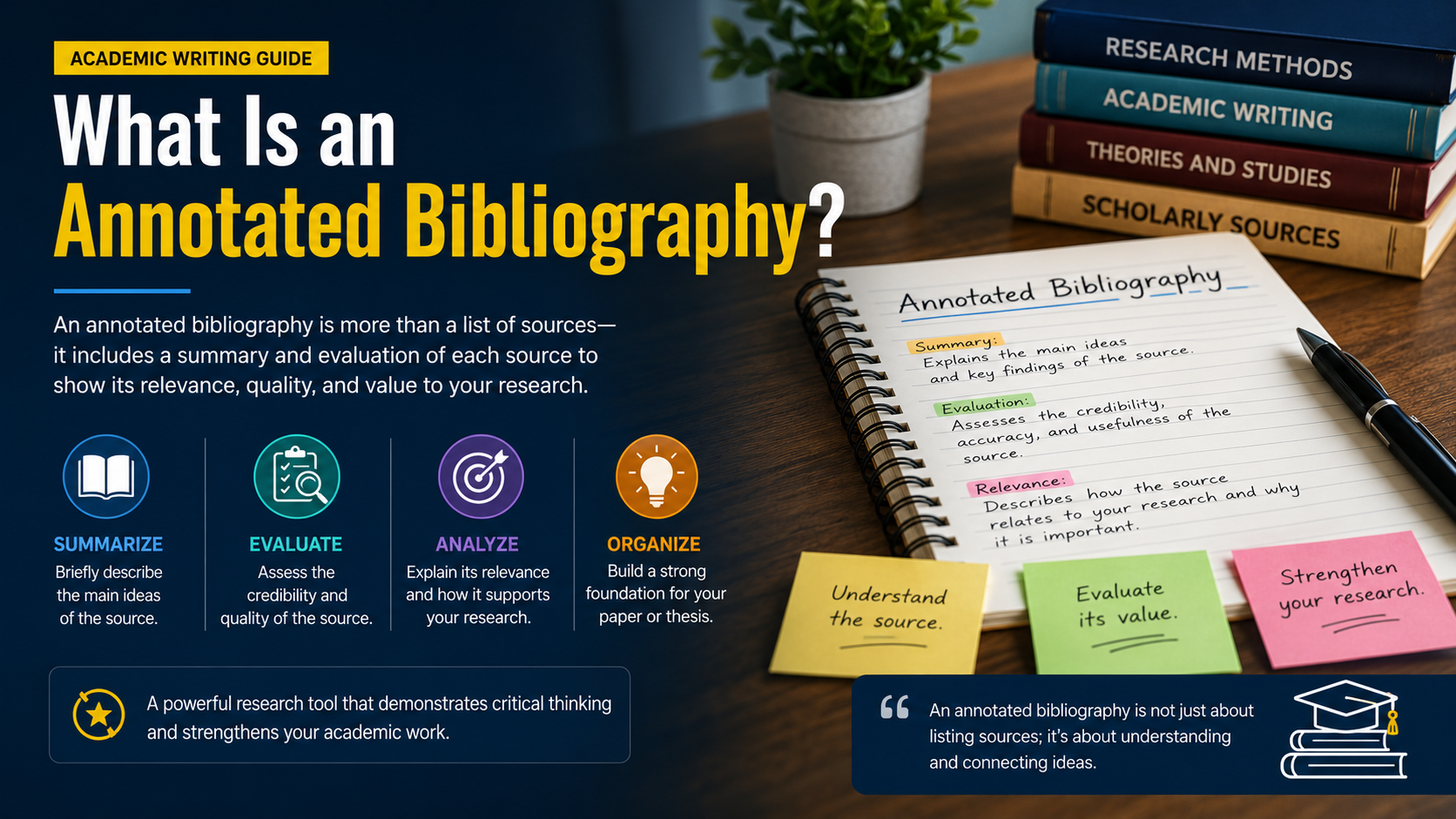
An annotated bibliography is more than just a list of sources—it's a valuable research tool that demonstrates your understanding of the materials you've consulted. Whether you're writing a research paper, thesis, dissertation, or academic essay, an annotated bibliography helps organize your sources while providing concise summaries and evaluations of each one.
Many students encounter annotated bibliographies in college or university but are often unsure how to write them correctly. Questions like "What should I include?", "How long should an annotation be?", and "What's the difference between a bibliography and an annotated bibliography?" are common.
This comprehensive guide explains everything you need to know about annotated bibliographies, including their purpose, structure, formatting styles, examples, benefits, and common mistakes to avoid.
What Is an Annotated Bibliography?
An annotated bibliography is a list of citations followed by a brief paragraph—called an annotation—that summarizes, evaluates, and explains the relevance of each source.
Unlike a standard bibliography, which only lists references, an annotated bibliography provides additional information about why each source is useful and how it contributes to your research.
Each entry typically contains:
A complete citation
A summary of the source
An evaluation of its credibility
An explanation of its relevance to your topic
Why Is an Annotated Bibliography Important?
Annotated bibliographies serve several important purposes in academic writing.
They help researchers:
Organize research materials
Understand the strengths and weaknesses of sources
Identify gaps in existing research
Demonstrate critical thinking
Build a stronger literature review
Save time during the writing process
Professors often assign annotated bibliographies to ensure students have thoroughly evaluated their sources before beginning a research paper.
Components of an Annotated Bibliography
Every annotated bibliography consists of two main parts.
1. Citation
The citation follows the required citation style, such as:
APA
MLA
Chicago
Harvard
Example (APA):
Smith, J. (2023). Artificial Intelligence in Higher Education. Academic Press.
2. Annotation
The annotation usually ranges from 100 to 200 words and includes:
Summary
Briefly explain the main ideas of the source.
Evaluation
Assess the credibility, accuracy, and authority of the source.
Reflection
Explain how the source supports your research topic.
Types of Annotated Bibliographies
Different assignments require different types of annotations.
Descriptive Annotation
A descriptive annotation summarizes the content without evaluating the source.
Example:
This book examines the impact of artificial intelligence on university education, focusing on teaching methods, student engagement, and future learning technologies.
Evaluative Annotation
An evaluative annotation summarizes the source while also assessing its quality and credibility.
Example:
The author provides evidence-based research supported by peer-reviewed studies. Although the focus is primarily on North American universities, the findings are highly relevant for global higher education research.
Combination Annotation
Most universities require a combination of summary and evaluation.
This includes:
Summary
Author credentials
Reliability
Strengths
Weaknesses
Relevance to your research
When Do You Need an Annotated Bibliography?
Annotated bibliographies are commonly required for:
Research papers
Literature reviews
Theses
Dissertations
Capstone projects
Grant proposals
Academic reports
Researchers also create them to stay organized during large research projects.
How to Write an Annotated Bibliography
Step 1: Choose Reliable Sources
Use trustworthy academic resources, including:
Peer-reviewed journals
Scholarly books
Government publications
University websites
Professional organizations
Avoid unreliable blogs or unverified websites unless specifically permitted.
Step 2: Create the Citation
Format each reference according to your instructor's required citation style.
For example:
APA
Author, A. A. (Year). Title. Publisher.
MLA
Author Last Name, First Name. Title. Publisher, Year.
Chicago
Author Last Name, First Name. Title. Publisher, Year.
Step 3: Summarize the Source
Identify the main purpose of the work.
Ask yourself:
What is the author discussing?
What are the key findings?
What arguments are presented?
Keep your summary concise.
Step 4: Evaluate the Source
Consider questions such as:
Is the author an expert?
Is the information current?
Is the evidence reliable?
Is the source unbiased?
Has it been peer-reviewed?
Step 5: Explain Its Relevance
Describe how the source contributes to your research.
For example:
Supports your thesis
Provides background information
Offers statistical evidence
Presents an opposing viewpoint
Annotated Bibliography Example (APA)
Smith, J. (2023). Artificial Intelligence in Higher Education. Academic Press.
Annotation
This book explores the growing role of artificial intelligence in universities, including AI-assisted learning, academic integrity, and ethical concerns. The author uses current research and case studies from leading educational institutions. Because the book is written by an experienced education researcher and references peer-reviewed studies, it is considered highly credible. This source provides valuable background information for understanding how AI is transforming higher education and supports research on responsible AI implementation.
Difference Between a Bibliography and an Annotated Bibliography
Although a bibliography and an annotated bibliography may appear similar, they serve different purposes. A standard bibliography simply lists the sources used in a research project, allowing readers to identify the references consulted by the author. It does not include summaries, evaluations, or additional commentary. In contrast, an annotated bibliography goes a step further by providing a brief explanation after each citation. These annotations summarize the source's main ideas, evaluate its credibility and usefulness, and explain how it relates to the research topic. As a result, annotated bibliographies are more detailed and analytical than standard bibliographies. While a bibliography is primarily used for citation purposes, an annotated bibliography helps researchers critically assess their sources, organize their research effectively, and build a stronger foundation for academic writing.
Benefits of an Annotated Bibliography
Creating an annotated bibliography offers many advantages:
Improves research organization
Enhances critical thinking
Simplifies literature reviews
Identifies credible sources
Prevents duplicate research
Helps develop stronger arguments
Saves time when writing the final paper
Common Mistakes to Avoid
Students often make these errors:
Writing summaries that are too long
Forgetting to evaluate the source
Using unreliable references
Incorrect citation formatting
Including personal opinions without evidence
Copying annotations from online sources
Always write original annotations based on your own understanding of the material.
Tips for Writing a Strong Annotated Bibliography
Read the source carefully before writing.
Use academic language.
Keep annotations concise.
Follow the required citation style consistently.
Focus on relevance to your research question.
Proofread for grammar and formatting errors.
Conclusion
An annotated bibliography is an essential component of academic research that goes beyond simply listing references. By summarizing, evaluating, and reflecting on each source, it demonstrates your ability to engage critically with scholarly materials and build a solid foundation for your research.
Whether you're preparing a research paper, thesis, dissertation, or literature review, mastering the annotated bibliography process will improve your research skills, strengthen your writing, and make your academic work more organized and credible.
With careful source selection, accurate citations, and thoughtful annotations, you can create an annotated bibliography that not only meets academic standards but also supports a successful research project.
Frequently Asked Questions
Everything you need to know about our services
Related Posts

Common Citation Mistakes Students Make (And How to Avoid Them)

MLA Citation Guide (Latest Edition): Complete Guide with Examples for Students
