How Many References for a 2,000-Word Essay? A Complete Student Guide
Writing a 2,000-word essay involves more than presenting your ideas—it also requires supporting your arguments with credible evidence. One of the most common questions students ask is: "How many references should a 2,000-word essay have?"
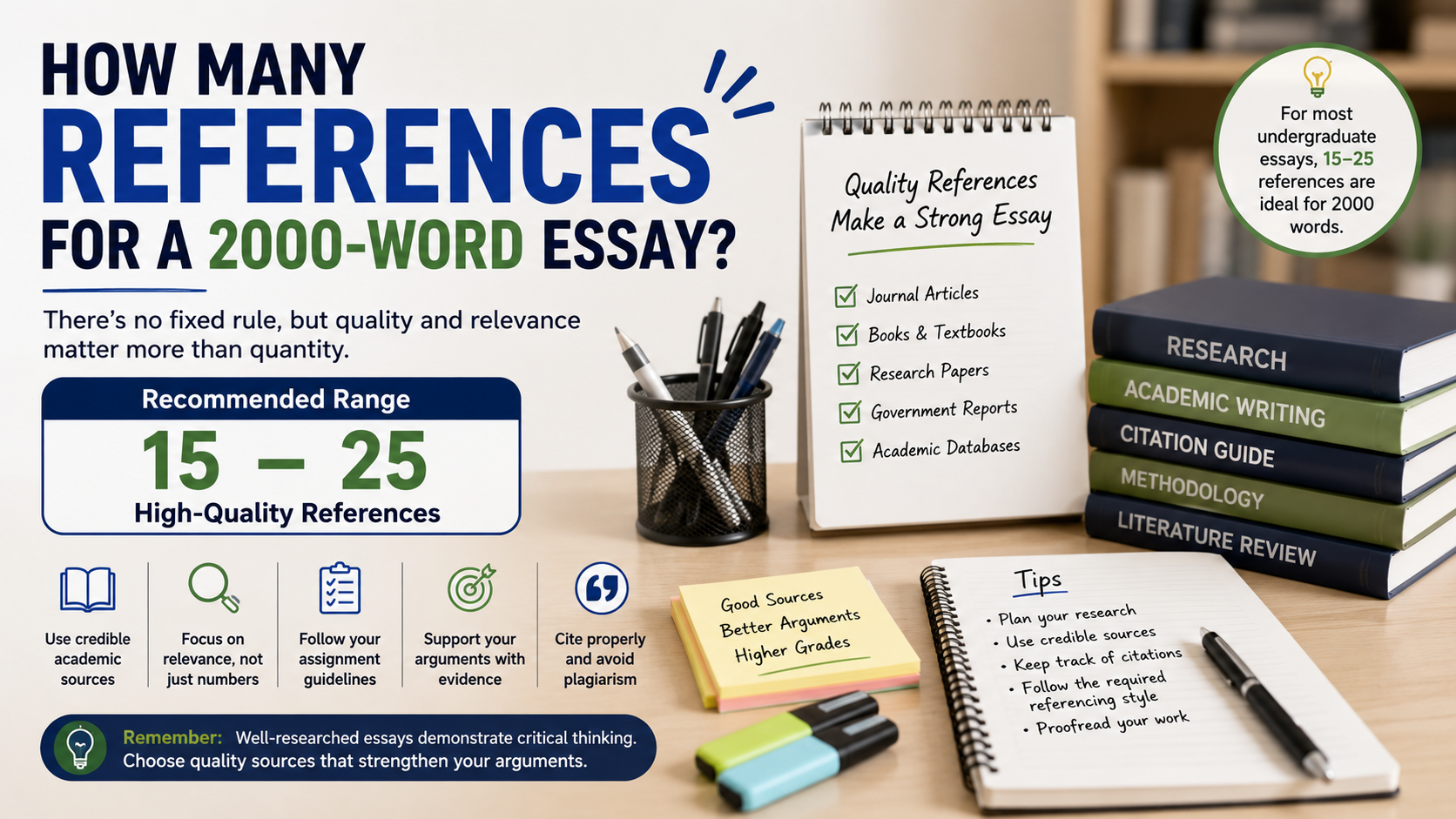
The truth is that there is no universal rule. The ideal number of references depends on your subject, university guidelines, essay type, and the depth of your research. However, understanding general expectations can help you produce a well-supported, high-quality academic paper.
In this guide, we'll explain how many references are appropriate for a 2,000-word essay, what factors affect the number, and how to choose reliable sources.
Is There a Standard Number of References?
Most universities do not specify an exact number of references. Instead, they expect students to demonstrate sufficient research using credible academic sources.
For a typical 2,000-word undergraduate essay, including 15–25 high-quality academic references is generally sufficient. Focus on using credible, relevant, peer-reviewed, and up-to-date sources that directly support your arguments instead of simply increasing the number of citations.
What Determines the Number of References?
Several factors influence how many sources you should include.
1. Your Academic Subject
Different disciplines have different research expectations.
Humanities
Subjects like English Literature, History, and Philosophy often rely heavily on books, journal articles, and primary sources. These essays may require around 20–30 references.
Social Sciences
Psychology, Sociology, Education, and Business usually require 15–25 references, including peer-reviewed journal articles.
Science and Engineering
Scientific essays often cite recent journal articles rather than books. A 2,000-word paper may include 20–35 references because research is evidence-based.
2. Assignment Requirements
Always read your assignment brief carefully.
Some lecturers specifically mention:
-
Minimum number of journal articles
-
Maximum number of websites
-
Recent publications only
-
Peer-reviewed sources
-
Required citation style
If your instructor asks for 20 references, follow those instructions even if general recommendations differ.
3. Essay Type
The purpose of your essay affects how many references you need.
Argumentative Essays
These require evidence from multiple perspectives.
Recommended references:
20–30
Analytical Essays
You'll analyse theories and research findings.
Recommended references:
15–25
Reflective Essays
These rely more on personal reflection than research.
Recommended references:
5–15
Literature Reviews
These require extensive reading.
Recommended references:
30 or more
Quality Matters More Than Quantity
Many students believe adding more references automatically improves grades.
That's not true.
Using 20 strong academic sources is far better than citing 50 weak or unreliable websites.
Good references should be:
-
Peer-reviewed journal articles
-
Academic books
-
Government publications
-
University publications
-
Professional organisations
-
Official statistics
Avoid relying heavily on blogs, Wikipedia, or random websites unless specifically allowed.
How Often Should You Cite in a 2,000-Word Essay?
There is no rule that every paragraph must contain a citation.
However, most academic essays include:
-
One or two citations in each body paragraph
-
Multiple citations when discussing research
-
References whenever facts, statistics, theories, or ideas come from another author
A typical 2,000-word essay might contain 20–40 in-text citations, even if the reference list includes only 20 sources.
Remember that one source can be cited multiple times throughout your essay.
Choosing High-Quality References
Instead of searching randomly online, start with trusted academic databases.
Recommended sources include:
-
Google Scholar
-
JSTOR
-
ScienceDirect
-
PubMed
-
IEEE Xplore
-
SpringerLink
-
Taylor & Francis
-
University Library databases
These platforms provide peer-reviewed research that strengthens your arguments.
Should You Use Books or Journal Articles?
The answer depends on your subject.
Books are useful for:
-
Background information
-
Historical context
-
Theoretical frameworks
Journal articles are ideal for:
-
Current research
-
Recent findings
-
Evidence-based discussions
-
Scientific studies
Most university essays benefit from a combination of both.
Common Referencing Mistakes Students Make
Many students lose marks because of avoidable referencing errors.
Common mistakes include:
Using too few references
Weak research often results in unsupported arguments.
Using unreliable websites
Avoid citing blogs or anonymous sources when academic evidence is available.
Outdated sources
Unless discussing historical developments, try to use research published within the last five to ten years.
Incorrect citation style
Always follow the required referencing style, such as APA, Harvard, MLA, or Chicago.
Missing in-text citations
Every borrowed idea, statistic, quotation, or paraphrased concept must be cited.
Tips for Managing References Efficiently
Referencing becomes much easier with the right tools.
Useful reference managers include:
-
Zotero
-
Mendeley
-
EndNote
-
RefWorks
These tools automatically generate citations and reference lists in different academic styles, reducing formatting errors and saving time.
Final Thoughts
So, how many references should a 2,000-word essay have?
For most university assignments, 15–25 credible academic references provide a solid foundation. However, the exact number depends on your subject, assignment requirements, and the depth of analysis expected.
Rather than focusing solely on quantity, prioritise relevant, authoritative, and up-to-date sources. A well-researched essay supported by credible evidence demonstrates critical thinking, strengthens your arguments, and helps you achieve higher academic grades.
Frequently Asked Questions
Everything you need to know about our services
Related Posts

Assignment Editing Checklist: 20 Things to Review Before You Submit

How to Score High Marks in Assignments: A Complete Guide for Students
