What If Your Supervisor Says "Rewrite Everything"?
Introduction
Few moments during a dissertation project feel more discouraging than opening your supervisor's feedback and seeing words like:
"This needs to be rewritten."
Or even worse:
"Rewrite everything."
Your first reaction might be panic.
You may wonder:
Have I failed?
Is all my work useless?
Will I finish before the deadline?
Should I start from scratch?
The good news is that "rewrite everything" rarely means every single sentence is wrong. In most cases, supervisors use this phrase to highlight significant issues with structure, argument, or clarity—not to dismiss all the work you've already completed.
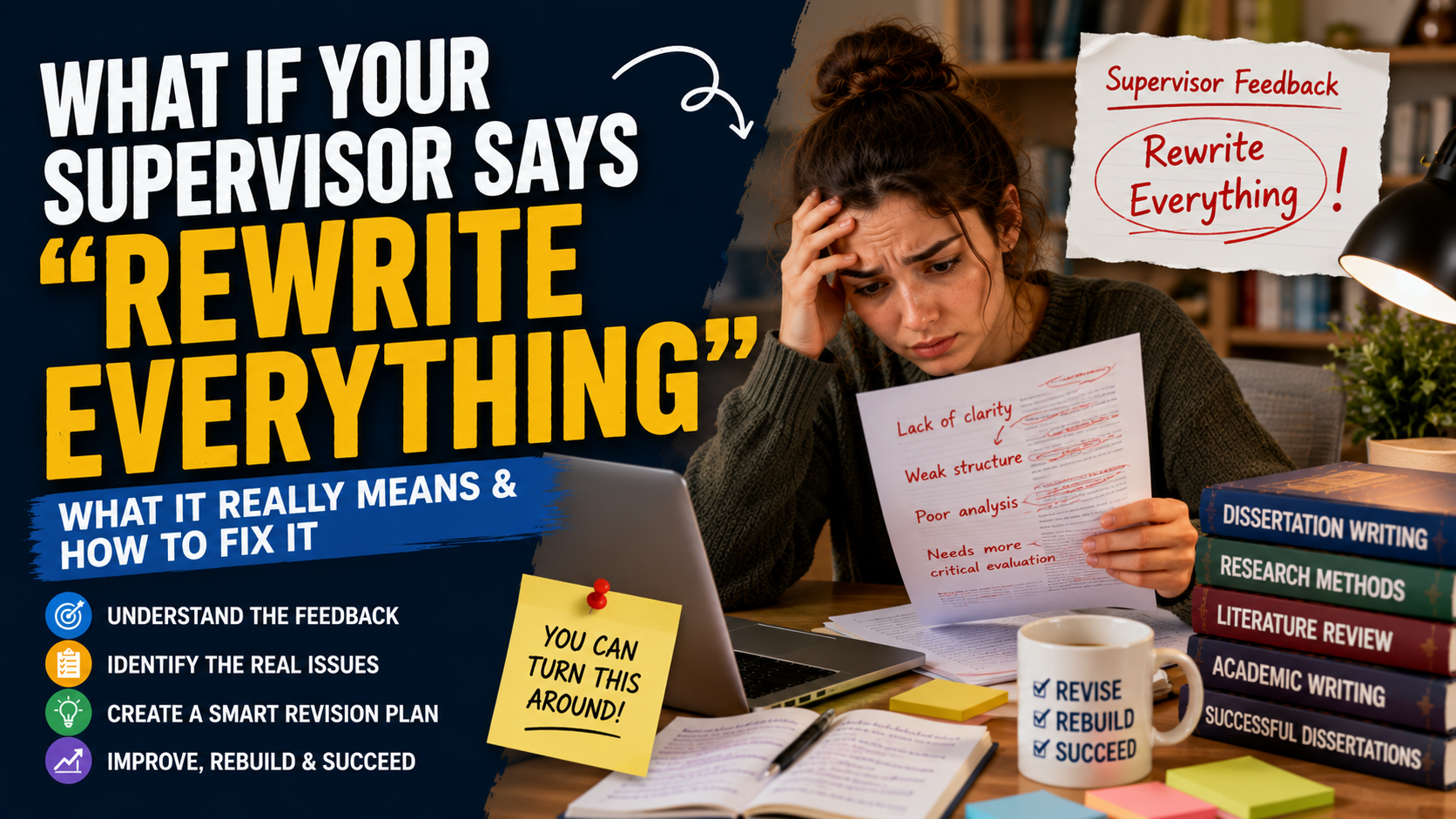
This guide explains what your supervisor may really mean, how to interpret the feedback constructively, and how to rebuild your dissertation efficiently without starting over unnecessarily.
What Does "Rewrite Everything" Usually Mean?
Although the wording sounds dramatic, supervisors often use it as shorthand for substantial revision rather than literal replacement.
Common reasons include:
Weak overall structure.
Unclear research question.
Limited critical analysis.
Poor logical flow.
Inconsistent argument.
Methodology that lacks justification.
Literature review that is descriptive rather than analytical.
Usually, your research, sources, and ideas remain valuable—the way they are presented simply needs improvement.
Don't Panic or Delete Your Work
One of the biggest mistakes students make is deleting their draft immediately.
Instead:
Save your current version.
Create a copy.
Review every comment carefully.
Identify recurring themes.
Your existing draft contains useful material that can often be reorganised and strengthened.
Never delete work before understanding the feedback.
Read the Entire Feedback First
Avoid editing paragraph by paragraph immediately.
Instead:
Read every supervisor comment.
Highlight repeated suggestions.
Identify the major problems.
Separate essential revisions from minor corrections.
Patterns matter more than individual comments.
Identify the Root Problem
Large-scale revision usually stems from one or two core issues.
Ask yourself:
Is the research question unclear?
If so, every chapter may need better alignment.
Is the structure weak?
Perhaps ideas appear in the wrong order.
Reorganising chapters may solve many problems without rewriting every sentence.
Is the analysis too descriptive?
Many students summarise research instead of evaluating it.
Adding critical discussion can transform existing content.
Does the methodology need stronger justification?
Sometimes the methods are appropriate but poorly explained.
Expanding your rationale may resolve the issue.
Break the Rewrite Into Smaller Tasks
Thinking about rewriting an entire dissertation is overwhelming.
Instead, divide the work.
Example:
Week 1
Clarify research question.
Revise dissertation outline.
Week 2
Rewrite introduction.
Improve literature review.
Week 3
Strengthen methodology.
Week 4
Expand analysis.
Improve discussion.
Final Week
Proofreading.
Referencing.
Formatting.
Small milestones make large revisions manageable.
Keep What Still Works
Not everything needs replacing.
You can often keep:
High-quality references.
Data collection.
Tables.
Figures.
Literature summaries.
Method descriptions.
Focus your effort on improving organisation, analysis, and clarity rather than rewriting every sentence.
Ask for Clarification
If the feedback simply says:
"Rewrite everything."
Politely ask for more detail.
For example:
"Could you identify the main areas that require revision? Would you recommend prioritising structure, analysis, or methodology?"
Specific questions help you understand where your effort will have the greatest impact.
Compare Your Draft With the Assessment Criteria
Review your university's marking rubric.
Check whether your dissertation demonstrates:
Clear research aims.
Critical analysis.
Logical structure.
Appropriate methodology.
Academic writing.
Accurate referencing.
Assessment criteria often explain why supervisors recommend substantial revision.
Create a Revision Checklist
Convert comments into actions.
Feedback | Revision Task |
|---|---|
Weak structure | Reorganise chapter order |
Limited analysis | Compare evidence more critically |
Unclear argument | Rewrite topic sentences |
Methodology unclear | Explain research decisions |
Poor flow | Add transitions between sections |
Working systematically reduces stress.
Maintain Perspective
Even experienced researchers receive requests for major revisions.
Journal reviewers frequently recommend:
Major revisions.
Extensive rewriting.
Additional analysis.
Reorganisation.
Revision is a normal part of academic research—not evidence of failure.
Academic Integrity During Major Revisions
While rewriting your dissertation:
Cite all sources accurately.
Follow your university's referencing guidelines.
Use AI tools only where permitted by institutional policies.
Ensure all analysis, interpretation, and conclusions remain your own original academic work.
Strong revisions improve quality while maintaining academic integrity.
"Rewrite Everything" vs What It Often Means
Supervisor Comment | Practical Interpretation |
|---|---|
Rewrite everything | Major structural improvements needed |
Develop your argument | Add stronger evidence and reasoning |
Be more critical | Evaluate rather than describe |
Clarify methodology | Explain research decisions |
Improve flow | Reorganise ideas logically |
Expand discussion | Analyse findings more deeply |
Final Thoughts
Hearing the words "rewrite everything" can feel overwhelming, but it rarely means your dissertation is beyond saving. More often, it reflects the need for stronger structure, clearer arguments, deeper analysis, or better organisation rather than a complete restart. Your research, evidence, and hard work still provide a valuable foundation.
By reviewing feedback carefully, identifying the underlying issues, creating a structured revision plan, and focusing on the areas that matter most, you can transform a difficult draft into a much stronger dissertation. Major revisions are a normal part of academic research, and approaching them with patience, critical thinking, and a clear strategy will help you produce work that reflects your true potential.
Frequently Asked Questions
Everything you need to know about our services


