How Structured Feedback Improved One Dissertation
Introduction
Receiving detailed feedback on a dissertation can be both encouraging and intimidating. After spending weeks researching and writing, opening a document filled with comments, suggestions, and tracked changes may feel overwhelming.
However, experienced students often discover that constructive feedback is one of the most valuable parts of the dissertation process. Rather than viewing comments as criticism, successful students learn to treat feedback as a roadmap for improvement.
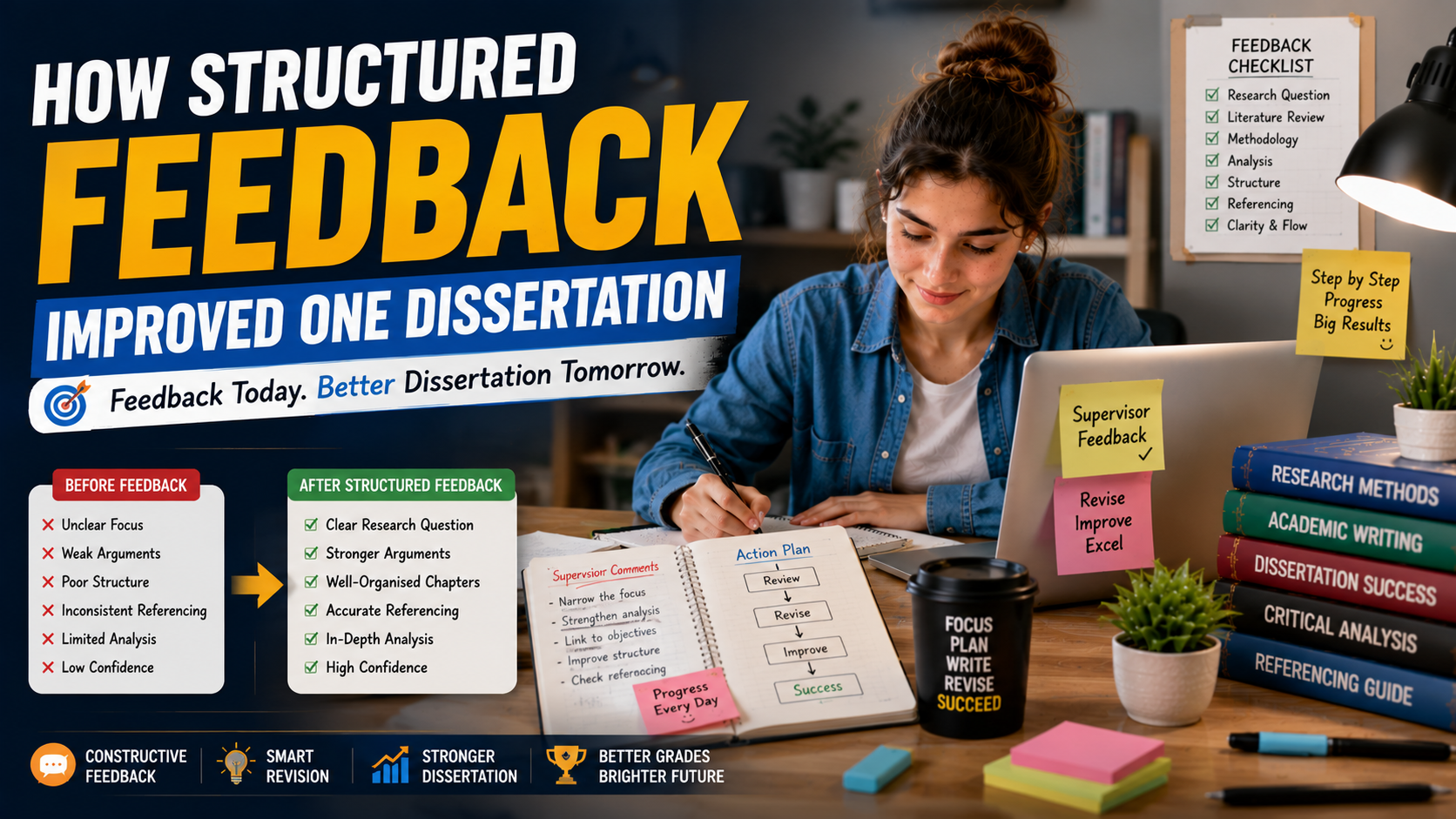
This article follows a realistic student journey inspired by common dissertation experiences and demonstrates how structured feedback helped transform an average draft into a stronger, more organised, and academically persuasive dissertation.
The Initial Challenge
Imagine a postgraduate student named Alex.
After several months of research, Alex submitted the first complete dissertation draft to a supervisor with cautious optimism.
A week later, the document returned covered in comments.
Some observations included:
The research question needed greater focus.
The literature review lacked critical evaluation.
Several arguments required stronger evidence.
Chapter transitions were unclear.
Referencing contained inconsistencies.
At first glance, the feedback appeared discouraging.
Yet none of these issues meant the dissertation had failed.
Instead, they identified clear opportunities for improvement.
Understanding the Purpose of Feedback
Many students believe feedback is simply a list of mistakes.
In reality, supervisors aim to help students:
Develop stronger academic arguments.
Improve critical thinking.
Refine research methods.
Increase clarity.
Meet university assessment criteria.
Feedback is designed to improve learning—not merely evaluate performance.
Step 1: Organising Every Comment
Rather than attempting to fix everything immediately, Alex grouped comments into categories.
For example:
Research
Narrow research question.
Clarify objectives.
Literature Review
Compare studies more critically.
Include recent publications.
Methodology
Explain sampling decisions.
Justify chosen methods.
Analysis
Expand interpretation of findings.
Link evidence to research questions.
Presentation
Improve formatting.
Correct referencing.
Breaking feedback into sections made the revision process much more manageable.
Step 2: Prioritising High-Impact Changes
Not all feedback carries equal importance.
Alex focused first on comments affecting the overall quality of the dissertation.
Priority order included:
Research question.
Literature review.
Methodology.
Data analysis.
Structure.
Referencing.
Grammar and formatting.
Improving major academic issues first prevented unnecessary rewriting later.
Step 3: Meeting the Supervisor
Rather than guessing how to interpret comments, Alex arranged another supervision meeting.
The discussion clarified:
Which revisions were essential.
Which improvements were optional.
Expectations for the next draft.
How chapters connected together.
A short meeting prevented hours of uncertainty.
Step 4: Revising One Chapter at a Time
Trying to revise the entire dissertation simultaneously quickly became overwhelming.
Instead, Alex adopted a structured approach.
Each chapter followed the same process:
Read supervisor comments.
Review relevant literature.
Revise arguments.
Improve clarity.
Check references.
Proofread before moving forward.
This method created visible progress every week.
Step 5: Strengthening Critical Analysis
One recurring comment noted that the dissertation described research without analysing it.
To improve critical thinking, Alex began asking questions such as:
Why do these studies disagree?
Which methodology is strongest?
What limitations exist?
How do these findings relate to my research?
These changes significantly strengthened the literature review and discussion chapters.
Step 6: Improving Academic Writing
Feedback also highlighted writing style.
Common improvements included:
Shorter sentences.
Clearer topic sentences.
Better transitions.
More formal academic language.
Removing repetition.
Small writing improvements made the dissertation easier to read.
Step 7: Reviewing References Carefully
The final revision stage focused on academic integrity.
Alex:
Checked every citation.
Updated the bibliography.
Corrected referencing style.
Verified quotations.
Removed duplicate sources.
Accurate referencing increased professionalism and reduced the risk of academic misconduct.
The Outcome
By responding systematically to structured feedback, the dissertation improved in several areas.
Instead of:
Unclear arguments.
Weak organisation.
Inconsistent referencing.
The revised dissertation demonstrated:
Clear research objectives.
Stronger evidence.
Better critical analysis.
Improved academic writing.
Logical chapter structure.
Consistent referencing.
The transformation came through revision—not rewriting everything from scratch.
Lessons Every Student Can Apply
Regardless of your subject area, structured feedback becomes more valuable when you:
Read every comment carefully.
Organise suggestions into categories.
Prioritise major academic improvements.
Discuss unclear comments with your supervisor.
Revise systematically.
Proofread thoroughly before submission.
Each revision strengthens the final dissertation.
Academic Integrity During Revision
While revising your dissertation, continue to maintain responsible academic practice.
Remember to:
Cite every source accurately.
Follow your university's required referencing style.
Use AI tools only where permitted by institutional policies.
Ensure revisions reflect your own independent critical thinking and academic judgement.
Responsible revision enhances both the quality and credibility of your work.
Unstructured vs Structured Feedback
Unstructured Approach | Structured Approach |
|---|---|
Reacts emotionally to comments | Reviews feedback objectively |
Revises randomly | Organises revisions by priority |
Focuses on grammar first | Improves arguments before editing |
Avoids supervisor meetings | Seeks clarification when needed |
Rushes revisions | Revises chapter by chapter |
Leaves references until the end | Updates citations throughout |
Final Thoughts
Structured feedback is not a sign that your dissertation has failed—it's an opportunity to strengthen it. The most successful students rarely produce a perfect first draft. Instead, they use supervisor comments to refine their research, improve their arguments, and develop clearer academic writing through thoughtful revision.
By approaching feedback systematically, prioritising the most important changes, and revising one section at a time, you can transform a challenging draft into a well-organised, persuasive dissertation. Every comment represents a chance to improve, and embracing that process can make a significant difference to the quality of your final submission.
Frequently Asked Questions
Everything you need to know about our services


