What Examiners Look for in a Distinction Assignment
Introduction
Many students assume that a distinction assignment simply means writing more words, adding more references, or spending extra hours researching. In reality, distinction-level work is judged by a different standard.
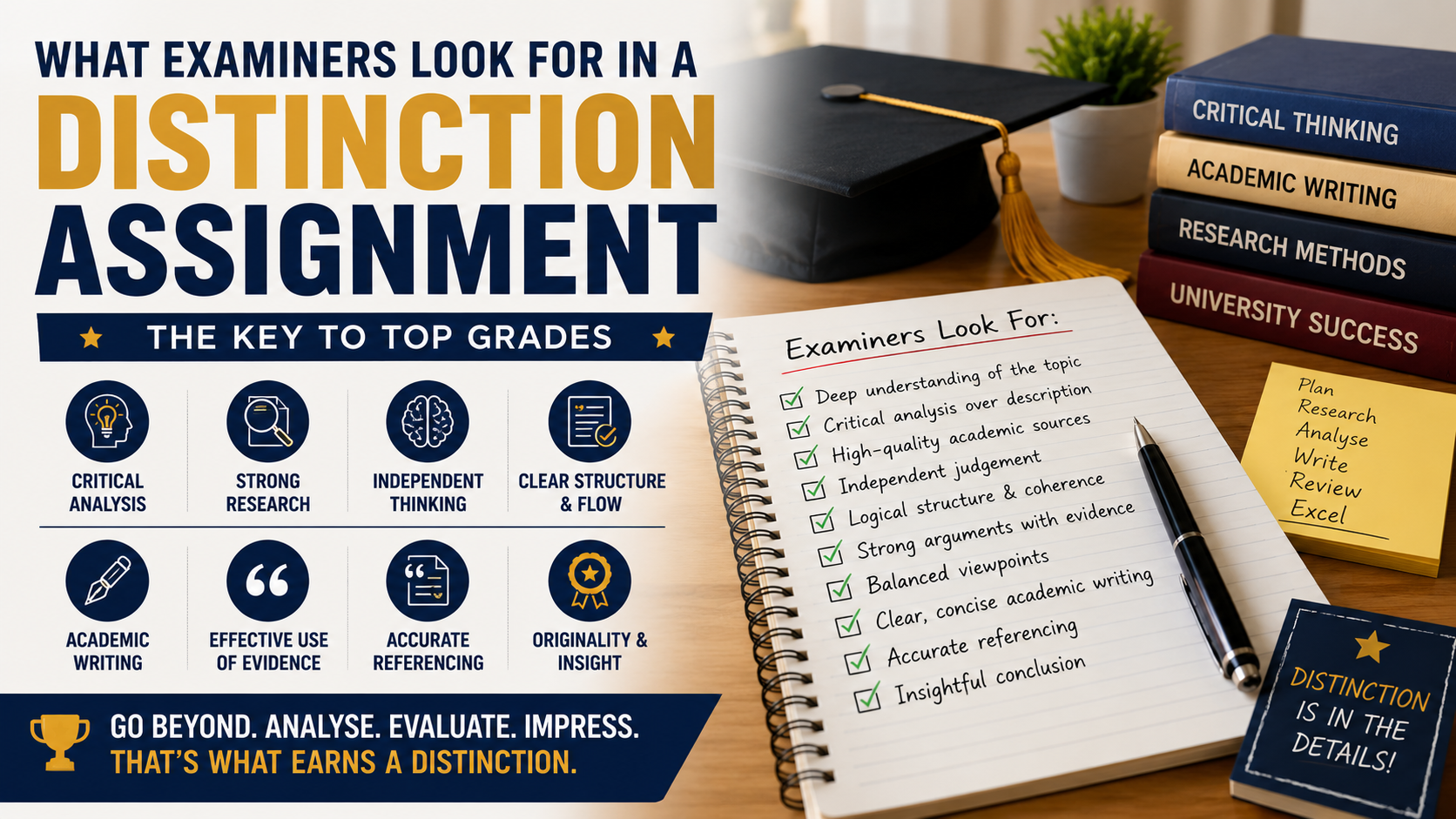
Examiners and lecturers are not looking for quantity. They are looking for quality. They want to see evidence of critical thinking, independent analysis, academic rigour, and a deep understanding of the subject matter.
A distinction assignment stands out because it demonstrates intellectual maturity and goes beyond basic university requirements.
Whether you are studying in the UK, Australia, or another higher education system, understanding what examiners actually look for can dramatically improve your academic performance.
In this guide, you'll learn:
What Is a Distinction Assignment?
A distinction is generally considered one of the highest academic classifications.
Although grading systems vary between institutions, distinction-level work typically demonstrates:
Exceptional understanding
Advanced critical thinking
Strong academic research
Independent judgement
Excellent structure
Professional academic writing
Examiners expect distinction assignments to go beyond basic description and demonstrate meaningful engagement with the topic.
Why Understanding Examiner Expectations Matters
Many students focus on what they want to write rather than what examiners are actually assessing.
However, assignments are marked using assessment criteria and marking rubrics.
Understanding these expectations helps you:
Prioritise important criteria
Avoid common mistakes
Improve assignment quality
Increase grading potential
The most successful students write with the marking criteria in mind from the very beginning.
1. Deep Understanding of the Topic
One of the first things examiners assess is subject knowledge.
Distinction assignments demonstrate:
Accurate understanding
Advanced knowledge
Strong conceptual awareness
Relevant application of theory
Students should move beyond definitions and show they understand how concepts relate to real-world situations and academic debates.
2. Critical Analysis Rather Than Description
This is one of the biggest differences between average assignments and distinction-level work.
Weak assignments describe information.
Distinction assignments analyse it.
Examiners expect students to:
Compare perspectives
Evaluate evidence
Discuss strengths and weaknesses
Challenge assumptions
Reach reasoned conclusions
For example:
Weak:
"Transformational leadership improves employee motivation."
Stronger:
"While transformational leadership is often associated with increased employee motivation, critics argue that its effectiveness depends heavily on organisational culture and leadership implementation."
The second example demonstrates analytical thinking.
3. Independent Thinking
Examiners reward students who contribute their own judgement.
This does not mean inventing opinions without evidence.
Instead, it means:
Evaluating research critically
Forming reasoned conclusions
Identifying limitations
Recognising alternative interpretations
Independent thinking shows academic maturity.
4. Strong Academic Research
Distinction assignments are usually supported by high-quality academic sources.
Examiners look for:
Peer-reviewed journals
Academic books
Government publications
Professional reports
Using current and credible evidence strengthens arguments and improves academic credibility.
5. Effective Use of Evidence
Simply inserting references does not impress examiners.
What matters is how evidence is used.
Strong assignments:
Integrate evidence naturally
Support arguments effectively
Compare findings
Explain significance
Evidence should strengthen analysis rather than replace it.
6. Clear and Logical Structure
A distinction assignment is usually easy to follow.
Examiners appreciate:
Logical organisation
Effective headings
Smooth transitions
Strong paragraph flow
A typical structure includes:
Introduction
Context
Aim
Thesis
Main Body
Arguments
Analysis
Evidence
Conclusion
Summary
Findings
Final judgement
Good structure improves readability and clarity.
7. Strong Introduction
The introduction sets expectations.
A distinction-level introduction should:
Introduce the topic
Explain significance
Outline objectives
Present the central argument
Avoid vague or overly broad openings.
8. Excellent Academic Writing
Writing quality plays an important role in assessment.
Examiners look for:
Clarity
Precision
Formal tone
Professional presentation
Distinction assignments communicate ideas effectively without unnecessary complexity.
9. Accurate Referencing
Referencing demonstrates academic integrity.
Examiners expect:
Consistent citation style
Complete references
Accurate formatting
Common styles include:
Harvard
APA
MLA
OSCOLA
Chicago
Even strong assignments can lose marks because of referencing errors.
10. Originality
Originality is another important factor.
This does not mean discovering entirely new ideas.
Instead, it involves:
Unique perspectives
Independent analysis
Thoughtful interpretation
Examiners appreciate students who engage critically with existing research.
11. Relevance Throughout
Every paragraph should contribute to answering the assignment question.
Distinction assignments avoid:
Irrelevant content
Unnecessary description
Off-topic discussion
Everything included should support the central argument.
12. Balanced Arguments
Strong assignments rarely present only one side of an issue.
Examiners prefer balanced discussion.
Students should:
Present multiple viewpoints
Evaluate competing arguments
Explain disagreements in literature
This demonstrates a deeper understanding of academic debates.
13. Strong Conclusions
Weak conclusions simply repeat previous content.
Distinction conclusions:
Summarise findings
Reinforce arguments
Demonstrate insight
Provide clear judgement
They bring the discussion together effectively.
What Examiners Notice Immediately
Within the first few pages, examiners often notice:
Quality of writing
Structure
Referencing
Clarity of argument
Understanding of the question
First impressions matter.
A well-presented assignment creates confidence in the quality of the work.
Common Reasons Students Miss Distinction Grades
Many students fall short because they:
Describe rather than analyse
Use weak sources
Ignore marking criteria
Lack critical thinking
Have poor structure
Reference incorrectly
Fail to answer the question directly
These issues can often be corrected with careful planning.
Distinction Assignment Checklist
Before submission, ask yourself:
✔ Have I answered the question directly?
✔ Have I demonstrated critical analysis?
✔ Have I evaluated evidence?
✔ Have I used credible academic sources?
✔ Is my structure logical?
✔ Is my referencing accurate?
✔ Have I proofread thoroughly?
✔ Does my conclusion provide a clear judgement?
If the answer is yes, your assignment is much closer to distinction standard.
Key Takeaways
Distinction assignments prioritise quality over quantity.
Critical analysis is essential.
Independent thinking impresses examiners.
Strong academic research strengthens arguments.
Structure and organisation matter.
Referencing must be accurate.
Every section should contribute directly to answering the question.
Conclusion
Understanding what examiners look for in a distinction assignment allows students to focus on the areas that truly matter. High-scoring assignments demonstrate critical thinking, strong research, independent judgement, and clear academic communication.
Rather than trying to impress examiners with word count or complex language, focus on developing evidence-based arguments, engaging critically with research, and meeting the assessment criteria. These are the qualities that consistently distinguish distinction-level work from average submissions.
Frequently Asked Questions
Everything you need to know about our services


