How to Turn University Feedback Into Higher Grades
Introduction
Receiving feedback on a university assignment can be both encouraging and disappointing. While positive comments validate your efforts, critical feedback often highlights areas that need improvement. Many students glance at their feedback, note the grade, and move on to the next assignment. However, this approach means missing one of the most valuable learning opportunities offered by university.
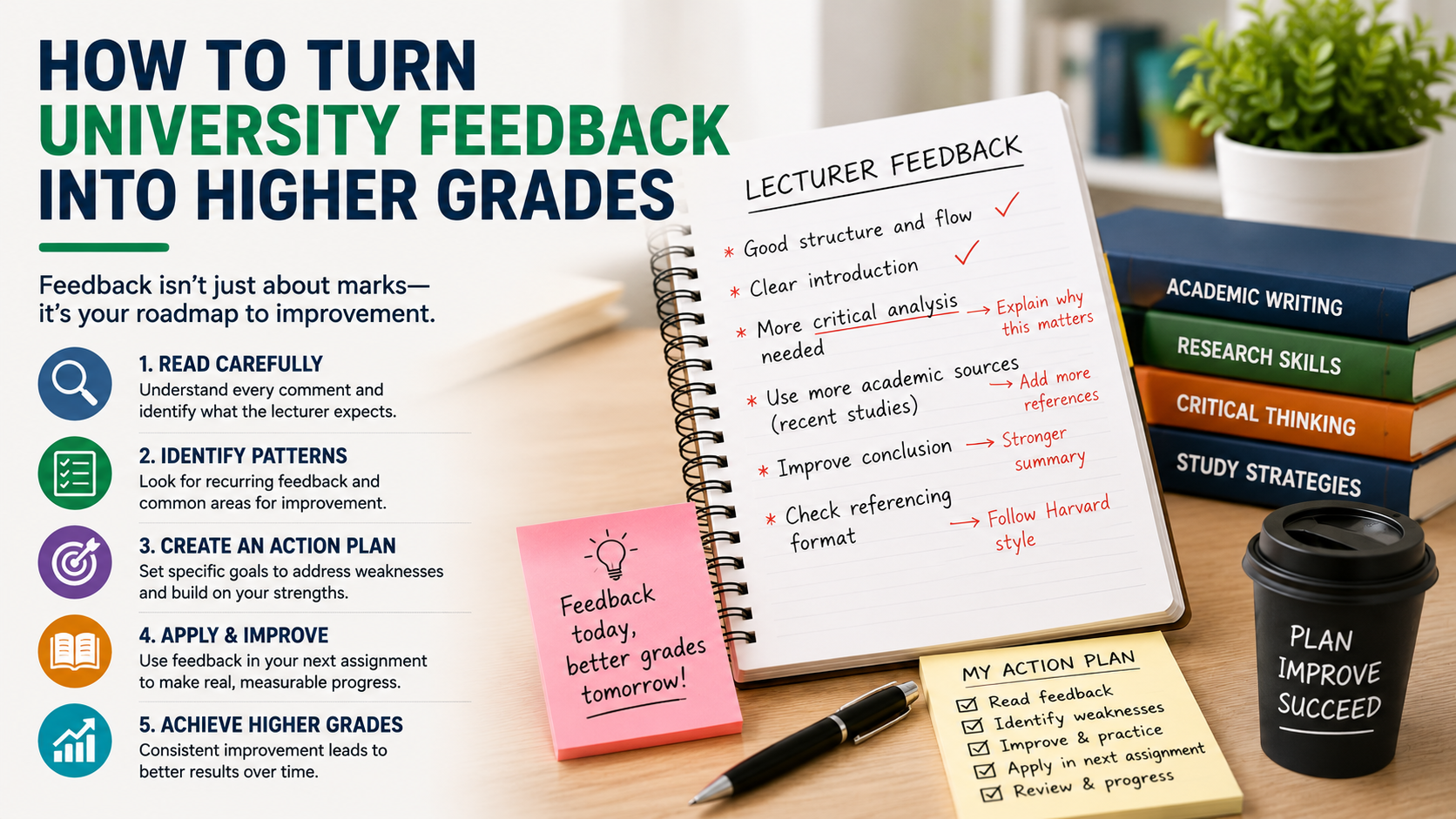
Feedback is more than just a justification for your grade—it's a personalized guide to improving your academic performance. Every comment from your lecturer identifies strengths to maintain and weaknesses to address. By understanding and applying feedback effectively, you can significantly improve future assignments, develop stronger academic skills, and consistently achieve higher grades.
This guide explains how to interpret university feedback, identify recurring issues, create an action plan, and transform lecturer comments into measurable academic improvement.
Why University Feedback Matters
University feedback is designed to help students develop their academic abilities rather than simply explain why marks were awarded. Lecturers assess your work against specific learning outcomes and marking criteria, providing comments that show where your work met expectations and where improvements are needed.
Effective feedback helps students:
-
Understand academic expectations
-
Improve critical thinking
-
Strengthen research skills
-
Develop better academic writing
-
Avoid repeating mistakes
-
Achieve higher marks in future assessments
Students who actively use feedback often see continuous improvement throughout their degree.
Don't Focus Only on the Grade
One of the biggest mistakes students make is concentrating entirely on the numerical mark.
Instead of asking:
"Why did I only get 62%?"
Ask:
-
Which assessment criteria lost the most marks?
-
What improvements does the lecturer recommend?
-
Which strengths should I continue using?
-
What can I change before my next assignment?
The comments often contain far more valuable information than the grade itself.
Understand the Marking Rubric
Every assignment is assessed using a marking rubric or assessment criteria.
Typical assessment categories include:
-
Knowledge and understanding
-
Critical analysis
-
Research quality
-
Structure and organisation
-
Academic writing
-
Referencing accuracy
-
Originality
-
Evidence and argument
Compare your feedback with the rubric to identify exactly where marks were lost.
For example:
Feedback:
"Your discussion is descriptive and lacks critical evaluation."
This usually means marks were deducted under:
-
Critical Analysis
-
Evaluation
-
Independent Thinking
Understanding this connection helps you improve the correct skill rather than rewriting everything.
Identify Recurring Feedback Patterns
Many students receive the same feedback comments repeatedly without realizing they're making recurring mistakes. A simple feedback tracker can help you identify patterns and focus on the areas that need the most improvement.
| Assignment | Lecturer Feedback | Improvement Needed |
| Essay 1 | Weak critical analysis | Compare different viewpoints and evaluate evidence. |
| Report | Limited academic sources | Use more peer-reviewed journals and recent studies. |
| Literature Review | Poor structure | Improve headings, transitions, and logical flow. |
| Case Study | Referencing errors | Follow the required citation style consistently. |
💡 Pro Tip: Review your feedback tracker before starting every new assignment. Recurring comments reveal the academic skills you should prioritize, helping you make measurable improvements and achieve higher grades over time.
Separate Positive and Development Feedback
Feedback isn't only about mistakes.
Divide comments into two sections.
Strengths
Examples include:
-
Well-structured introduction
-
Strong research
-
Clear writing
-
Logical organisation
-
Good referencing
Continue using these strengths in future assignments.
Areas for Improvement
Examples include:
-
Limited analysis
-
Weak conclusion
-
Poor evidence
-
Descriptive writing
-
Inconsistent citations
These become your academic improvement goals.
Decode Common Lecturer Comments
Many feedback comments appear vague at first.
"Be more critical."
This means:
-
Evaluate evidence
-
Compare different opinions
-
Discuss strengths and weaknesses
-
Explain why arguments are convincing
"Develop your argument."
Your points need:
-
More explanation
-
Stronger evidence
-
Better examples
-
Clear links between ideas
"Improve referencing."
Review:
-
Citation format
-
Reference list accuracy
-
Missing sources
-
Consistency
"Use more academic sources."
Instead of relying on websites, include:
-
Peer-reviewed journals
-
Academic books
-
Government reports
-
University publications
"Improve structure."
Your assignment should include:
-
Clear introduction
-
Logical headings
-
Connected paragraphs
-
Strong conclusion
Turn Feedback Into an Action Plan
Don't simply read your feedback—turn it into clear, measurable goals that you can apply in your next assignment. A practical action plan helps you stay focused and monitor your academic progress over time.
| Feedback | Action Plan |
| Weak analysis | Compare at least two academic viewpoints in every section. |
| Limited research | Include 10–15 peer-reviewed journal articles to strengthen evidence. |
| Poor referencing | Use reference management software to ensure accurate citations. |
| Weak conclusion | Summarise key findings without introducing new information. |
📌 Success Tip: Convert every piece of lecturer feedback into one specific action before starting your next assignment. Following a written improvement plan makes it easier to track progress, build stronger academic skills, and achieve higher grades consistently.
Ask Questions If Feedback Is Unclear
Sometimes feedback is brief or difficult to understand.
Don't hesitate to contact your lecturer or academic tutor.
You might ask:
-
Could you explain where my analysis was lacking?
-
Which section needs the most improvement?
-
Can you recommend resources to improve?
-
What would distinguish this assignment at a higher grade boundary?
Most lecturers appreciate students who actively engage with feedback.
Apply Feedback Immediately
The best time to use feedback is before starting your next assignment.
Before writing:
-
Review previous feedback.
-
Check your improvement goals.
-
Read the marking rubric.
-
Create an assignment checklist.
This prevents repeating the same mistakes.
Improve Academic Writing Skills
Many feedback comments relate to writing quality rather than subject knowledge.
Focus on improving:
Paragraph Structure
Use:
-
Topic sentence
-
Supporting evidence
-
Critical analysis
-
Linking sentence
Critical Thinking
Instead of describing information, explain:
-
Why it matters
-
How it compares
-
What evidence supports it
-
What limitations exist
Academic Style
Avoid:
-
Informal language
-
Personal opinions without evidence
-
Repetition
-
Long, confusing sentences
Aim for clarity, precision, and objectivity.
Use University Support Services
Most universities provide free academic support.
These services often include:
-
Writing workshops
-
Referencing guidance
-
Study skills sessions
-
Academic mentors
-
Library research support
-
One-to-one tutoring
Taking advantage of these resources can accelerate improvement.
Keep a Feedback Portfolio
Save feedback from every assignment throughout your degree.
Your portfolio should include:
-
Assignment title
-
Grade
-
Lecturer comments
-
Common weaknesses
-
Improvement goals
-
Results after applying feedback
Over time, you'll see measurable progress and identify recurring strengths and weaknesses.
Common Mistakes Students Make
Avoid these common errors:
-
Reading only the grade
-
Ignoring lecturer comments
-
Repeating previous mistakes
-
Not checking the marking rubric
-
Failing to ask questions
-
Leaving improvements until the next semester
Consistent improvement comes from acting on feedback immediately.
Final Thoughts
University feedback is one of the most valuable academic resources available to students. Rather than viewing it as criticism, treat it as a personalised roadmap for improvement. Every comment identifies an opportunity to strengthen your writing, research, critical thinking, and overall academic performance.
Students who carefully analyse feedback, identify recurring patterns, set practical improvement goals, and apply those lessons to future assignments often achieve significantly better grades over time. Remember, success at university isn't about never making mistakes—it's about learning from them and continuously improving.
The next time you receive an assignment back, don't just check the mark. Read every comment, reflect on the suggestions, and use them to produce stronger, more confident work in your next assessment.
Frequently Asked Questions
Everything you need to know about our services


