Time Management for Working Master's Students
Introduction
Balancing a full-time or part-time job with a master's degree is one of the biggest challenges postgraduate students face. Between work commitments, lectures, assignments, family responsibilities, and personal wellbeing, it can feel like there simply are not enough hours in the day.
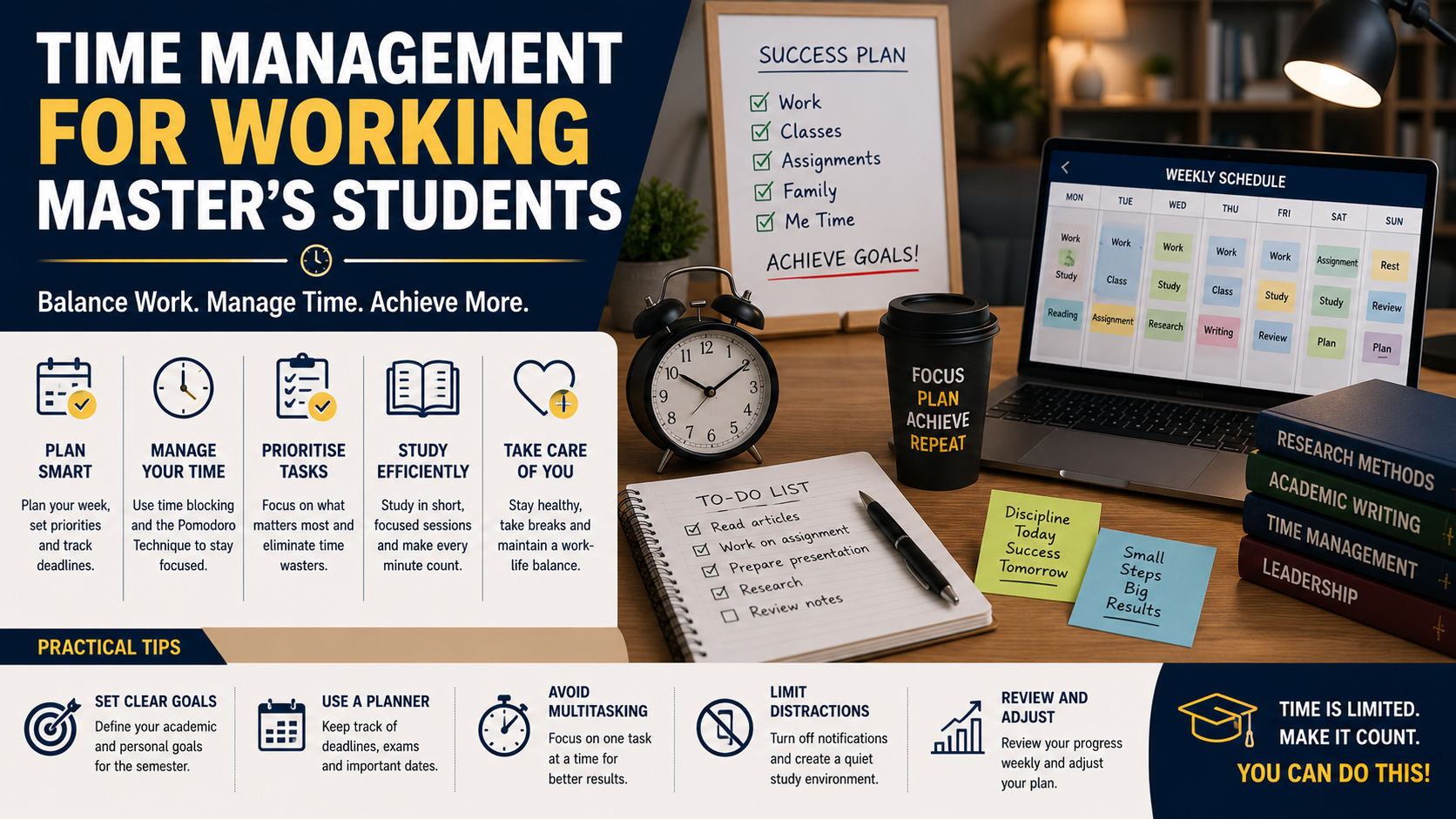
The good news is that many working professionals successfully complete their master's degrees every year. The difference often lies in effective time management rather than having more free time.
Learning how to prioritise tasks, plan ahead, and study efficiently can help you reduce stress, meet deadlines, and maintain a healthy work-life-study balance.
In this guide, you'll learn:
Time Management Is Essential
A master's programme requires significantly more independent study than undergraduate education.
Most postgraduate students spend time on:
Reading academic literature
Conducting research
Writing assignments
Revising lecture materials
Preparing presentations
Participating in seminars
When combined with employment, poor planning can quickly lead to missed deadlines and unnecessary stress.
Effective time management allows you to:
Stay organised
Reduce last-minute pressure
Improve assignment quality
Maintain consistent academic progress
Common Challenges for Working Master's Students
Many postgraduate students experience similar difficulties.
These include:
Long working hours
Tight assignment deadlines
Family commitments
Fatigue after work
Unexpected workplace demands
Difficulty maintaining motivation
Recognising these challenges helps you develop realistic study plans.
Step 1: Set Clear Academic Goals
Begin each semester by identifying your priorities.
Examples include:
Achieving distinction grades
Completing assignments early
Improving academic writing
Reading more journal articles
Developing research skills
Clear goals help you allocate time more effectively.
Step 2: Plan Your Semester
Rather than focusing only on weekly tasks, map out the entire semester.
Include:
Assignment deadlines
Exams
Work commitments
Holidays
Important university events
Seeing the bigger picture helps prevent deadline clashes.
Step 3: Use a Weekly Study Schedule
Create a timetable that includes:
Work hours
Lectures
Study sessions
Breaks
Personal time
Consistency is more effective than occasional long study sessions.
Even one or two focused hours each day can produce significant progress.
Step 4: Prioritise Important Tasks
Not every task has equal importance.
A useful approach is to identify:
Urgent and important tasks
Important but non-urgent tasks
Less important activities
Prioritising high-impact work ensures steady academic progress.
Step 5: Break Large Assignments into Smaller Tasks
Large assignments often feel overwhelming.
Instead of writing "Complete assignment" on your to-do list, divide it into manageable stages.
For example:
Read assignment brief
Find journal articles
Create outline
Write introduction
Complete literature review
Draft discussion
Edit and proofread
Small milestones make progress easier to track.
Step 6: Study During Your Most Productive Hours
Everyone has periods of peak concentration.
Some students work best:
Early morning
During lunch breaks
Evenings
Weekends
Identify when your concentration is highest and schedule demanding academic work during those times.
Step 7: Avoid Multitasking
Many students attempt to:
Check emails
Reply to messages
Watch videos
Study simultaneously
Research consistently shows that multitasking reduces productivity.
Focus on one academic task at a time.
Step 8: Limit Distractions
Common distractions include:
Social media
Mobile phones
Television
Notifications
Consider:
Turning off notifications
Using website blockers
Studying in quiet environments
A distraction-free hour is often more productive than three interrupted hours.
Step 9: Use Productivity Techniques
Several time-management methods work particularly well for postgraduate students.
The Pomodoro Technique
Study for:
25 minutes
Take a 5-minute break
After four sessions, take a longer break.
This approach improves concentration while reducing fatigue.
Time Blocking
Allocate specific time blocks for:
Reading
Research
Writing
Editing
Dedicated blocks reduce decision fatigue.
Step 10: Read Strategically
Working students often have limited study time.
Instead of reading every article from beginning to end:
Focus on:
Abstract
Introduction
Findings
Conclusion
This helps determine whether the article is relevant before investing more time.
Step 11: Start Assignments Early
Procrastination is one of the biggest causes of stress.
Starting early allows time for:
Better research
Multiple drafts
Feedback
Editing
Assignments completed gradually are usually stronger than those written under pressure.
Step 12: Learn to Say No
Working professionals often accept additional commitments.
During busy academic periods, it may be necessary to decline:
Extra shifts
Social events
Non-essential responsibilities
Protecting study time supports long-term success.
Step 13: Communicate with Your Employer
Many employers support professional development.
If appropriate:
Discuss flexible working arrangements
Request study leave
Adjust schedules around major deadlines
Open communication often reduces unnecessary pressure.
Step 14: Take Care of Your Wellbeing
Productivity depends on physical and mental health.
Prioritise:
Sleep
Exercise
Healthy meals
Short breaks
Burnout reduces both academic performance and workplace productivity.
Step 15: Review Your Progress Weekly
At the end of each week, ask yourself:
What did I complete?
What remains unfinished?
What caused delays?
How can I improve next week?
Regular reflection strengthens time-management habits.
Common Time Management Mistakes
Working master's students often:
Leave assignments until the last minute
Overcommit themselves
Study without a plan
Ignore deadlines
Skip breaks
Attempt to multitask constantly
Avoiding these mistakes leads to more consistent academic performance.
Recommended Digital Tools
Helpful productivity tools include:
Google Calendar
Microsoft Outlook Calendar
Notion
Trello
Todoist
Microsoft OneNote
Choose tools that fit your personal workflow.
Sample Weekly Study Routine
Monday–Friday
1–2 hours after work
Reading journal articles
Planning assignments
Saturday
Research
Draft writing
Editing
Sunday
Proofreading
Revision
Planning the following week
A consistent routine is often more sustainable than occasional intensive study sessions.
Benefits of Good Time Management
Students who manage their time effectively often experience:
Better assignment grades
Reduced stress
Improved work-life balance
Higher productivity
Greater confidence
More enjoyable postgraduate study
These benefits extend into professional careers as well.
Time Management Checklist
Before each week begins:
✔ Review deadlines.
✔ Plan study sessions.
✔ Prioritise important tasks.
✔ Break assignments into smaller goals.
✔ Schedule breaks.
✔ Protect study time.
✔ Review progress at the end of the week.
Key Takeaways
Working while completing a master's degree requires careful planning.
Small daily study sessions are often more effective than occasional long sessions.
Prioritising tasks improves productivity.
Starting assignments early reduces stress.
Productivity techniques like time blocking and the Pomodoro Technique improve focus.
Maintaining wellbeing is essential for long-term academic success.
Consistent planning leads to stronger postgraduate performance.
Conclusion
Balancing employment and postgraduate study is demanding, but it is entirely achievable with effective time management. Rather than trying to find more hours in the day, successful master's students maximise the time they already have by planning carefully, prioritising important work, and maintaining healthy study habits.
By developing a structured routine, breaking assignments into manageable tasks, and protecting dedicated study time, working professionals can successfully complete their master's degrees while continuing to perform well in their careers.
Strong time management not only improves academic results but also builds organisational skills that remain valuable throughout professional life.
Frequently Asked Questions
Everything you need to know about our services


