How to Humanize AI Content: Proven Tips
Introduction
Artificial intelligence has transformed the way people create content. Students use AI to brainstorm essays, marketers generate blog posts in minutes, and businesses rely on AI tools for emails, social media captions, and website copy. While these tools save time and improve productivity, AI-generated content often lacks one essential element—it doesn't always sound human.
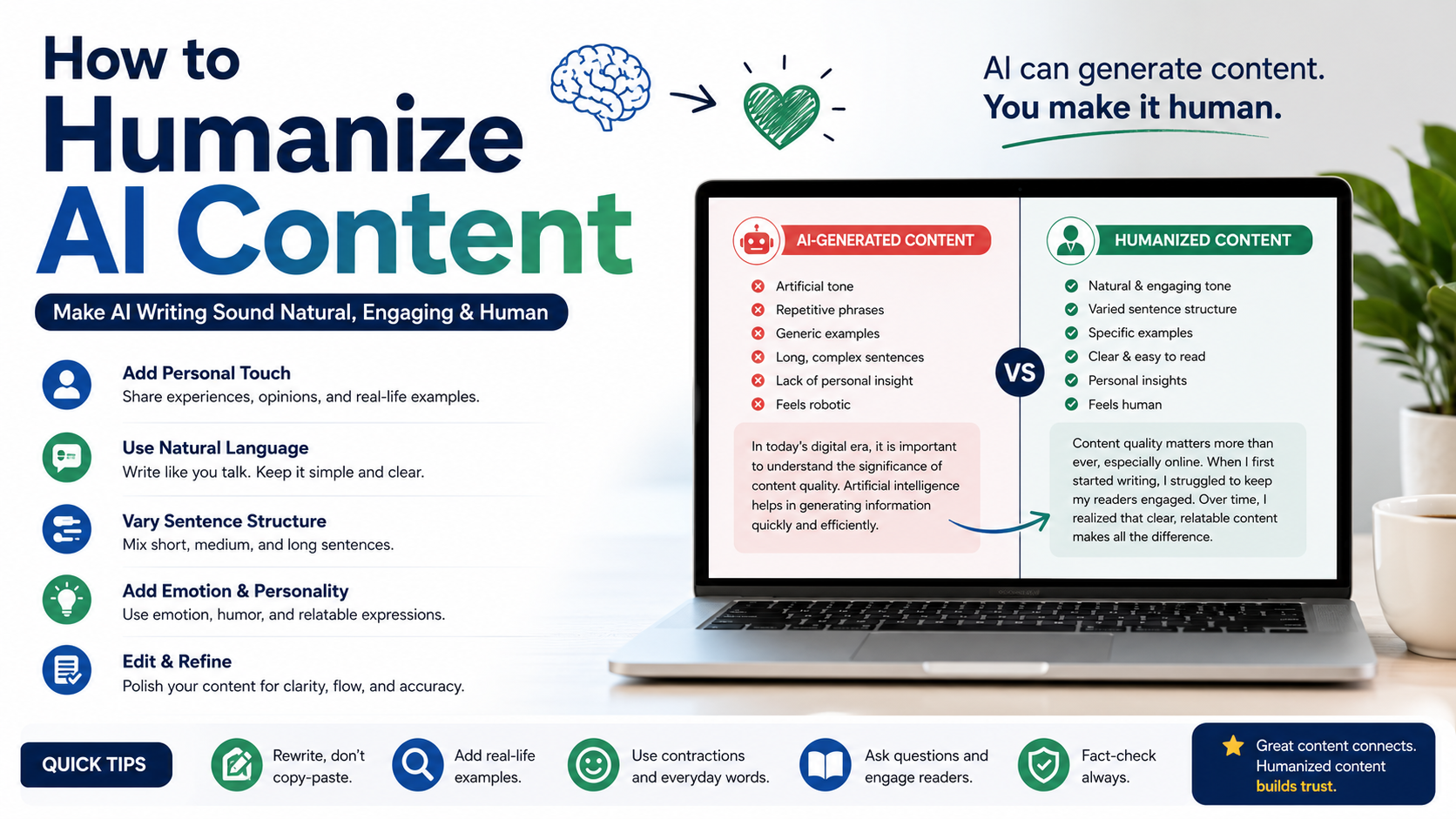
Readers can quickly recognize robotic writing through repetitive phrases, overly formal language, generic examples, and predictable sentence structures. Search engines are also becoming better at identifying low-quality, AI-generated content that offers little value to users.
This raises an important question:
How can you make AI-generated content sound more natural, engaging, and authentic?
The answer lies in humanizing AI content. Rather than copying AI-generated text directly, you should refine it by adding personality, real-life insights, varied sentence structures, and a conversational tone.
In this guide, you'll learn why humanizing AI content matters, common mistakes to avoid, and practical strategies to transform robotic writing into content that connects with readers.
Quick Answer
To humanize AI content, rewrite it using natural language, vary sentence lengths, add personal insights or examples, remove repetitive phrases, simplify complex wording, and edit the content to reflect your own voice. The goal is to make the writing sound like it was created by a knowledgeable person rather than generated by a machine.
What Is AI Content?
AI content refers to text generated using artificial intelligence tools such as ChatGPT, Gemini, Claude, or Microsoft Copilot. These tools use large language models to produce articles, essays, emails, product descriptions, and many other types of written content based on user prompts.
AI can create high-quality drafts in seconds, making it a valuable writing assistant. However, AI-generated text often requires human editing to improve clarity, originality, and engagement.
Why Does AI Content Sound Robotic?
Although AI has become increasingly sophisticated, it still lacks genuine human experiences, emotions, and creativity.
Common characteristics of robotic AI writing include:
-
Repetitive sentence structures
-
Overuse of transition words
-
Generic examples
-
Lack of personal perspective
-
Predictable vocabulary
-
Long, overly formal paragraphs
-
Excessive keyword repetition
These patterns make content feel artificial rather than engaging.
Why Humanizing AI Content Matters
Humanized content offers several benefits:
-
Builds trust with readers
-
Improves readability
-
Increases engagement
-
Enhances SEO performance
-
Reduces the likelihood of AI detection
-
Reflects your unique voice and expertise
Ultimately, people prefer reading content that feels authentic and relatable.
15 Proven Ways to Humanize AI Content
1. Rewrite the Introduction
AI introductions often sound generic. Replace them with a compelling question, interesting statistic, or relatable scenario that captures the reader's attention.
2. Use Conversational Language
Write the way people naturally speak.
Instead of:
Furthermore, it is imperative to acknowledge...
Try:
It's important to remember...
Simple language is easier to understand and feels more natural.
3. Vary Sentence Length
AI frequently produces sentences of similar length.
Mix short, medium, and longer sentences to create a natural rhythm.
Example:
AI is incredibly useful. But it isn't perfect. Without editing, the content can sound repetitive and impersonal, making readers lose interest.
4. Add Personal Insights
Whenever appropriate, include your own observations, experiences, or opinions.
For example:
In my experience, spending just 15 minutes editing AI content dramatically improves readability.
Personal perspectives make content more authentic.
5. Include Real-World Examples
Concrete examples help readers understand concepts more easily.
Instead of saying:
Businesses use AI.
Write:
Many businesses use AI to draft marketing emails, write product descriptions, and generate social media posts.
Specific examples improve credibility.
6. Remove Repetitive Words
AI often repeats phrases like:
-
Furthermore
-
Moreover
-
Additionally
-
In conclusion
Replace repetitive transitions with smoother alternatives or remove them entirely.
7. Simplify Complex Sentences
Avoid unnecessarily complicated wording.
Instead of:
Organizations should endeavor to optimize operational efficiencies.
Write:
Companies should improve how they work.
Clear writing is more effective than complicated writing.
8. Add Emotion
Human writing reflects emotion.
Use words that convey curiosity, excitement, concern, or confidence where appropriate.
For example:
Many students feel overwhelmed when facing multiple assignment deadlines.
This creates an emotional connection with readers.
9. Ask Questions
Questions encourage readers to think and stay engaged.
Examples include:
-
Have you ever noticed how AI writing can sound repetitive?
-
What would happen if you published AI content without editing it?
Questions make content more interactive.
10. Use Active Voice
Active voice sounds more direct and engaging.
Instead of:
The article was written by AI.
Write:
AI wrote the article.
Active sentences improve readability.
11. Break Up Long Paragraphs
Large blocks of text can overwhelm readers.
Aim for paragraphs of two to four sentences, especially for online content.
Short paragraphs improve readability on mobile devices.
12. Add Original Research or Data
Support your content with trustworthy statistics, studies, or expert opinions.
Reliable information builds authority and demonstrates expertise.
13. Match Your Brand Voice
Whether your tone is professional, friendly, or academic, ensure every article reflects a consistent voice.
Consistency helps build trust with your audience.
14. Fact-Check Everything
AI occasionally generates inaccurate or outdated information.
Always verify:
-
Statistics
-
Dates
-
Laws
-
Academic references
-
Company information
-
Technical details
Accuracy is essential for credibility.
15. Edit Thoroughly
Never publish AI-generated content without reviewing it.
Check for:
-
Grammar
-
Clarity
-
Flow
-
Originality
-
Relevance
-
Tone
-
Readability
Editing transforms a rough draft into polished content.
Common Mistakes to Avoid
Many writers make these mistakes when using AI:
-
Publishing AI output without editing
-
Overusing keywords
-
Ignoring factual errors
-
Writing overly formal content
-
Adding unnecessary filler
-
Using repetitive transitions
-
Forgetting to cite reliable sources
-
Neglecting proofreading
Avoiding these issues significantly improves content quality.
AI vs Humanized Content
Best Tools to Help Humanize AI Content
Several tools can assist with editing and improving AI-generated text:
-
Grammarly
-
Hemingway Editor
-
QuillBot
-
ProWritingAid
-
LanguageTool
Remember, these tools assist with editing but cannot replace thoughtful human review.
Is Humanized AI Content Good for SEO?
Yes—provided it delivers genuine value to readers.
Search engines prioritize content that is:
-
Helpful
-
Accurate
-
Original
-
Well-structured
-
Easy to read
-
Demonstrates expertise
Simply rewriting AI text without adding meaningful insights is unlikely to perform well in search results.
Final Thoughts
AI has become an invaluable writing assistant, but it should not replace human creativity, critical thinking, or expertise. The best content is created through collaboration: AI provides a strong first draft, while human writers refine it with original ideas, accurate information, and a natural voice.
If you want your content to rank well, engage readers, and build trust, don't rely solely on AI output. Edit thoughtfully, add meaningful insights, and write with your audience in mind.
In the end, the goal isn't to hide the use of AI—it's to create content that is genuinely useful, authentic, and enjoyable to read.
Frequently Asked Questions
Everything you need to know about our services


