The Value of Structured Dissertation Feedback Before Submission
Introduction
Writing a dissertation is rarely a straightforward process. Even after months of research, countless revisions, and meetings with your supervisor, many students still wonder whether their dissertation is truly ready for submission.
One reason is that writing and evaluating a dissertation require different skills.
As the author, you know what you intended to communicate. An academic reviewer, however, evaluates only what appears on the page. If your argument isn't clear, your structure is inconsistent, or your critical analysis is underdeveloped, those issues can affect how your work is assessed.
This is where structured dissertation feedback becomes valuable.
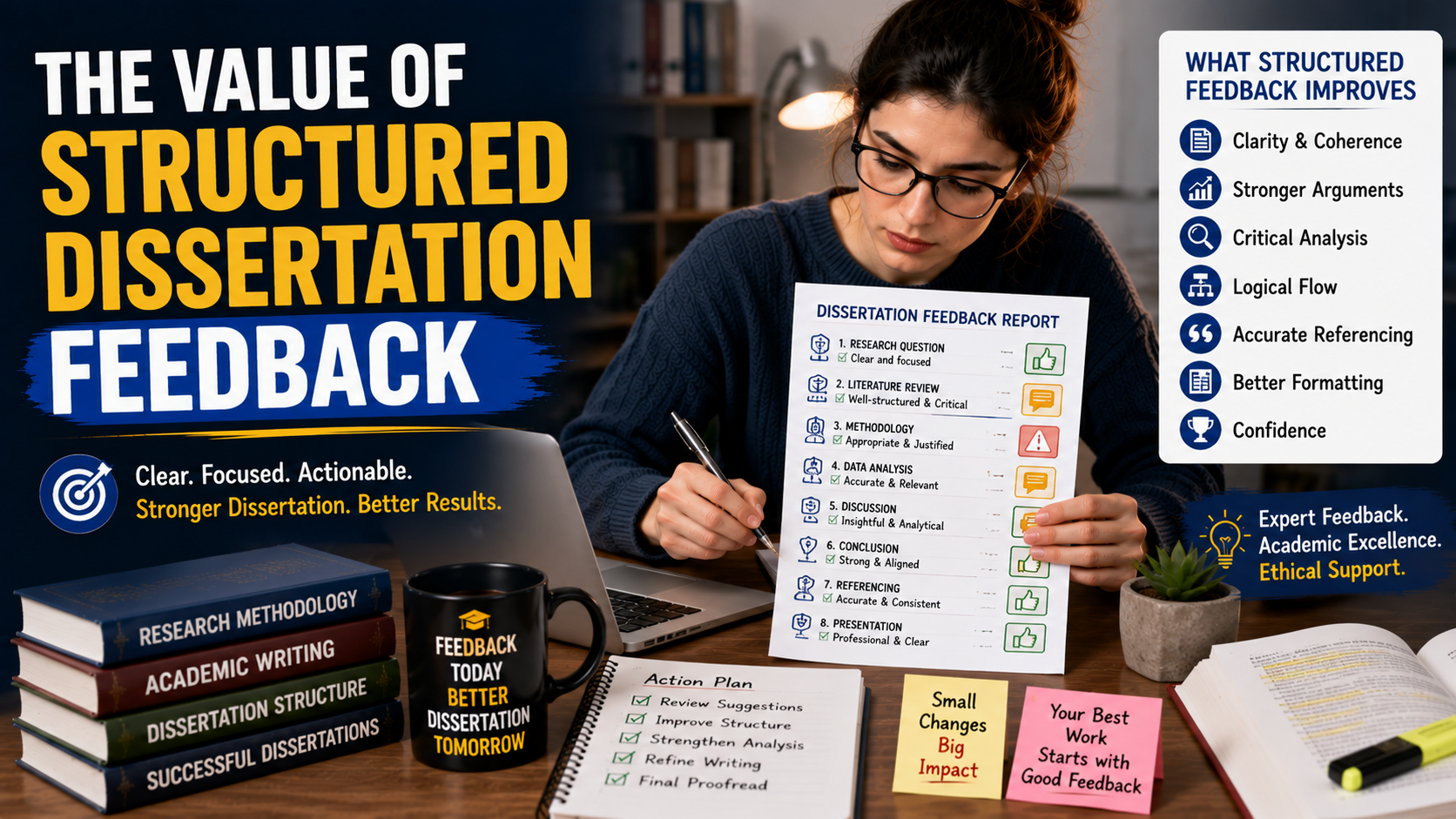
Rather than offering vague comments such as "improve this chapter" or "expand your discussion," structured feedback systematically reviews each part of the dissertation against recognised academic standards.
In this guide, you'll learn what structured dissertation feedback includes, why it matters, and how ethical academic guidance can help strengthen your own original work before submission.
What Is Structured Dissertation Feedback?
Structured dissertation feedback is a comprehensive academic review that examines every major component of a dissertation instead of focusing on isolated grammar or formatting issues.
A structured review considers:
Research question
Dissertation structure
Literature review
Research methodology
Data analysis
Discussion chapter
Conclusion
Academic writing
Referencing
Presentation and formatting
The goal is to provide organised, constructive comments that help students improve the quality of their own research.
Why General Feedback Isn't Always Enough
Many students receive useful comments from supervisors, but these comments are often brief due to time constraints.
Examples include:
"Develop this argument."
"Needs more critical analysis."
"Clarify your methodology."
"Improve the discussion."
Although helpful, these comments don't always explain how improvements can be made.
Structured feedback expands on these observations and identifies practical areas for revision.
What Structured Dissertation Feedback Usually Evaluates
1. Research Question
A reviewer considers whether the dissertation consistently addresses the stated research question and whether the objectives remain focused throughout the study.
2. Literature Review
A structured review examines whether the literature review:
Critically evaluates previous research.
Identifies knowledge gaps.
Compares different viewpoints.
Supports the research objectives.
3. Research Methodology
Feedback often considers:
Suitability of the chosen methodology.
Justification for research methods.
Sampling strategy.
Data collection techniques.
Ethical considerations.
Reliability and validity.
4. Data Analysis
The reviewer checks whether:
Results are presented clearly.
Analysis supports the research question.
Findings are interpreted correctly.
Conclusions follow logically from the evidence.
5. Discussion Chapter
The discussion should explain:
What the findings mean.
How they compare with previous studies.
Why they matter.
What limitations exist.
Weak discussion chapters often lose marks despite strong research.
6. Conclusion
A strong conclusion should:
Answer the research question.
Summarise key findings.
Avoid introducing new evidence.
Provide realistic recommendations.
Reflect on research limitations.
7. Academic Writing
Structured feedback also reviews:
Clarity.
Formal academic tone.
Logical flow.
Paragraph structure.
Sentence readability.
Consistent terminology.
8. Referencing
Accurate referencing is essential for academic credibility.
A reviewer checks:
Citation consistency.
Reference formatting.
Missing sources.
Incorrect in-text citations.
Style compliance (Harvard, APA, OSCOLA, MLA, Chicago, IEEE).
9. Formatting
Presentation influences readability.
A structured review checks:
Heading hierarchy.
Tables.
Figures.
Page numbering.
Margins.
Spacing.
Appendix formatting.
Benefits of Structured Feedback
Students often notice improvements in:
Dissertation organisation.
Critical thinking.
Academic confidence.
Logical argument development.
Research clarity.
Writing quality.
Overall readability.
Submission readiness.
Common Problems Identified During Reviews
Structured feedback frequently identifies issues such as:
Repetitive arguments.
Weak transitions.
Missing evidence.
Unclear methodology.
Unsupported conclusions.
Poor chapter flow.
Referencing inconsistencies.
Formatting errors.
These problems are often difficult for authors to recognise because they have become highly familiar with their own writing.
Why Timing Is Important
The most useful feedback is usually received before the final submission deadline.
Students often benefit from a structured review after:
Completing the first full draft.
Finishing the literature review.
Completing the discussion chapter.
Responding to supervisor comments.
Preparing the final submission version.
Waiting until the final day leaves little opportunity for meaningful improvement.
Can AI Replace Structured Feedback?
AI tools can support:
Grammar.
Readability.
Sentence refinement.
Organisation.
Brainstorming.
However, AI cannot reliably determine:
Whether arguments are convincing.
If the research design is appropriate.
Whether critical analysis meets postgraduate standards.
How well the dissertation aligns with university marking criteria.
AI works best alongside human academic judgement.
How AssignmentCart Can Help
AssignmentCart provides ethical academic support designed to help students strengthen their dissertations before submission.
Our services include:
Structured dissertation feedback.
Chapter-by-chapter academic review.
Dissertation editing.
Professional proofreading.
Literature review guidance.
Research methodology support.
Critical analysis suggestions.
Referencing checks (Harvard, APA, OSCOLA, MLA, Chicago & IEEE).
Formatting review.
Confidential student support.
Our role is to help students improve the clarity, organisation, and academic quality of their own original work while respecting university academic integrity policies.
Make Every Chapter Stronger Before Submission
Your dissertation represents months of research, effort, and independent learning. A structured academic review helps ensure that your ideas are communicated clearly, your arguments remain logical, and your presentation reflects the quality of your research.
Rather than relying on assumptions, structured dissertation feedback provides organised recommendations that can help you refine your work before submission.
If you're preparing your dissertation for final submission, AssignmentCart's Dissertation Help service offers ethical academic guidance designed to help you strengthen your dissertation with confidence.
Why Students Choose AssignmentCart
Experienced dissertation specialists.
Structured academic feedback.
Ethical academic guidance.
Editing and proofreading experts.
Research methodology support.
Referencing assistance.
Confidential communication.
Fast turnaround options for eligible requests.
👉 Visit our services page today and request structured dissertation feedback before your submission deadline.
Final Thoughts
Strong dissertations are rarely produced in a single draft. They improve through careful revision, thoughtful reflection, and constructive feedback. Structured dissertation feedback provides a systematic way to evaluate your work, helping you identify weaknesses, strengthen arguments, and present your research more effectively before submission.
By combining your own independent research, supervisor guidance, and ethical academic support, you can submit a dissertation that demonstrates both academic rigour and confidence.
Frequently Asked Questions
Everything you need to know about our services
Related Posts

Why Students Seek Expert Dissertation Feedback Before Submission

Why Most Dissertation Conclusions Cost Students Marks (And How to Avoid It)

Why Your Literature Review Isn't Strong Enough (And How to Fix It)
