Open University Assignment Writing Guide (2026 Complete Guide)
Introduction
Studying with the Open University gives students the flexibility to earn a recognised qualification while balancing work, family, and personal commitments. However, distance learning also requires strong self-discipline, effective time management, and excellent academic writing skills. Unlike traditional universities, Open University students complete much of their learning independently, making assignments a crucial part of the assessment process.
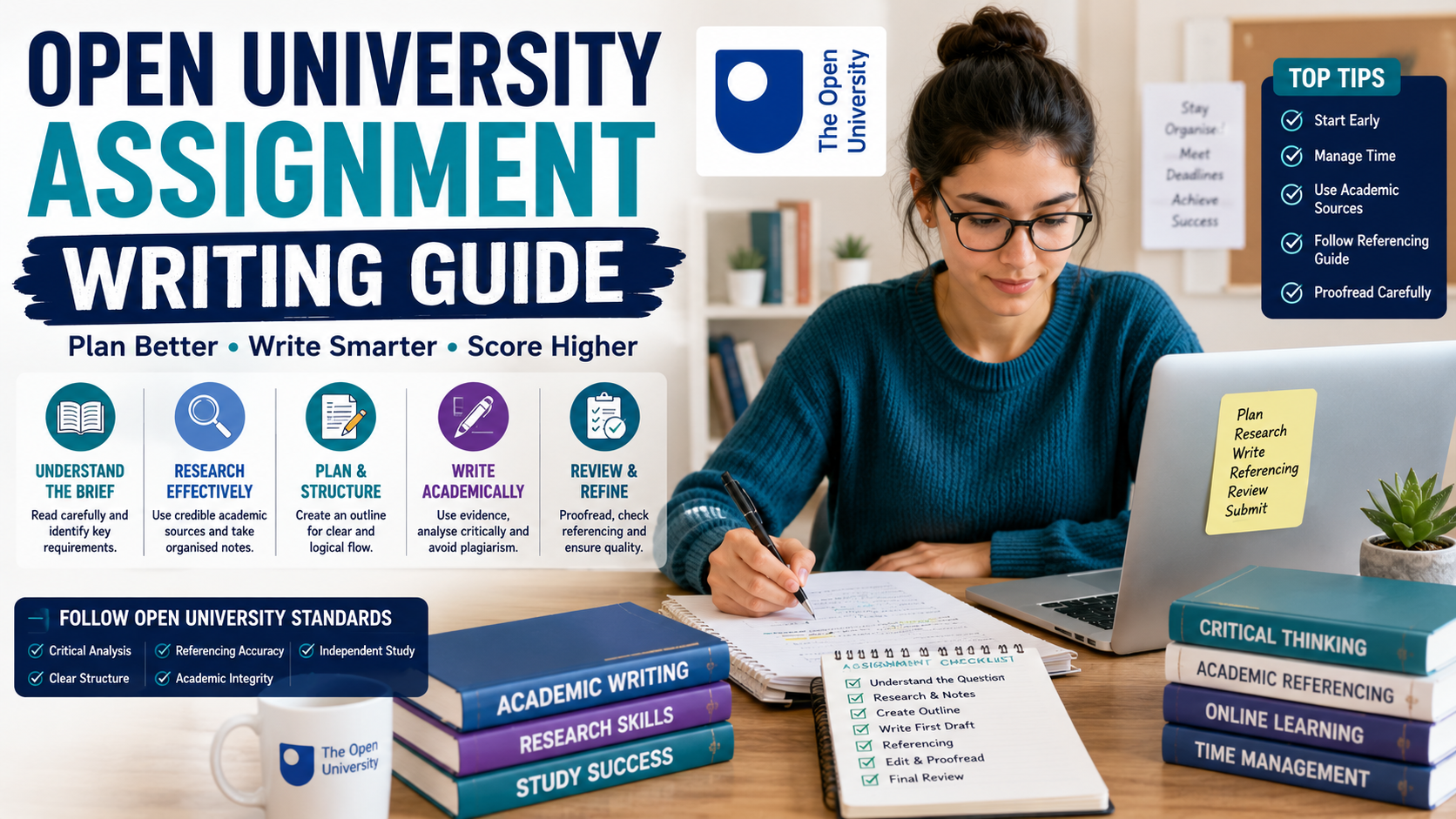
Whether you are writing your first Tutor-Marked Assignment (TMA), an End-of-Module Assessment (EMA), or another coursework task, understanding how to approach academic writing can significantly improve your grades.
This guide explains every stage of writing an Open University assignment—from understanding the assignment brief and conducting research to structuring your work, referencing sources, and proofreading before submission.
What Is an Open University Assignment?
An Open University assignment is an academic assessment used to evaluate your understanding of course materials and your ability to apply knowledge, analyse evidence, and communicate ideas effectively.
Depending on your module, assignments may include:
Tutor-Marked Assignments (TMAs)
End-of-Module Assessments (EMAs)
Essays
Reports
Case studies
Reflective writing
Literature reviews
Research projects
Presentations
Each assessment is designed to measure specific learning outcomes outlined in your module.
Why Assignment Writing Is Important
Assignments contribute significantly to your overall module grade.
More importantly, they help you develop valuable skills such as:
Critical thinking
Academic research
Problem-solving
Evidence-based writing
Referencing
Professional communication
Independent learning
Strong assignment writing skills benefit both your academic studies and future career.
Understand the Assignment Brief
Before writing anything, carefully read the assignment instructions.
Pay attention to:
Assessment question
Word count
Submission deadline
Learning outcomes
Marking criteria
Referencing style
Required structure
Highlight directive words such as:
Analyse
Evaluate
Compare
Discuss
Critically assess
Explain
Justify
These command words indicate what your tutor expects you to demonstrate.
If you misunderstand the question, even excellent writing may not score well.
Identify the Learning Outcomes
Every Open University assignment is linked to specific learning outcomes.
Ask yourself:
What knowledge should I demonstrate?
Which theories should I apply?
What evidence should support my arguments?
What skills are being assessed?
Your assignment should clearly address these outcomes throughout every section.
Plan Before You Write
Many students lose marks because they begin writing immediately without planning.
Instead:
Step 1
Read the assignment brief carefully.
Step 2
Review the module materials.
Step 3
Identify key topics.
Step 4
Research supporting evidence.
Step 5
Create an outline.
Planning first produces a more organised and logical assignment.
Create an Assignment Outline
An outline provides direction while writing.
A typical academic assignment includes:
Introduction
Introduce the topic, explain the purpose, and outline what the assignment will discuss.
Main Body
Present evidence, theories, examples, and critical analysis using clear headings where appropriate.
Conclusion
Summarise the key findings without introducing new information.
References
List every source cited in the assignment using the required referencing style.
Conduct Academic Research
Although Open University provides extensive learning materials, additional academic research often strengthens assignments.
Use credible sources such as:
Peer-reviewed journals
Academic books
Government publications
Professional organisations
University library resources
Avoid relying solely on blogs or unverified websites.
Always evaluate the reliability and relevance of each source before including it.
Take Organised Research Notes
While reading academic sources, record:
Key arguments
Supporting evidence
Useful quotations
Publication details
Page numbers
Keeping organised notes saves significant time when writing references later.
Write a Strong Introduction
Your introduction should:
Introduce the topic.
Provide context.
Explain the purpose of the assignment.
Briefly outline the structure.
Avoid lengthy background information.
Aim to keep the introduction focused and concise.
Develop Clear Academic Paragraphs
Each paragraph should focus on one main idea.
A useful structure is:
Point
Introduce the main argument.
Evidence
Support the argument using credible academic sources.
Analysis
Explain why the evidence is important.
Link
Connect the paragraph to the next idea.
This approach creates logical flow throughout the assignment.
Demonstrate Critical Analysis
Open University assignments usually require more than description.
Instead of simply explaining information, evaluate it.
Consider questions such as:
Why is this theory important?
What evidence supports it?
Are there alternative viewpoints?
What are the strengths and weaknesses?
Critical analysis demonstrates deeper understanding.
Support Arguments with Evidence
Academic writing should be evidence-based.
Support your arguments using:
Journal articles
Books
Module materials
Professional reports
Government publications
Avoid making unsupported personal opinions.
Every important claim should be backed by reliable evidence.
Use Academic Language
Academic writing should be:
Clear
Formal
Objective
Precise
Avoid:
Slang
Informal expressions
Emotional language
Unsupported opinions
Simple, professional language is usually more effective than overly complex vocabulary.
Manage Your Time Effectively
Distance learning requires excellent organisation.
A simple assignment schedule might include:
Week | Task |
|---|---|
Week 1 | Understand the assignment and begin research |
Week 2 | Collect academic sources and prepare an outline |
Week 3 | Write the first draft |
Week 4 | Edit, proofread, and submit |
Starting early allows enough time for revision and feedback.
Common Assignment Writing Mistakes
Many students lose marks because they:
Misinterpret the assignment question.
Ignore the marking criteria.
Use insufficient academic evidence.
Write descriptively instead of critically.
Forget to reference sources correctly.
Leave proofreading until the submission day.
Exceed the word count significantly.
Avoiding these mistakes can improve assignment quality considerably.
Proofread Carefully
Before submitting your assignment, check:
Grammar
Spelling
Sentence clarity
Referencing
Formatting
Word count
Consistency
Reading your work aloud often helps identify awkward sentences.
Use Tutor Feedback
Tutor feedback is one of the best learning resources available.
Review comments carefully to identify:
Strengths
Areas for improvement
Recurring mistakes
Suggestions for future assignments
Applying feedback consistently helps improve grades over time.
Final Thoughts
Writing successful Open University assignments requires more than simply answering a question. Strong assignments demonstrate careful planning, independent research, critical thinking, structured writing, and accurate referencing. By understanding the assignment brief, following the learning outcomes, using credible academic evidence, and managing your time effectively, you can produce work that meets university standards and reflects your knowledge and analytical skills.
Remember that academic writing is a skill developed through practice. Every assignment provides an opportunity to strengthen your research, organisation, and communication abilities. With consistent effort, thoughtful planning, and a willingness to learn from tutor feedback, you can continue improving your performance and achieve success throughout your Open University studies.
Frequently Asked Questions
Everything you need to know about our services
Related Posts

What Examiners Look for in a Distinction Assignment

UK University Marking Rubrics Explained: How Lecturers Grade Your Assignments
