UK University Marking Rubrics Explained: How Lecturers Grade Your Assignments
Introduction
Understanding university marking rubrics is one of the easiest ways to improve your assignment grades. Yet many students ignore the marking criteria until after they receive feedback and discover they have lost marks in unexpected areas.
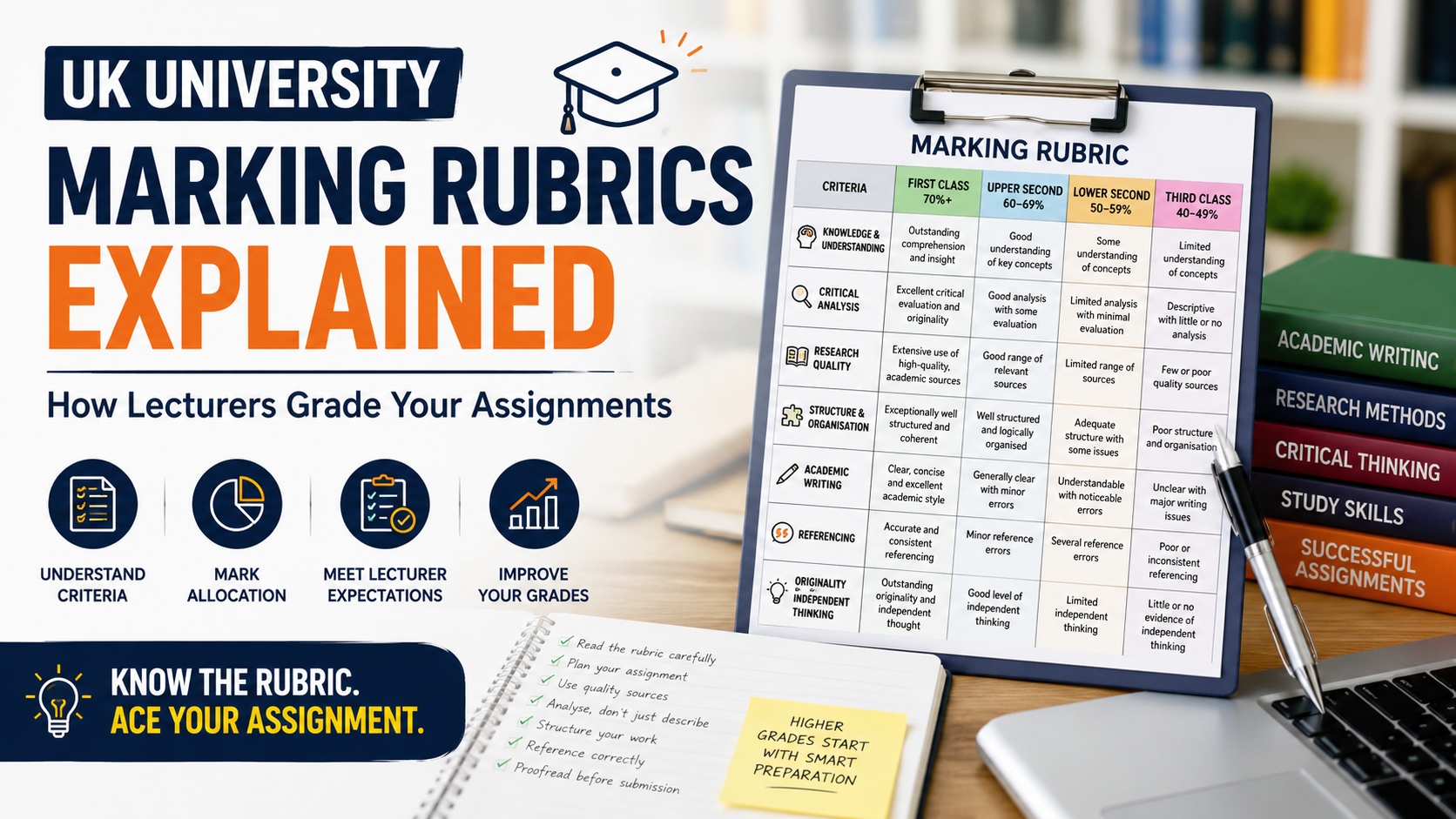
A marking rubric is essentially a guide that explains exactly how your work will be assessed. It tells lecturers what to look for and shows students how marks are allocated across different assessment criteria.
Whether you are studying at undergraduate or postgraduate level, learning how to use marking rubrics effectively can significantly improve your academic performance.
In this guide, you'll learn:
What Is a Marking Rubric?
A marking rubric is a structured assessment tool used by universities to evaluate student work fairly and consistently.
Rather than marking assignments based solely on personal judgement, lecturers compare submissions against predefined criteria.
These criteria often include:
-
Subject knowledge
-
Critical analysis
-
Research quality
-
Academic writing
-
Structure
-
Referencing
-
Originality
-
Presentation
Each area is usually assigned a weighting that contributes to the final grade.
Why Do UK Universities Use Marking Rubrics?
Marking rubrics help create consistency across modules and departments.
Without rubrics, students could receive very different grades depending on who marked their work.
Rubrics help ensure:
-
Fair assessment
-
Transparent grading
-
Consistent standards
-
Clear expectations
-
Useful feedback
They also allow students to understand exactly how their work will be evaluated before they begin writing.
Where Can You Find Your Marking Rubric?
Most UK universities provide marking rubrics through:
-
Blackboard
-
Moodle
-
Canvas
-
Student portals
-
Module handbooks
-
Assignment briefs
The rubric is usually available before the submission deadline.
Students who review it early often produce stronger assignments because they understand what lecturers expect.
How Lecturers Use Marking Rubrics
When assessing an assignment, lecturers compare the work against each assessment criterion.
Instead of simply deciding whether an assignment is "good" or "bad," they evaluate how effectively it meets specific standards.
For example:
A lecturer may assess:
-
Quality of analysis
-
Depth of research
-
Academic argument
-
Use of evidence
-
Referencing accuracy
Marks are then awarded according to the performance level described within the rubric.
Common Sections Found in UK Marking Rubrics
Although every university has its own assessment framework, most marking rubrics contain similar categories.
1. Knowledge and Understanding
This criterion measures how well you understand the topic.
Lecturers assess whether you:
-
Understand key theories
-
Explain concepts accurately
-
Demonstrate subject knowledge
-
Apply relevant ideas
Strong assignments show a thorough understanding of the topic rather than simply repeating information.
2. Critical Analysis
Critical analysis is often one of the highest-weighted criteria.
Students are expected to:
-
Evaluate evidence
-
Compare viewpoints
-
Challenge assumptions
-
Discuss strengths and weaknesses
-
Justify conclusions
Assignments that only describe information typically score lower than those that critically engage with the material.
3. Research Quality
Lecturers assess the quality of sources used.
High-scoring assignments usually include:
-
Peer-reviewed journals
-
Academic books
-
Government reports
-
Professional publications
Using reliable evidence strengthens credibility and improves grades.
4. Structure and Organisation
A well-structured assignment is easier to read and assess.
Lecturers look for:
-
Clear introduction
-
Logical progression
-
Effective headings
-
Strong paragraphing
-
Coherent conclusion
Poor organisation often makes even strong research appear weaker.
5. Academic Writing
Academic writing is another important criterion.
Lecturers evaluate:
-
Grammar
-
Clarity
-
Formal tone
-
Sentence structure
-
Academic style
Strong writing improves communication and enhances overall quality.
6. Referencing
Referencing demonstrates academic integrity.
Common referencing styles include:
-
Harvard
-
APA
-
MLA
-
OSCOLA
-
Chicago
Marks can be lost for:
-
Missing citations
-
Incorrect formatting
-
Incomplete reference lists
7. Originality and Independent Thinking
Universities value independent thought.
Lecturers reward students who:
-
Develop their own arguments
-
Evaluate evidence critically
-
Reach reasoned conclusions
Assignments should not simply repeat information from sources.
Typical Marking Rubric Example
Many university marking rubrics allocate different weightings to assessment criteria. Understanding these weightings helps students focus their efforts on the areas that contribute most to the final grade.
| Assessment Area | Weighting |
| Knowledge and Understanding | 20% |
| Critical Analysis | 30% |
| Research Quality | 20% |
| Structure and Organisation | 10% |
| Academic Writing | 10% |
| Referencing | 10% |
📌 Important: In this example, Critical Analysis (30%) carries the greatest influence on the final mark. This means students who focus on evaluating evidence, comparing viewpoints, and developing independent arguments are often more likely to achieve higher grades than those who rely mainly on descriptive writing.
Understanding Grade Descriptors
Most marking rubrics describe performance levels.
For example:
First-Class (70%+)
-
Outstanding analysis
-
Excellent research
-
Independent thinking
-
Strong academic writing
Upper Second (60–69%)
-
Good understanding
-
Strong evidence
-
Effective structure
Lower Second (50–59%)
-
Competent work
-
Adequate research
-
Limited analysis
Third-Class (40–49%)
-
Basic understanding
-
Weak evidence
-
Significant weaknesses
These descriptors help lecturers grade assignments consistently.
How Students Should Use Marking Rubrics
Many students only look at rubrics after receiving feedback.
Instead, use the rubric before writing.
Review every criterion and ask:
-
What is being assessed?
-
How are marks allocated?
-
What distinguishes a First-Class grade?
This approach helps you write strategically rather than guessing lecturer expectations.
Turn the Rubric Into a Checklist
A useful strategy is converting each assessment criterion into a personal checklist.
Before submission, ask:
✔ Have I answered the question?
✔ Have I demonstrated critical analysis?
✔ Have I used academic sources?
✔ Is my structure logical?
✔ Is my referencing correct?
✔ Have I proofread carefully?
This process reduces avoidable mistakes.
Common Mistakes Students Make
Students frequently lose marks because they:
-
Ignore the rubric
-
Focus only on content
-
Use descriptive writing
-
Neglect critical analysis
-
Use weak sources
-
Reference incorrectly
-
Submit without proofreading
Many of these issues can be prevented by following the assessment criteria carefully.
Why Understanding Rubrics Improves Grades
Students who understand marking rubrics can:
-
Prioritise high-weighted criteria
-
Focus on lecturer expectations
-
Improve assignment quality
-
Reduce common errors
-
Produce stronger academic work
Simply understanding how marks are awarded can lead to noticeable grade improvements.
Key Takeaways
-
Marking rubrics explain how assignments are assessed.
-
They promote fairness and consistency.
-
Critical analysis is often the most heavily weighted criterion.
-
Research quality and academic writing matter significantly.
-
Students should use rubrics before writing, not after submission.
-
Turning the rubric into a checklist can improve grades.
Conclusion
UK university marking rubrics provide a roadmap for academic success. Rather than seeing them as administrative documents, students should treat them as guides that reveal exactly what lecturers expect.
By understanding the assessment criteria, focusing on critical analysis, using high-quality evidence, and reviewing work against the rubric before submission, students can significantly improve their assignment performance and achieve higher grades throughout university.
Frequently Asked Questions
Everything you need to know about our services


