Need an Assignment Finished Fast? Canadian Student Guide
Introduction
An assignment deadline can arrive faster than expected.
You may have lectures to attend, readings to complete, research to organise, and several assessments competing for your attention. Then you check your course portal and realise your assignment is due tomorrow—or even tonight.
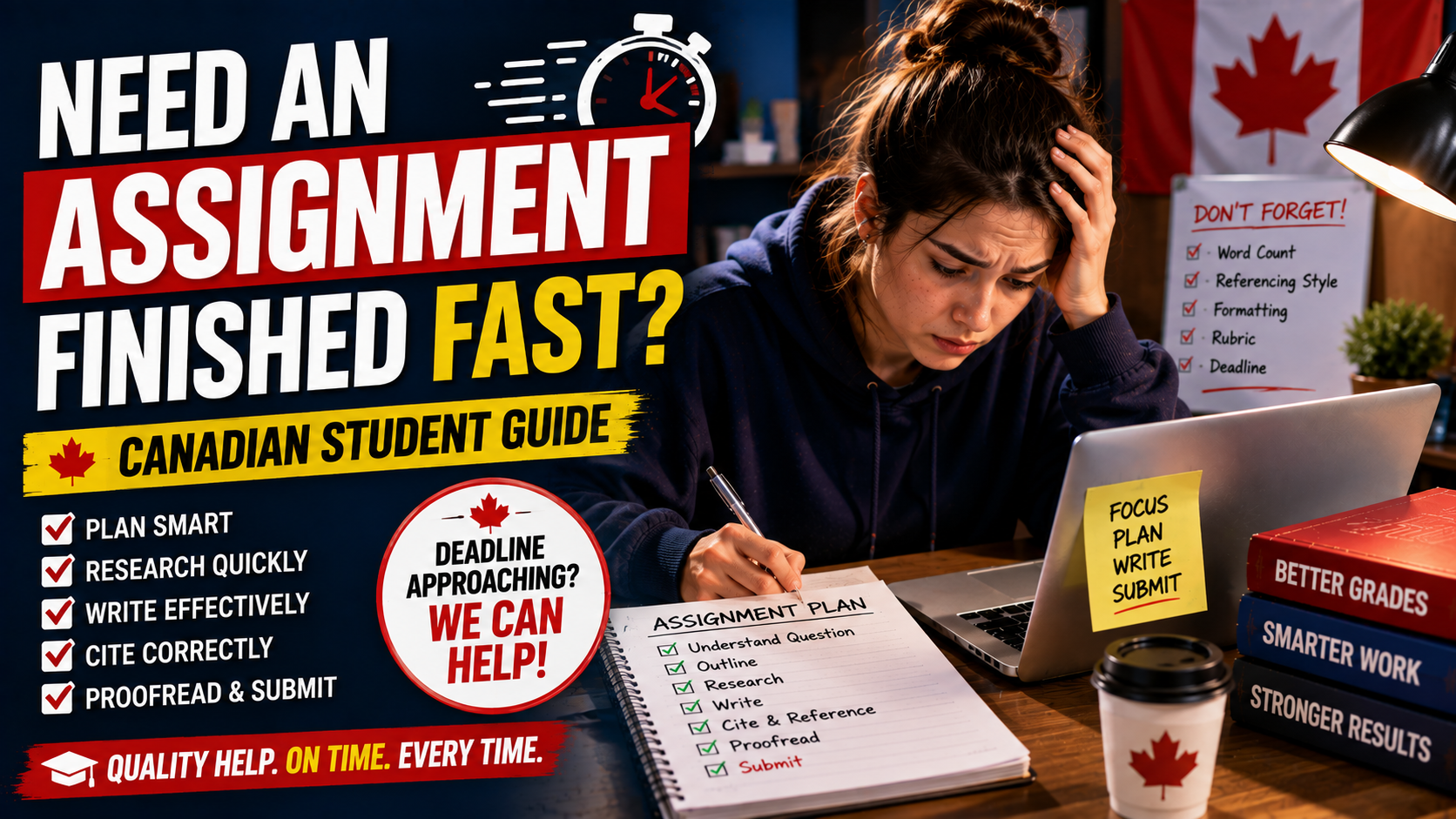
If you're a Canadian university or college student facing a tight deadline, the key is not to panic. A focused plan can help you identify what needs to be completed first, use your remaining time efficiently, and submit work that meets your course requirements.
This Canadian student guide to finishing an assignment fast explains what to do when your deadline is approaching, how to prioritise your work, when academic support may be useful, and what to check before submission.
What Should You Do If Your Assignment Is Due Soon?
When an assignment is due within a short timeframe, avoid trying to do everything simultaneously.
Start by identifying the essential requirements.
Check:
Assignment question
Word count
Submission deadline
Required format
Marking criteria
Referencing style
Required sources
Number of sections
Learning outcomes
Submission platform
Your course instructions should always take priority over general assignment-writing advice.
Once you understand the requirements, divide the assignment into smaller tasks.
For example:
Understand the question
Create a quick structure
Gather relevant sources
Develop your argument
Draft the main sections
Add citations
Write the conclusion
Edit and proofread
Check formatting
Submit
This makes a large assignment feel more manageable.
Assignment Due Tomorrow? Start Here
If your assignment is due tomorrow, you still need to be strategic.
Don't spend several hours searching for the "perfect" source before writing anything.
Instead, establish:
Your Main Question
What exactly is the assignment asking you to do?
Look for instruction words such as:
Analyse
Evaluate
Compare
Discuss
Critically assess
Examine
Explain
Reflect
These words indicate the type of response expected.
Your Main Argument
What is the central point you are trying to establish?
Even a short assignment should have a clear direction.
Your Evidence
Which academic sources support your main points?
Prioritise sources that directly relate to your question instead of collecting large numbers of sources that you may never use.
How to Finish an Assignment Fast
Step 1: Read the Assignment Question Carefully
Before opening a search engine or database, read the question several times.
Identify:
Topic
Scope
Key concepts
Required perspective
Instruction word
Time period
Geographic context
Required examples
For example, "Critically evaluate" requires a different approach from simply "describe."
Understanding the question correctly can save significant time later.
Step 2: Check the Marking Rubric
If your instructor provided a rubric, read it before writing.
The rubric may explain how marks are allocated for:
Knowledge
Analysis
Critical thinking
Research
Structure
Referencing
Presentation
Evidence
Use these criteria as a checklist while working.
Step 3: Create a Simple Structure
Don't begin with a blank document and immediately start writing paragraphs.
Create a basic outline first.
For an essay, you might use:
Introduction
Background
Topic
Central argument
Essay direction
Body Paragraph 1
Main point
Evidence
Analysis
Body Paragraph 2
Main point
Evidence
Analysis
Body Paragraph 3
Main point
Evidence
Analysis
Conclusion
Main argument
Key findings
Final response to the question
The exact structure depends on your assignment type.
Step 4: Find Relevant Academic Sources
Use appropriate academic sources rather than relying entirely on general websites.
Depending on your institution and subject, useful resources may include:
University library databases
Peer-reviewed journal articles
Academic books
Government publications
Official institutional reports
Scholarly databases
Search using combinations of your key concepts.
For example, instead of searching:
climate change
try a more specific search such as:
climate change consumer behaviour Canada
The more specific search can make it easier to identify relevant literature.
Step 5: Don't Collect Too Many Sources
When time is limited, source quality matters more than quantity.
For each source, ask:
Is it relevant?
Is it credible?
Does it directly support my point?
Can I explain why it matters?
You don't need to fill your reference list with sources that don't contribute to your argument.
Step 6: Build a Quick Evidence Table
A simple evidence table can save time.
Source | Main Finding | How It Helps |
|---|---|---|
Source A | Key finding | Supports Point 1 |
Source B | Alternative finding | Provides comparison |
Source C | Limitation | Supports critical analysis |
Source D | Recent evidence | Updates discussion |
This helps you remember why you selected each source.
How to Write Faster Without Sacrificing Clarity
Writing quickly doesn't mean writing carelessly.
One useful approach is to separate drafting from editing.
During your first draft, focus on getting your ideas onto the page.
Don't stop every few sentences to fix minor punctuation.
You can return to language corrections later.
Use a Paragraph Framework
A useful academic paragraph can follow:
Point → Evidence → Explanation → Analysis → Link
For example:
Point: Introduce the main argument.
Evidence: Support it with relevant academic research.
Explanation: Explain what the evidence demonstrates.
Analysis: Evaluate its significance, limitations, or implications.
Link: Connect the discussion back to the assignment question.
This structure can help prevent paragraphs from becoming collections of unrelated information.
Don't Confuse Summary With Analysis
One of the biggest problems students encounter is writing too much description.
For example:
Smith (2023) found that students experienced increased academic pressure.
That reports what the source found.
Analysis asks what the finding means.
For example:
Smith's (2023) findings suggest that academic pressure may influence student behaviour, although the study's sample characteristics may limit how broadly the results can be applied.
The second approach demonstrates greater engagement with the evidence.
Your exact interpretation should always reflect what the source actually supports.
Assignment Due Tonight? Prioritise
If your deadline is only a few hours away, you need a different strategy.
Focus on the highest-impact tasks.
Priority 1: Answer the Question
Make sure your assignment actually responds to the question.
Priority 2: Complete the Required Structure
Don't leave major sections unfinished.
Priority 3: Add Relevant Evidence
Support important academic claims with appropriate sources.
Priority 4: Add Citations
Record your citations while writing instead of trying to reconstruct them later.
Priority 5: Write the Conclusion
Don't leave the conclusion until the final minute if possible.
Priority 6: Proofread
Check obvious grammar, spelling, punctuation, and formatting issues.
Priority 7: Submit
Confirm that the correct file has been uploaded to the correct submission area.
What If You Haven't Started Your Assignment?
If the deadline is very close and you haven't started, begin with the question rather than trying to research everything.
Spend a short amount of time identifying:
What the question asks
What position you might take
What evidence you need
How many main sections you need
Then create a basic outline.
A rough structure is much easier to improve than a blank page.
What If You Have Research but No Writing?
This is a common situation.
You may have dozens of browser tabs, PDFs, notes, and highlighted passages but no actual assignment.
Stop researching temporarily.
Create your structure and begin assigning evidence to each section.
For each source, write a short note:
What does this source contribute to my argument?
If you can't answer that question, the source may not be necessary.
What If Your Assignment Is Almost Finished?
If the content is already complete, don't start rewriting everything.
Instead, move into final-review mode.
Check:
Assignment question
Argument
Structure
Evidence
Citations
References
Word count
Formatting
Grammar
Spelling
Submission requirements
A final quality check can be more valuable than unnecessary rewriting.
Fast Assignment Help: What Can Academic Support Include?
Students sometimes use academic support when they are struggling with a tight deadline.
Legitimate academic support can include:
Assignment planning
Topic clarification
Research guidance
Source-finding guidance
Structure feedback
Academic writing feedback
Editing
Proofreading
Referencing guidance
Formatting checks
Study planning
The exact services available depend on the provider.
Students should also check their institution's academic-integrity policies before using external academic assistance.
Can Someone Help With an Urgent Assignment?
Urgent academic support may be available depending on:
Assignment length
Subject
Academic level
Deadline
Complexity
Required support
Provider availability
If you need support quickly, provide clear information about the assignment.
Useful details include:
Course or subject
Assignment type
Word count
Exact deadline
Academic level
Assignment question
Referencing style
University requirements
Current progress
The more specific the information, the easier it is to determine what type of support is appropriate.
How Much Does Urgent Assignment Help Cost?
There isn't one standard price for urgent academic support.
Costs can vary according to:
Word count
Subject
Academic level
Complexity
Deadline
Type of support
Turnaround time
For example, proofreading an existing 2,000-word assignment is very different from providing extensive feedback on a complex dissertation.
If you are considering a service, understand exactly what is included before paying.
Canadian University Assignment Deadlines
Canadian students study under different institutional policies and course structures.
Your university's official instructions should always be your primary source for:
Assignment deadlines
Extensions
Late submissions
Academic consideration
Formatting
Referencing
Academic integrity
Submission procedures
Don't assume that a policy at one Canadian university applies to another.
If an unexpected situation is affecting your ability to complete an assignment, check your institution's official procedures as soon as possible.
What If You Need an Extension?
If you genuinely cannot meet the deadline, don't wait until after the deadline to investigate your options.
Check whether your university or course provides procedures for:
Extensions
Academic consideration
Short-term accommodations
Late submission
Exceptional circumstances
The process varies between institutions and courses.
Use the official university website, course handbook, learning-management system, or appropriate academic department for the most accurate information.
How to Avoid Last-Minute Assignment Stress
The easiest assignment to finish quickly is usually the one you started early.
You don't need to complete everything weeks in advance.
Instead, break the project into milestones.
Several Days Before
Understand the question
Review the rubric
Create an outline
Begin research
Two Days Before
Complete the main research
Draft major sections
Check your argument
One Day Before
Finish the draft
Complete citations
Review references
Final Hours
Proofread
Check formatting
Confirm word count
Review submission requirements
Submit
Even a small amount of planning can significantly reduce last-minute pressure.
Quick Assignment Checklist for Canadian Students
Before submitting, ask:
Content
Did I answer the assignment question?
Is my main argument clear?
Did I use relevant evidence?
Did I provide sufficient analysis?
Does my conclusion answer the question?
Research
Are my sources relevant?
Are important claims supported?
Have I used appropriate academic sources?
Have I represented sources accurately?
Referencing
Are citations included?
Do citations match the reference list?
Is the required referencing style followed?
Are references complete?
Writing
Grammar checked
Spelling checked
Punctuation checked
Academic tone consistent
Repetition reduced
Paragraphs logically organised
Formatting
Correct word count
Correct headings
Correct spacing
Page numbers checked
Tables and figures checked
Required file format
Submission
Correct document selected
Correct submission portal
Deadline confirmed
Submission instructions followed
Confirmation saved
Emergency Assignment Strategy: The 60-Minute Final Review
If you have approximately one hour left after completing the assignment, use your time carefully.
First 10 Minutes: Assignment Requirements
Check:
Question
Word count
Required sections
Formatting
File type
Next 15 Minutes: Content
Check whether each section contributes to answering the question.
Next 15 Minutes: Citations
Review important claims and ensure citations are present.
Next 10 Minutes: References
Check the reference list for obvious inconsistencies.
Final 10 Minutes: Proofreading
Look for:
Spelling
Grammar
Punctuation
Repeated words
Formatting errors
Then save and submit the final version.
Common Mistakes When Finishing an Assignment Fast
Researching Forever
More research doesn't necessarily mean a better assignment.
Once you have enough relevant evidence to support your planned discussion, start writing.
Writing Without a Structure
A quick outline can save time later.
Leaving Citations Until the End
Trying to remember which source supports which statement can become difficult.
Record citations while drafting.
Ignoring the Rubric
The rubric tells you what your instructor is evaluating.
Use it as a final checklist.
Spending Too Long on the Introduction
The introduction should establish the topic and direction without consuming most of your available writing time.
Forgetting the Conclusion
Always leave enough time to complete the conclusion.
Making Major Changes at the Last Minute
Large revisions immediately before submission can introduce new inconsistencies.
Prioritise meaningful improvements.
When Should You Consider Professional Assignment Support?
Professional academic support may be worth considering when you need help with an existing academic task and require assistance such as:
Research guidance
Assignment structure
Academic editing
Proofreading
Referencing checks
Formatting
Feedback on clarity
Before using any external service, check your university's current academic-integrity rules.
The safest approach is to use support that helps you understand, improve, or review your own academic work rather than submitting someone else's work as your own.
What Information Should You Provide for Urgent Support?
If you're contacting an academic-support provider, give them the information they need immediately.
For example:
"I am a Canadian university student working on a 3,000-word business assignment due tomorrow at 11:59 p.m. The first draft is complete, and I need help reviewing the structure, academic clarity, citations, and formatting."
This is much more useful than simply saying:
"I need assignment help urgently."
Final Thoughts
When an assignment deadline is approaching, working faster doesn't mean skipping every quality check.
The most effective approach is to prioritise.
Understand the question, follow the rubric, create a simple structure, use relevant academic evidence, develop a clear argument, add citations as you write, and leave enough time for proofreading and submission checks.
If you need additional academic support, services such as research guidance, editing, proofreading, referencing assistance, and structure feedback may help you improve your existing work. Always make sure any support you use complies with your university's academic-integrity policies.
For Canadian students facing a tight deadline, the goal isn't simply to finish an assignment as quickly as possible.
The goal is to use your remaining time intelligently and submit your best completed work while following your institution's requirements.
Frequently Asked Questions
Everything you need to know about our services
Related Posts

Assignment Due Tomorrow? Emergency Assignment Help in Canada

Assignment Due Tonight? What Canadian Students Can Do
