Assignment Due Tonight? What Canadian Students Can Do
Introduction
An assignment due tonight can make even a normal study session feel overwhelming. You may still have research to complete, sections to write, references to organise, or a final draft that needs serious editing.
The good news is that having only a few hours left does not mean you should give up.
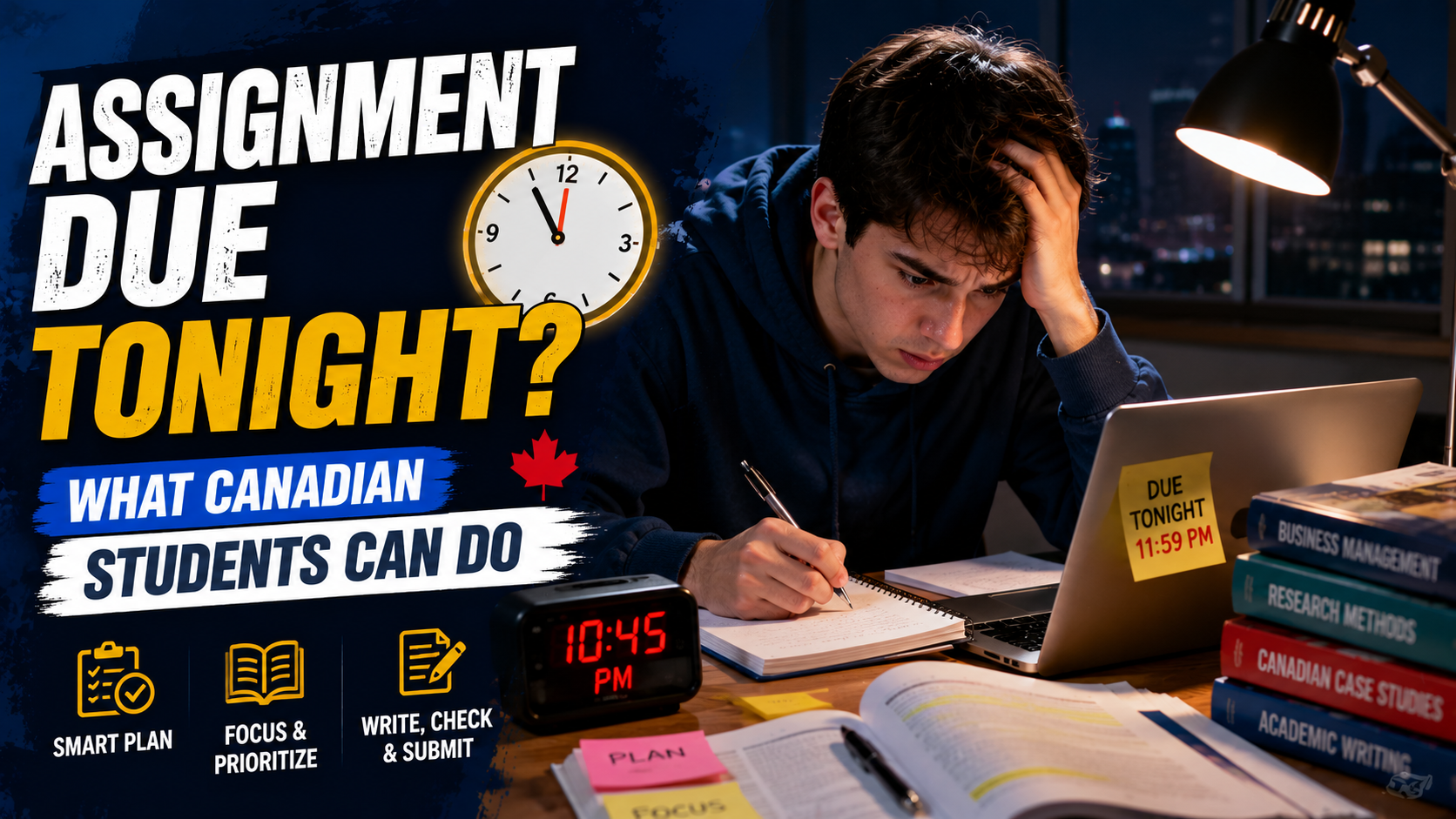
If your assignment is due tonight, the best approach is to stop trying to do everything at once. Instead, identify what matters most, create a realistic plan, and use the remaining time efficiently.
For Canadian university and college students, this guide explains what to do when an assignment deadline is only hours away and when professional academic support may be worth considering.
First: Don't Panic
When students realise an assignment is due in a few hours, the first reaction is often panic.
That can lead to:
Constantly changing the assignment structure
Spending too long researching minor points
Rewriting the same paragraph repeatedly
Ignoring the marking criteria
Forgetting references
Leaving submission until the final few minutes
Your goal tonight is not necessarily to create a perfect assignment.
Your goal is to submit the strongest academically appropriate work you can produce within the available time.
Start by identifying exactly what remains unfinished.
Step 1: Check Your Assignment Brief
Before writing another sentence, open the assignment instructions.
Look for:
Exact assignment question
Word count
Submission time
Required sections
Assessment criteria
Referencing style
Number or type of sources required
Formatting requirements
File type
Submission platform
This step is easy to overlook when you are stressed, but it can prevent avoidable mistakes.
For example, spending three hours writing an excellent response that does not address the actual question is far worse than spending a few minutes checking what your professor or course requires.
Step 2: Calculate How Much Time You Actually Have
Don't simply say, "I have tonight."
Work backwards from the exact deadline.
For example, if your assignment is due at 11:59 PM and it is currently 5:00 PM, you have approximately seven hours.
But you should not plan to work for all seven hours.
Leave time for:
Final proofreading
Formatting
Uploading
Technical problems
Submission confirmation
A simple emergency schedule might look like this:
Time Remaining | Task |
|---|---|
6–7 hours | Review brief and create a quick outline |
4–6 hours | Complete the main content |
3–4 hours | Improve analysis and supporting evidence |
2–3 hours | Complete references and formatting |
1–2 hours | Proofread and make final corrections |
Final 30–60 minutes | Upload and confirm submission |
Adjust the schedule according to the assignment and the amount of work you have already completed.
Step 3: Identify What You Already Have
You may not actually be starting from zero.
Ask yourself:
What is already finished?
You might have:
Research notes
Academic sources
A rough introduction
Several completed paragraphs
A draft conclusion
A partial bibliography
An outline
Lecture notes
Data or case-study information
Separate your work into three categories:
Completed
Leave these sections alone unless they contain obvious errors.
Partially Completed
Improve these sections first.
Not Started
Determine whether they are essential to meeting the assignment requirements.
This prevents you from wasting valuable time rewriting material that is already acceptable.
Step 4: Focus on the Assignment Question
When time is limited, stay focused.
Read the question again and identify the instruction words.
Common academic instruction words include:
Analyse
Evaluate
Discuss
Compare
Critically assess
Examine
Explain
Justify
Recommend
These words tell you what your assignment is expected to do.
For example, an assignment asking you to evaluate something generally requires more than simply describing it.
Similarly, a question asking you to compare two concepts requires you to establish similarities, differences, and their significance.
Make sure your paragraphs directly contribute to answering the question.
Step 5: Create a Fast Assignment Structure
If your assignment has little structure, create one before continuing.
For many essays, a basic structure might look like:
Introduction
Briefly introduce the topic, explain the purpose of the assignment, and establish the central argument or direction of the discussion.
Main Section 1
Introduce the first major argument or concept and support it with appropriate evidence.
Main Section 2
Develop the next argument and connect it to the assignment question.
Main Section 3
Provide further analysis, comparison, evaluation, or discussion.
Conclusion
Summarise the main findings and directly address the assignment question.
References
List the sources used according to the required referencing style.
Your actual structure should depend on your subject and assignment instructions.
Step 6: Don't Spend Hours Searching for Sources
Research can consume your entire evening if you are not careful.
When your deadline is tonight, focus on relevant, credible sources rather than collecting dozens of articles you will never use.
Useful sources may include:
Peer-reviewed journal articles
Academic books
Government publications
Official institutional reports
University resources
Professional organisations
Reputable research databases
Your university library can be particularly useful for finding scholarly material.
For every source you use, make sure you understand what claim it supports.
Avoid adding citations simply to make the reference list look longer.
Step 7: Write the Main Argument First
If you are struggling to begin, don't necessarily start with the introduction.
Write the strongest main section first.
You can then build the introduction around what you actually discuss.
A useful paragraph structure is:
Point → Evidence → Analysis → Connection
For example:
Make a clear point.
Support it with evidence.
Explain what the evidence means.
Connect it back to the assignment question.
This approach can help prevent paragraphs from becoming simple descriptions.
Step 8: Don't Chase Perfection
One of the biggest problems during an emergency deadline is perfectionism.
You might spend 45 minutes changing one sentence while another three pages still need to be written.
Instead, use two passes.
Pass One: Complete
Get the essential content onto the page.
Pass Two: Improve
Return to the assignment and improve:
Clarity
Grammar
Transitions
Evidence
Analysis
Referencing
Formatting
A complete draft gives you something to improve.
An unfinished "perfect" paragraph does not.
Step 9: Check Your References
A rushed assignment can easily contain referencing mistakes.
Before submitting, check:
Are important claims supported by sources?
Are in-text citations included where required?
Does every cited source appear in the reference list?
Are references formatted consistently?
Are publication details complete?
Are you using the referencing style required by your course?
Whether your institution requires APA, MLA, Chicago, OSCOLA, Vancouver, or another style, follow the specific requirements provided for your course.
Step 10: Use Editing and Proofreading Strategically
If your assignment is already written but feels rough, proofreading may provide more value than trying to rewrite everything.
Look for:
Grammar
Check sentence structure, verb agreement, punctuation, and spelling.
Clarity
Remove sentences that are unnecessarily complicated.
Repetition
Look for ideas that appear multiple times without adding anything new.
Flow
Check whether each paragraph naturally follows from the previous one.
Academic Style
Replace informal wording where appropriate and make sure your claims are precise.
Formatting
Check headings, spacing, page numbers, tables, figures, and other requirements.
If you have very little time, read your assignment from the beginning and look specifically for obvious errors rather than trying to make every sentence perfect.
What If You Still Can't Finish the Assignment?
Sometimes there simply isn't enough time.
You may have a large assignment, limited research, work commitments, or several deadlines at the same time.
In this situation, you have several options.
Ask Your Instructor or University
If an unexpected circumstance has genuinely affected your ability to complete the assessment, check your university's policies and contact the appropriate academic staff or student-support service.
Do not assume that an extension or accommodation is available. Follow your institution's actual process and requirements.
Ask for Academic Support
If you need help understanding the assignment, structuring your ideas, proofreading your draft, improving your references, or reviewing your academic writing, academic support services may be an option.
When contacting a provider, give them the exact:
Assignment question
Word count
Subject
Academic level
Deadline
Referencing style
Assignment requirements
Work you have already completed
The earlier you ask, the more realistic your options are likely to be.
Can You Get Emergency Assignment Help in Canada?
Depending on the provider, emergency assignment help in Canada may be available for students working with very short deadlines.
However, availability can vary based on:
Subject
Assignment length
Complexity
Deadline
Type of support required
Provider workload
A short proofreading request may be much easier to accommodate at short notice than a large research project requiring extensive work.
If your assignment is due tonight, provide the exact deadline rather than simply saying that it is "urgent."
What Types of Help Can Students Request?
Academic support can take several forms.
Proofreading
Useful when your assignment is already complete but needs a final language review.
Editing
Useful when your writing needs improvement in areas such as clarity, organisation, grammar, and flow.
Referencing Support
Useful when you are unsure whether citations and references follow the required style.
Structure Feedback
Useful when you have ideas and research but are unsure how to organise the assignment.
Research Guidance
Useful when you need help developing a more efficient strategy for finding and evaluating academic sources.
Formatting Support
Useful when your content is complete but the document does not meet the required presentation standards.
The appropriate type of support depends on what you have already completed.
What Canadian Students Should Avoid on the Final Night
When you have only a few hours left, avoid making the situation worse.
Don't Start Unnecessary Research
If you already have enough credible evidence to support your argument, don't spend hours collecting additional sources simply because you are worried you don't have enough.
Don't Rewrite Everything
If a paragraph answers the question and is reasonably clear, move forward.
Don't Ignore the Rubric
Your marking criteria can tell you where to spend your remaining time.
Don't Leave Submission Until the Last Minute
Technical problems can happen.
Upload your assignment early enough to deal with unexpected issues.
Don't Forget to Save Your Work
Keep a backup copy of the final document.
If possible, save versions as you progress.
A 60-Minute Final Assignment Checklist
If you have approximately one hour left, use this checklist.
Content
Have I answered the assignment question?
Have I included the required sections?
Is my main argument clear?
Have I supported important claims with evidence?
References
Are citations included?
Does the reference list match the citations?
Is the required referencing style being followed?
Writing
Have I corrected obvious grammar mistakes?
Have I removed unnecessary repetition?
Are paragraphs logically connected?
Formatting
Is the word count acceptable?
Are headings formatted correctly?
Is the file in the required format?
Submission
Am I uploading the correct document?
Have I checked the submission instructions?
Have I submitted before the deadline?
Have I confirmed the submission?
What If the Assignment Is Due in Less Than an Hour?
If you have less than an hour, stop trying to improve everything.
Prioritise:
Answering the question
Completing essential sections
Adding missing citations
Correcting obvious errors
Checking the file
Submitting on time
A submitted assignment is generally preferable to an excellent assignment that never reaches the submission system.
If you genuinely cannot complete the assessment because of circumstances beyond your control, check your institution's policies and contact the relevant university support channel as soon as possible.
How to Avoid Another Last-Minute Assignment
Once tonight's deadline is over, think about why the situation happened.
You can reduce future deadline pressure by:
Reading assignment briefs immediately
Breaking large projects into smaller tasks
Creating personal deadlines before official deadlines
Starting research early
Keeping references organised
Maintaining a basic weekly study schedule
Tracking multiple deadlines in one calendar
Asking for academic guidance before you become overwhelmed
The goal isn't to become perfect at time management overnight.
Even moving your starting point forward by a few days can make a significant difference.
Final Thoughts
An assignment due tonight is stressful, but the situation becomes much easier when you stop thinking about the entire assignment and focus on the next task.
Check the brief. Calculate your time. Prioritise the essential work. Complete the main argument. Check your references. Proofread. Submit.
If you need additional academic support, consider whether proofreading, editing, referencing assistance, structure feedback, or research guidance would address the specific problem you are facing.
And if the deadline is only hours away, don't wait until the final few minutes to make a decision.
Start with the assignment brief and take the next practical step now.
Frequently Asked Questions
Everything you need to know about our services
Related Posts

Assignment Due Tomorrow? Emergency Assignment Help in Canada

Dissertation Due Tomorrow? What Canadian Master's Students Should Do
