Dissertation Due Tomorrow? What Canadian Master's Students Should Do
Introduction
If your Master's dissertation is due tomorrow, the most important thing is to stop trying to make everything perfect at once.
At this stage, your priority should be to make sure the dissertation is complete, accurate, coherent, properly formatted and ready for submission. Spending hours rewriting sentences while an essential chapter is still unfinished can make the situation worse.
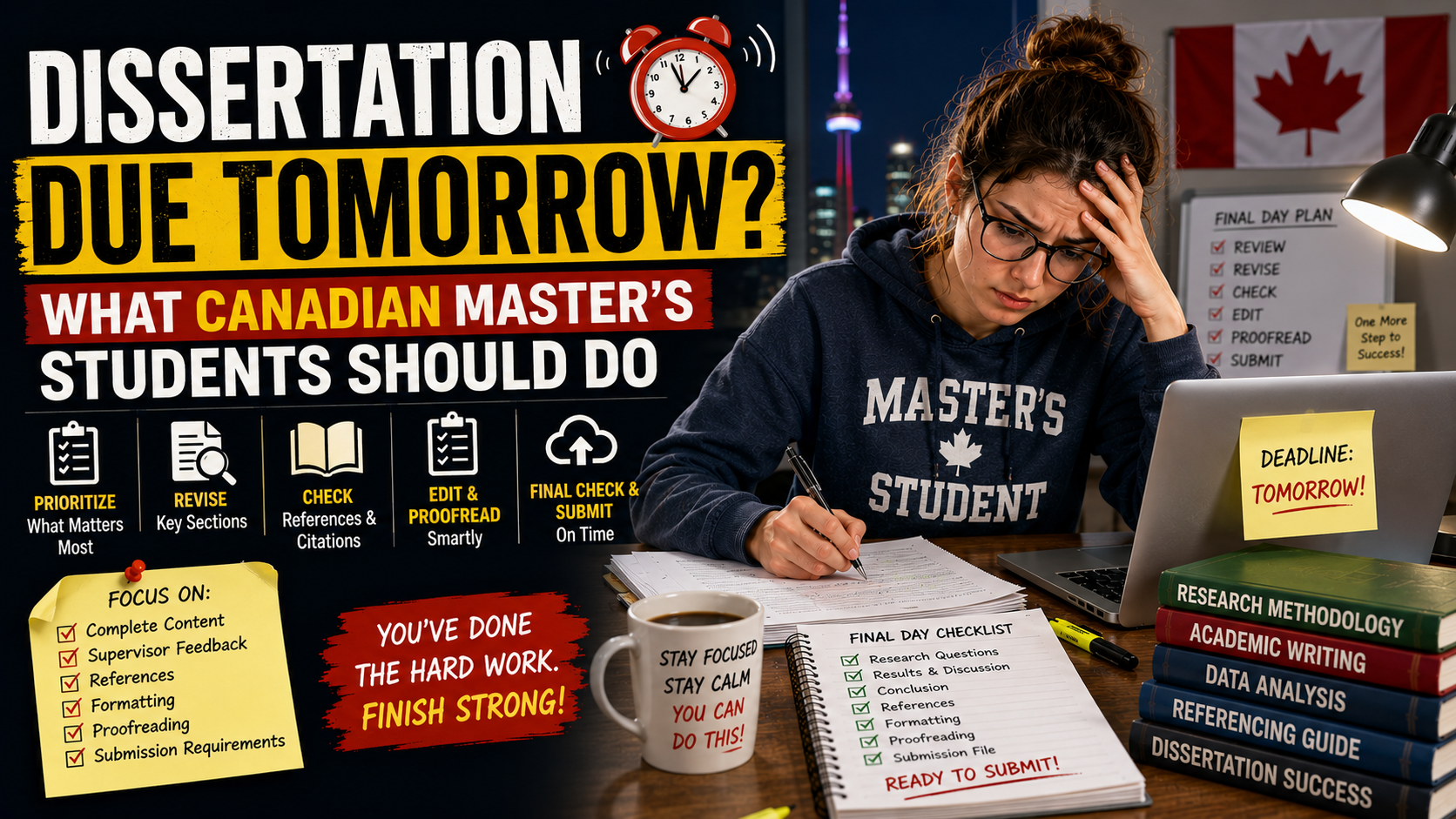
For Canadian Master's students, the final 24 hours should be about smart prioritisation, focused quality control and following the exact submission requirements of your university or graduate program.
This guide explains what to do when your dissertation deadline is tomorrow.
First: Don't Panic
A dissertation deadline can create the feeling that every problem needs immediate attention.
It doesn't.
Start by taking 15–20 minutes to identify exactly what remains unfinished.
Divide your remaining work into three categories:
Critical
These issues must be addressed before submission.
Examples:
Missing sections
Incomplete results
Missing discussion
Missing conclusion
Major supervisor revisions
Missing essential citations
Incorrect or incomplete research information
Important
These affect the quality of the dissertation but may not prevent submission.
Examples:
Weak transitions
Repetitive paragraphs
Inconsistent terminology
Unclear explanations
Minor structural issues
Cosmetic
These can be addressed after everything essential is complete.
Examples:
Small wording preferences
Minor punctuation changes
Cosmetic formatting adjustments
Optional stylistic improvements
Always deal with critical issues first.
Step 1: Check Whether the Dissertation Is Complete
Before editing anything, check whether every required section is present.
A typical Master's dissertation may contain:
Title page
Abstract
Table of contents
Introduction
Literature review
Methodology
Results or findings
Discussion
Conclusion
References
Appendices
Your actual requirements may differ depending on your university, faculty and program.
Use your official dissertation guidelines as the final authority.
If an essential section is missing, work on that before proofreading.
Step 2: Check Your Research Questions
One of the fastest ways to evaluate your dissertation is to compare the beginning and end of your research.
Ask:
What was my main research question?
Then ask:
Does my dissertation actually answer it?
Also check your research objectives.
For each objective, identify where it is addressed.
A simple table can help:
Research Objective | Where Addressed | Complete? |
|---|---|---|
Objective 1 | Results / Discussion | ✓ |
Objective 2 | Results / Discussion | ✓ |
Objective 3 | Discussion | Needs review |
If an objective is mentioned in the introduction but never addressed later, that is more important than a minor grammar mistake.
Step 3: Review Your Abstract
If you have already completed the dissertation, the abstract should accurately reflect the final version.
Check that it includes the appropriate information about:
Research problem
Purpose
Methodology
Key findings
Main conclusion
Important implications
Do not introduce findings in the abstract that are not actually supported by your dissertation.
If you have changed your results or conclusion recently, make sure the abstract still matches the final document.
Step 4: Check the Literature Review
You probably do not have time for a complete literature-review rewrite.
Instead, perform a targeted review.
Check whether:
The main research problem is clear.
Important literature is referenced.
The literature connects to your research question.
Major research gaps are identified.
Your discussion does not contradict the literature review.
Important claims have citations.
Avoid adding large numbers of new sources at the last minute unless they are genuinely necessary.
Every new source creates additional referencing work.
Step 5: Check the Methodology
Your methodology should accurately describe what you actually did.
Check whether it clearly explains the relevant:
Research design
Research approach
Participants or data sources
Data collection
Research instruments
Data-analysis approach
Ethical considerations
Methodological limitations
Do not invent methodological details to make the dissertation appear more complete.
If you discover a serious methodological problem at the last minute, contact your supervisor or appropriate academic representative rather than concealing it.
Step 6: Check Your Results
Your results or findings section deserves careful attention.
For quantitative research, check:
Tables
Statistical values
Sample information
Figures
Labels
Decimal consistency
Reported findings
For qualitative research, check:
Themes
Categories
Coding
Participant quotations
Findings
Connections to research questions
Make sure the results accurately represent your actual research.
Never fabricate or manipulate data simply because the deadline is approaching.
Step 7: Check Your Discussion
Your discussion should explain what your findings mean.
Check whether it:
Answers your research questions
Connects findings with previous research
Explains important similarities or differences
Discusses implications
Addresses limitations
Avoids making unsupported claims
A useful question is:
"What do my findings actually tell the reader?"
If your discussion simply repeats the results without interpreting them, consider improving the most important paragraphs first.
Step 8: Check Your Conclusion
Your conclusion should bring the dissertation together.
Check that it:
Answers the research question
Summarises the key findings
Connects back to the research objectives
Addresses the significance of the research
Mentions important limitations where appropriate
Provides suitable recommendations where required
Avoid introducing completely new arguments or evidence in the conclusion.
Step 9: Check Your References
Referencing errors can become especially noticeable in the final version.
Perform a quick audit of:
In-text citations
Reference list
Author names
Publication years
Titles
URLs or DOI information where required
Citation-reference matching
Duplicate references
Make sure the required referencing style is used consistently.
Depending on your program, this could be APA, Chicago, MLA, Harvard, IEEE, Vancouver or another style.
Use the referencing requirements provided by your institution or department.
Step 10: Check Your Dissertation Formatting
Do not assume that every Canadian university uses the same dissertation format.
Check your official requirements for:
Page size
Margins
Font
Font size
Line spacing
Heading styles
Page numbering
Title page
Table of contents
Tables
Figures
Captions
Appendices
References
Also update your table of contents if you have changed chapter headings or page structure.
Step 11: Proofread the Most Important Parts
If you only have a few hours remaining, you may not have enough time for an extremely detailed line-by-line proofreading pass.
Prioritise:
Abstract
Introduction
Research questions
Results
Discussion
Conclusion
Headings
Tables and figures
References
Appendices
Then perform a quick search for common errors.
Look for:
Double spaces
Missing punctuation
Incorrect spelling
Inconsistent terminology
Incorrect headings
Broken citations
Placeholder text
"[INSERT HERE]" notes
Comments left in the document
Track Changes that should be resolved
Step 12: Remove Comments and Track Changes
This is an easy step to forget.
Before submitting, check whether your document still contains:
Supervisor comments
Editor comments
Track Changes
Highlighted text
Draft notes
Internal reminders
Placeholder references
Temporary tables
Deleted sections
If comments or tracked changes are not supposed to be included, resolve them before creating the final submission file.
Step 13: Check the Word Count
Check the final word count against your program's requirements.
Pay attention to whether your university includes or excludes:
Abstract
References
Footnotes
Tables
Appendices
Bibliography
Do not assume that the standard word-count rules apply to your program.
Step 14: Create a Final Submission File
Do not submit a document called:
finalfinal2_REALFINAL.docx
Use a clear naming system.
For example:
Surname_FirstName_StudentID_Thesis.pdf
If your university specifies a particular naming format, follow that instead.
Create a final copy before making additional changes.
Step 15: Check the Submission Portal
Do not wait until the final minute to discover that the submission system requires a particular file type.
Check:
Submission portal
File format
Maximum file size
Naming requirements
Required declarations
Additional documents
Submission confirmation
Deadline time
Time zone
A deadline that appears to be "tomorrow" may have a specific submission time.
Use your university's official instructions rather than relying on assumptions.
What If Your Master's Dissertation Is Still Incomplete?
This is the most important situation to handle carefully.
If substantial sections are missing, identify what is essential.
For example:
Missing conclusion + references need checking + formatting needs work
Priority:
Conclusion → References → Formatting
Not:
Formatting → Fonts → Cover page → Conclusion
Do the work that affects academic completeness first.
What If Your Dissertation Is Written but Needs Editing?
This is a different situation.
If your research, analysis and chapters are already substantially complete, your remaining tasks may include:
Academic editing
Proofreading
Referencing
Formatting
Final consistency checks
Where permitted by your university, professional editing or proofreading can help identify language and presentation problems in existing work.
Students should retain responsibility for their research, authorship, analysis and intellectual contribution.
Can You Get Urgent Dissertation Editing in Canada?
Some academic-support providers offer urgent dissertation editing and proofreading services.
Depending on the provider, support may cover:
Grammar
Academic language
Clarity
Coherence
Referencing
Formatting
Proofreading
Final document checks
However, students should check their university's academic-integrity rules before using external assistance.
Not every form of academic assistance is necessarily permitted.
What Should You Tell an Urgent Dissertation Editor?
If permitted, provide clear instructions.
Useful information includes:
Word count
Deadline
University requirements
Referencing style
Thesis template
Supervisor feedback
Specific areas requiring attention
Formatting requirements
The clearer the requirements, the easier it is to prioritise the work.
What Should You Avoid When Looking for Urgent Help?
A deadline tomorrow can make students vulnerable to unrealistic promises.
Be cautious of providers that:
Guarantee grades
Promise guaranteed distinctions
Fabricate data
Fabricate references
Encourage plagiarism
Offer impersonation
Request university passwords
Claim to know examiners
Promise impossible turnaround times
Encourage academic misconduct
Urgency should never mean abandoning academic integrity.
What If You Are an International Master's Student in Canada?
International students may have additional concerns about:
Academic English
Referencing
Canadian academic conventions
Supervisor feedback
Research terminology
Formatting
Submission procedures
If permitted, language editing and proofreading may help improve the presentation of existing work.
However, the student's own research, analysis and intellectual contribution should remain their own.
What About AI When Your Dissertation Is Due Tomorrow?
Do not assume that using AI to edit or rewrite your dissertation is automatically permitted.
Check your:
University AI policy
Faculty requirements
Program rules
Graduate-school guidance
Supervisor instructions
If AI use is permitted, carefully verify its output.
AI tools can:
Change the meaning of sentences
Introduce inaccurate information
Create incorrect citations
Alter technical terminology
Produce unsupported claims
Never accept AI-generated references or factual claims without checking them.
A 24-Hour Master's Dissertation Emergency Schedule
If you have approximately 24 hours remaining, use your time carefully.
Hours 24–20: Complete Critical Content
Focus on:
Missing sections
Results
Discussion
Conclusion
Major supervisor feedback
Hours 20–16: Research and Argument Check
Check:
Research questions
Objectives
Methodology
Results
Discussion
Conclusion
Hours 16–13: References
Check:
In-text citations
Reference list
Citation-reference matching
Referencing style
Hours 13–10: Formatting
Check:
Headings
Page numbers
Contents
Tables
Figures
Appendices
Hours 10–7: Editing
Focus on:
Clarity
Academic language
Sentence structure
Repetition
Coherence
Hours 7–5: Proofreading
Look for:
Grammar
Spelling
Punctuation
Typographical errors
Placeholder text
Hours 5–3: Final Document Check
Check:
Word count
Formatting
References
Tables
Figures
Appendices
Comments
Track Changes
Hours 3–2: Submission Preparation
Prepare the final file according to official university instructions.
Hours 2–1: Final Review
Take a short break and then perform one final visual check.
Final Hour: Submit
Do not intentionally wait until the final minute.
Save proof of submission if the university provides a confirmation.
What If You Cannot Finish Everything?
This is an important reality.
You may not be able to fix every problem before tomorrow.
If that happens, prioritise:
Completeness → Accuracy → Academic Requirements → Major Revisions → References → Formatting → Editing → Cosmetic Changes
A dissertation with a minor punctuation issue is generally more useful than a beautifully formatted document with an unfinished conclusion.
Your Last-Minute Master's Dissertation Checklist
Content
All required chapters are present
Research question is clear
Objectives are addressed
Literature review is complete
Methodology is complete
Results are presented
Discussion is complete
Conclusion is complete
Academic Quality
Supervisor feedback reviewed
Major revisions addressed
Findings accurately represent research
Arguments are logically connected
Claims are appropriately supported
References
In-text citations checked
Reference list checked
Citation-reference matching checked
Referencing style followed
Formatting
Title page checked
Table of contents updated
Page numbers correct
Headings consistent
Tables numbered
Figures labelled
Appendices included
Formatting requirements followed
Final Quality Control
Grammar checked
Spelling checked
Punctuation checked
Comments removed
Track Changes resolved
Placeholder text removed
Word count checked
Correct file created
Submission requirements checked
Submission confirmation saved
Final Takeaway
If your Master's dissertation is due tomorrow, your goal is not perfection.
Your goal is to produce the strongest complete, accurate and compliant submission you can within the time available.
Use this order:
Complete → Check Research → Address Feedback → References → Formatting → Edit → Proofread → Final Check → Submit
Do not waste your final hours obsessing over minor wording while essential academic work remains unfinished.
If your dissertation is already substantially complete and you are struggling with final editing, proofreading, referencing or formatting, permitted academic support may help you improve the presentation of your existing work.
Most importantly, follow your Canadian university's official submission and academic-integrity requirements and retain responsibility for your own research, analysis, authorship and intellectual contribution.
Your dissertation does not need to be perfect tomorrow. It needs to be complete, accurate, professionally presented and ready to submit.
Frequently Asked Questions
Everything you need to know about our services
Related Posts

Dissertation Due in One Week? Your Canadian Student Survival Plan

Last-Minute Dissertation Help in Canada
