Is Your Dissertation Heading Towards a Fail? Here's How to Tell
Introduction
You've spent months researching, reading journal articles, meeting your supervisor, and writing chapter after chapter. Yet despite all that effort, you still have a nagging question:
"What if my dissertation isn't good enough?"
This concern is more common than you might think. Many postgraduate students worry about failing their dissertation—not because they haven't worked hard, but because they're unsure whether their work meets university expectations.
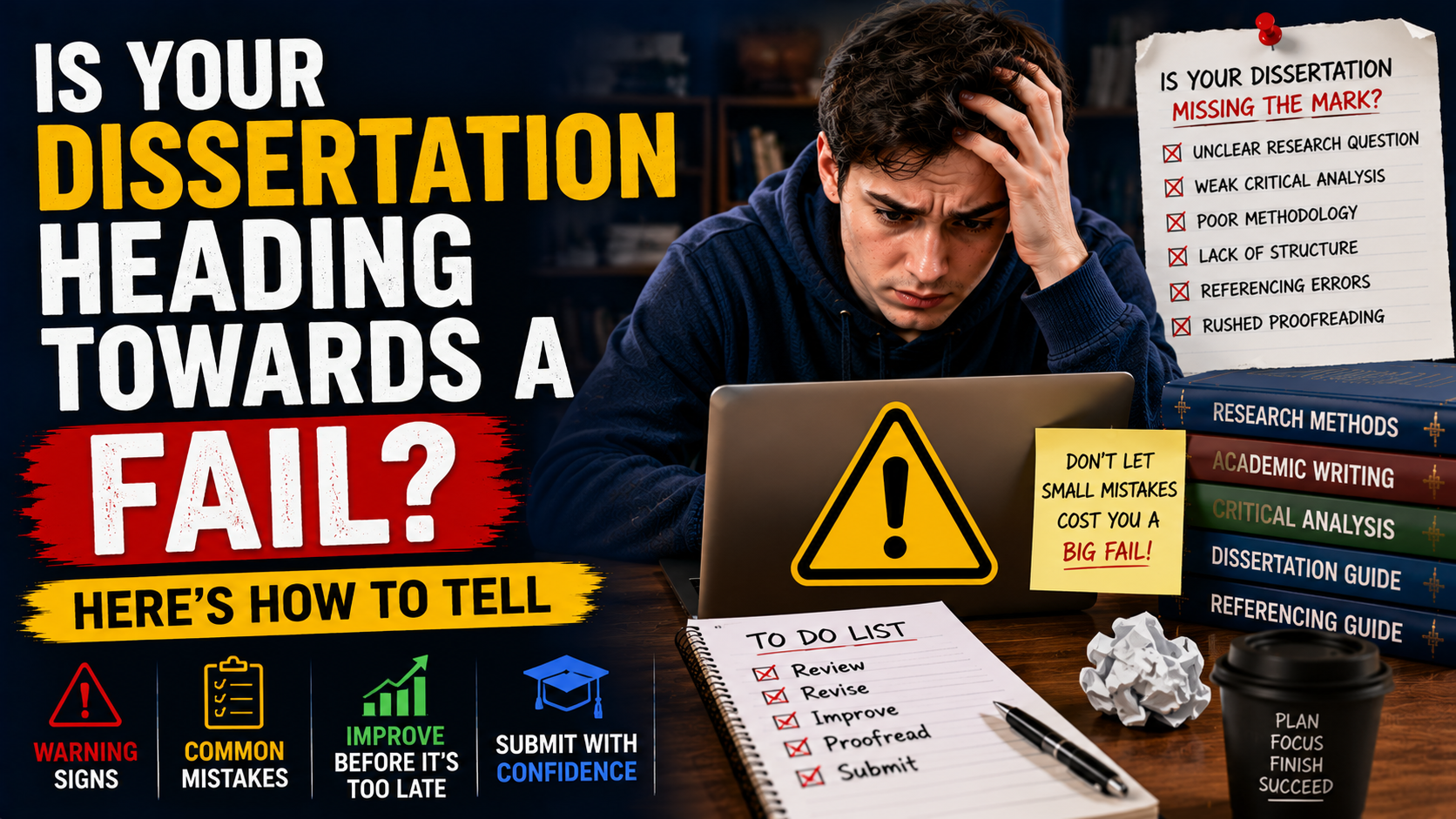
The encouraging news is that dissertations rarely receive poor marks because of one single mistake. More often, it's a combination of issues such as unclear arguments, weak critical analysis, inconsistent referencing, poor structure, or rushed proofreading.
The earlier you identify these problems, the easier they are to fix.
In this guide, we'll explore the most common warning signs that your dissertation may need further work, explain how to strengthen each area, and show when seeking ethical academic guidance can help you submit with greater confidence.
What Examiners Usually Look For
Although marking criteria vary between universities, dissertations are commonly assessed on:
A clear research question
Critical engagement with literature
Appropriate research methodology
Rigorous analysis
Logical organisation
Academic writing quality
Accurate referencing
Well-supported conclusions
Weakness in several of these areas can reduce your overall grade.
1. Your Research Question Is Still Vague
Ask yourself:
Can you explain your research question in one sentence?
Does every chapter contribute to answering it?
Do your conclusions directly address it?
If not, your dissertation may lack focus.
How to Improve
Refine your research question so it is specific, researchable, and aligned with your objectives.
2. Your Literature Review Describes More Than It Analyses
A common weakness is summarising studies without evaluating them.
Instead of listing what each author found, aim to:
Compare viewpoints
Highlight contradictions
Identify research gaps
Evaluate strengths and limitations
Explain how previous research informs your study
Critical analysis is a key feature of high-scoring dissertations.
3. Your Methodology Can't Be Justified
Your methodology chapter should explain not only what you did, but why you chose those methods.
Examiners often look for:
Clear research design
Appropriate sampling
Ethical considerations
Data collection methods
Justification for analysis techniques
If these explanations are missing, your methodology may appear weak.
4. Your Discussion Doesn't Explain the Findings
Many students repeat results instead of interpreting them.
A strong discussion chapter should answer questions such as:
Why are these findings important?
How do they compare with previous research?
What are the implications?
What limitations should readers consider?
Interpretation is just as important as presenting data.
5. Your Referencing Is Inconsistent
Incorrect referencing can affect the professionalism of your dissertation.
Check for:
Missing citations
Formatting inconsistencies
Incorrect reference list entries
Mismatched in-text citations
Missing page numbers where required
Always follow your university's preferred referencing style.
6. You Keep Receiving the Same Supervisor Feedback
If comments such as:
"Be more critical."
"Clarify your argument."
"Strengthen this section."
appear repeatedly, it's worth reviewing whether you've fully addressed the underlying issues rather than making only minor edits.
7. Your Chapters Don't Flow Together
Each chapter should connect logically to the next.
Readers should clearly understand:
Why the research matters
How the literature informs the study
Why the methodology was chosen
What the findings reveal
How the conclusions answer the research question
A disconnected structure can weaken otherwise strong research.
8. You've Left Editing Until the End
Completing your final chapter doesn't mean your dissertation is ready to submit.
Allow time for:
Grammar correction
Improving sentence clarity
Removing repetition
Checking formatting
Verifying references
Proofreading multiple times
A polished dissertation communicates ideas more effectively.
9. You're Relying on Hope Instead of a Checklist
Many students submit their dissertation hoping everything is correct.
Instead, review your work systematically:
Research question answered?
Objectives achieved?
Literature critically analysed?
Methodology justified?
Findings interpreted?
References checked?
Formatting complete?
Proofread thoroughly?
A structured checklist helps reduce avoidable mistakes.
10. You're Unsure Whether It Meets University Standards
If you're asking:
"Is this academic enough?"
"Will my supervisor approve?"
"Have I missed something important?"
it may be worthwhile to seek independent academic feedback before submission.
A second review can highlight issues that are easy to overlook after months of working on the same document.
A Quick Self-Assessment
If you answer "Yes" to several of these questions, your dissertation may need further revision:
Is your research question unclear?
Is your literature review mostly descriptive?
Are your supervisor's comments repeating?
Does your discussion lack interpretation?
Are references inconsistent?
Have you not proofread carefully?
Are you unsure about the overall quality?
Identifying these warning signs early gives you more time to improve your work.
Can AI Help You Check Your Dissertation?
AI tools can assist with:
Grammar and spelling
Readability
Sentence clarity
Identifying repetitive wording
Creating revision checklists
Explaining general academic concepts
However, students should:
Verify AI suggestions against reliable academic sources.
Follow their university's AI policies.
Make independent research decisions.
Ensure all submitted work reflects their own understanding.
AI is most effective as a support tool rather than a replacement for critical thinking.
How AssignmentCart Can Help Before Submission
If you're concerned that your dissertation may not yet meet university expectations, ethical academic support can help you identify areas for improvement.
AssignmentCart offers guidance with:
Dissertation proposal review
Literature review feedback
Research methodology guidance
Critical analysis improvement
SPSS and qualitative analysis support
Academic editing
Professional proofreading
Referencing checks
Formatting review
Chapter-by-chapter feedback
Confidential student support
Our role is to help you strengthen your own dissertation while maintaining originality and academic integrity.
Don't Wait Until It's Too Late
Many dissertation problems become much harder to fix in the final few days before submission.
The earlier you review your work, the more opportunities you have to improve its quality.
Whether you need help interpreting supervisor feedback, refining your methodology, improving your literature review, or polishing your final draft, AssignmentCart's ethical dissertation guidance is designed to support your academic journey.
Why Students Choose AssignmentCart
Experienced academic experts
Ethical academic guidance
Editing and proofreading specialists
Research methodology support
Referencing assistance
Confidential communication
Fast turnaround options for eligible requests
👉 Visit our services page today to explore our services and place your order before your submission deadline.
Final Thoughts
Worrying about your dissertation is normal, but uncertainty doesn't necessarily mean your research is weak. In many cases, the issues that reduce marks—such as unclear arguments, inconsistent referencing, or limited critical analysis—can be addressed with careful revision.
By identifying warning signs early, responding thoughtfully to feedback, and seeking ethical academic guidance when needed, you can strengthen your dissertation and submit with greater confidence.
Your dissertation represents months of dedication. Give it the final review it deserves before submission.
Frequently Asked Questions
Everything you need to know about our services
Related Posts

Why 70% of UK Master's Dissertations Lose Marks Before the Research Even Begins

15 Dissertation Mistakes That Can Cost You a Distinction (And How to Avoid Them)
