15 Dissertation Mistakes That Can Cost You a Distinction (And How to Avoid Them)
Introduction
After months of research, hundreds of journal articles, countless late nights, and thousands of words written, the difference between a Merit (60–69%) and a Distinction (70%+) often comes down to small but costly mistakes.
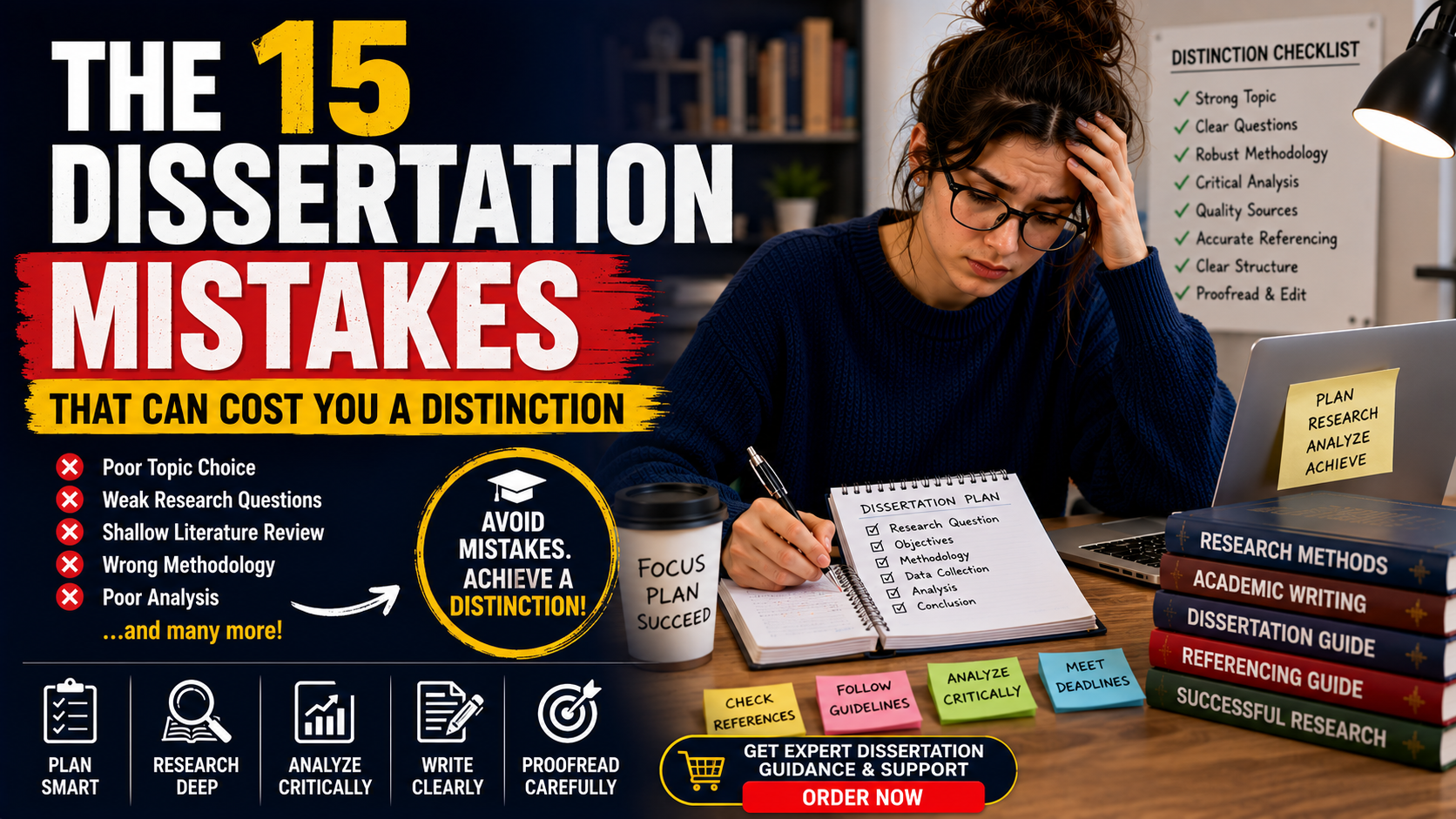
Many postgraduate students assume their dissertation grade depends only on how much research they conduct. In reality, supervisors frequently deduct marks because of avoidable problems such as weak research questions, poor critical analysis, inconsistent referencing, unclear methodology, and rushed editing.
The encouraging news is that these mistakes are preventable.
In this guide, you'll discover the 15 dissertation mistakes that commonly reduce grades at UK universities, practical ways to avoid them, and a checklist you can use before submitting your dissertation.
Why Small Mistakes Matter
A distinction-level dissertation is rarely defined by one brilliant chapter. Instead, it demonstrates consistency across every stage of the research process.
Examiners typically assess:
Research quality
Critical thinking
Methodology
Academic writing
Structure
Referencing
Originality
Presentation
Conclusions
Even strong research can lose marks if these areas are not executed well.
1. Choosing a Topic That's Too Broad
Many students begin with ambitious dissertation ideas.
For example:
❌ Artificial Intelligence in Healthcare
A more focused topic might be:
✅ The Impact of AI-Assisted Diagnostic Software on NHS Radiology Departments
Narrow topics allow deeper analysis and stronger conclusions.
2. Weak Research Questions
Your research question determines the direction of the entire dissertation.
Poor research questions are often:
Too vague
Too broad
Impossible to answer
Missing academic relevance
A clear question leads to clearer research.
3. Poor Dissertation Proposal
A weak proposal usually creates problems later.
Your proposal should clearly explain:
Research aim
Objectives
Literature background
Methodology
Expected contribution
Strong planning often produces stronger dissertations.
4. Describing Instead of Critically Analysing
This is one of the biggest reasons dissertations miss distinction grades.
Many students summarise research instead of evaluating it.
High-scoring dissertations compare studies, identify limitations, explain contradictions, and justify conclusions using evidence.
5. Weak Literature Review
Your literature review should do more than summarise articles.
Instead, it should:
Compare researchers
Identify themes
Highlight knowledge gaps
Explain theoretical perspectives
Build the foundation for your study
6. Choosing the Wrong Methodology
Your methodology should answer your research question.
Ask yourself:
Why qualitative?
Why quantitative?
Why mixed methods?
Why this sample?
Why these analytical techniques?
Every decision should be justified academically.
7. Poor Time Management
Many dissertations are written in the final few weeks.
This often results in:
Weak analysis
Incomplete chapters
Limited proofreading
Missed supervisor feedback
Rushed conclusions
Create a realistic timeline from the beginning.
8. Ignoring Supervisor Feedback
Supervisors provide valuable guidance.
Ignoring repeated comments often leads to repeated weaknesses throughout the dissertation.
Treat every meeting as an opportunity to improve your research.
9. Weak Academic Sources
Distinction-level dissertations rely on high-quality evidence.
Prioritise:
Peer-reviewed journals
Academic books
Government publications
Professional organisations
High-quality industry reports
Avoid excessive reliance on blogs or unsupported online sources.
10. Referencing Errors
Incorrect referencing may reduce marks and raise academic integrity concerns.
Always check:
In-text citations
Reference list
Formatting
Consistency
Required citation style
11. Poor Data Analysis
Collecting data is only half the process.
Examiners expect you to explain:
What the data means
Why the results matter
How findings compare with previous research
Practical implications
Analysis—not description—earns higher marks.
12. Weak Discussion Chapter
The discussion should connect:
Research findings
Literature review
Theory
Research questions
Practical implications
Avoid simply repeating your results.
13. Rushing the Editing Process
Many students finish writing only hours before submission.
Without editing, dissertations often contain:
Grammar mistakes
Repetition
Formatting inconsistencies
Weak transitions
Citation errors
Professional editing improves readability and presentation.
14. Writing an Unclear Conclusion
Your conclusion should:
Answer the research question
Summarise key findings
Explain contributions
Acknowledge limitations
Suggest future research
Avoid introducing new evidence.
15. Starting Too Late
Almost every other mistake becomes more likely when students postpone their dissertation.
Starting early allows time for:
Better research
Multiple drafts
Supervisor feedback
Editing
Proofreading
Refinement
Time is one of the biggest predictors of dissertation quality.
A Quick Distinction Checklist
Before submitting your dissertation, ask yourself:
✅ Is my research question clear?
✅ Have I critically analysed the literature?
✅ Is my methodology justified?
✅ Have I answered my research objectives?
✅ Are all references correct?
✅ Have I proofread every chapter?
✅ Does my discussion explain the significance of my findings?
✅ Have I followed my university's formatting requirements?
If you answered "No" to any of these questions, your dissertation may still need further refinement.
When Should You Seek Dissertation Support?
Many students wait until the week before submission to ask for help.
Instead, consider getting academic guidance when you need support with:
Choosing a dissertation topic
Refining research questions
Planning your proposal
Conducting literature reviews
Selecting an appropriate methodology
Academic editing
Proofreading
Referencing
Improving clarity and structure
Early guidance can help you address issues before they affect your final grade.
How AssignmentCart Can Support Your Dissertation Journey
Writing a dissertation is one of the most demanding parts of postgraduate study, but you do not have to manage every challenge alone.
At AssignmentCart, we provide ethical academic support designed to help students strengthen their own work through:
Dissertation proposal guidance
Literature review assistance
Research planning support
Methodology guidance
SPSS and qualitative data analysis support
Academic editing
Professional proofreading
Harvard, APA, OSCOLA, MLA, Chicago, and IEEE referencing assistance
Chapter-by-chapter feedback
Confidential student support
24/7 assistance
Whether you're just starting your dissertation or preparing your final submission, our academic experts can help you improve clarity, structure, organisation, and presentation while ensuring your work remains original and aligned with university academic integrity policies.
Ready to Improve Your Dissertation?
Don't wait until submission week to discover avoidable mistakes.
👉 Order Dissertation Help from Assignment Cart today and receive expert academic guidance to help you produce a well-structured, thoroughly researched, and professionally presented dissertation.
Explore our Dissertation Help Service and place your order to get started.
Final Thoughts
The difference between an average dissertation and a distinction-level dissertation often lies in avoiding common mistakes rather than producing extraordinary research. By planning carefully, choosing a focused topic, developing strong research questions, analysing evidence critically, and allowing enough time for revision, you can significantly improve the quality of your work.
If you would like expert guidance throughout your dissertation journey, Assignment Cart's Dissertation Help Service offers ethical academic support that helps you refine your research, strengthen your writing, and submit your dissertation with confidence.
Frequently Asked Questions
Everything you need to know about our services
Related Posts

Dissertation Proofreading Services: Why Every Dissertation Needs a Final Review

Dissertation Editing Services: Improve Your Dissertation Before Submission
