How to Write an Engineering Assignment (2026 Guide)
Introduction
Writing an engineering assignment requires more than solving equations or completing calculations. Universities expect students to apply engineering principles, analyse technical problems, evaluate solutions, interpret data, and communicate their findings using professional academic and technical writing.
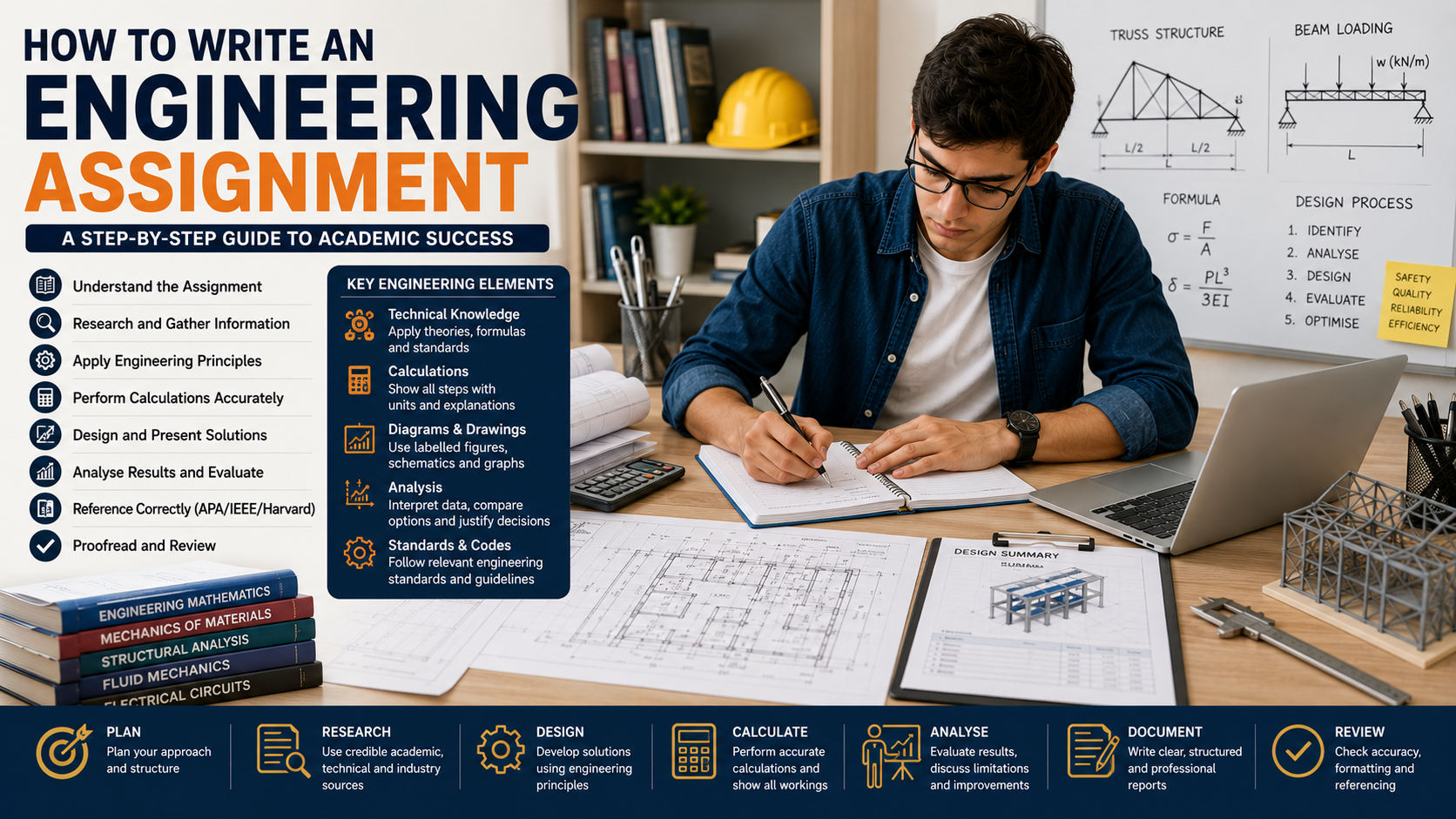
Whether you're studying Civil, Mechanical, Electrical, Chemical, Software, Aerospace, or any other engineering discipline, this guide explains how to write a high-quality engineering assignment that meets university standards and helps you achieve higher grades.
What Is an Engineering Assignment?
An engineering assignment is an academic assessment designed to evaluate your understanding of engineering theories, mathematical principles, design methodologies, technical analysis, and problem-solving abilities.
Depending on your course, you may be asked to:
Solve engineering calculations
Design engineering systems
Analyse case studies
Prepare technical reports
Evaluate engineering projects
Interpret experimental results
Develop engineering models
Analyse engineering failures
Recommend practical engineering solutions
Unlike standard essays, engineering assignments combine theory, calculations, technical analysis, diagrams, and professional reporting.
Why Engineering Assignments Matter
Engineering assignments help students develop technical and analytical skills required in professional engineering careers.
They assess your ability to:
Solve complex engineering problems
Apply engineering principles
Perform calculations accurately
Interpret technical data
Design practical solutions
Think critically
Communicate technical information professionally
Apply industry standards and engineering ethics
These skills prepare students for careers across multiple engineering disciplines.
Step 1: Understand the Assignment Question
Before starting calculations or research, carefully read the assignment brief.
Ask yourself:
What engineering problem must I solve?
Which engineering discipline does it relate to?
Are calculations required?
Do I need diagrams or technical drawings?
What standards or codes should I follow?
What is the required report format?
Which referencing style is required?
Pay attention to command words.
Command Word | Meaning |
|---|---|
Discuss | Present different engineering viewpoints using evidence |
Analyse | Break the engineering problem into smaller parts and examine them critically |
Evaluate | Assess strengths, weaknesses, risks, and feasibility |
Compare | Explain similarities and differences between engineering solutions |
Explain | Describe engineering concepts clearly using technical evidence |
Critically Assess | Evaluate evidence before reaching an informed engineering judgement |
Understanding these keywords helps you meet the assessment criteria.
Step 2: Conduct Thorough Research
Strong engineering assignments rely on authoritative technical information.
Use trusted resources such as:
Google Scholar
IEEE Xplore
ScienceDirect
SpringerLink
ASME Digital Collection
ASTM Standards
Engineering Toolbox
Institution of Civil Engineers (ICE)
Government engineering standards
Manufacturer technical documentation
Support your work using:
Peer-reviewed journals
Engineering textbooks
Technical standards
Industry codes
Conference papers
Official technical manuals
Avoid relying on outdated websites or unsupported online sources.
Step 3: Plan Your Assignment
Organise your assignment before writing.
Example structure:
Introduction
↓
Problem Definition
↓
Background Research
↓
Engineering Theory
↓
Design or Calculations
↓
Analysis
↓
Evaluation
↓
Recommendations
↓
Conclusion
Planning ensures your report is logical, professional, and easy to follow.
Step 4: Write a Strong Introduction
A strong introduction should:
Introduce the engineering problem
Explain its practical importance
State the assignment objectives
Provide technical background
Outline the report structure
Example:
This report evaluates the structural performance of a reinforced concrete beam using engineering calculations, relevant design standards, and finite element analysis to recommend an optimal design solution.
Step 5: Apply Engineering Principles
Support your assignment using recognised engineering theories and standards.
Depending on your discipline, you may apply:
Engineering Mathematics
Mechanics
Thermodynamics
Fluid Mechanics
Electrical Circuit Theory
Control Systems
Structural Analysis
Materials Engineering
Manufacturing Processes
Software Engineering Principles
Environmental Engineering
Project Engineering
Clearly explain why each principle is relevant to the engineering problem.
Step 6: Present Calculations, Designs, and Technical Evidence
Engineering assignments often require technical evidence.
Include where appropriate:
Engineering calculations
Formula derivations
Graphs
Tables
CAD drawings
Circuit diagrams
Flowcharts
Free-body diagrams
Schematics
Simulation results
Experimental data
Show each calculation clearly and explain how the results support your conclusions.
Step 7: Demonstrate Critical Analysis
High-scoring engineering assignments do more than present calculations.
Critically evaluate:
Design alternatives
Engineering assumptions
Material selection
Safety considerations
Cost effectiveness
Sustainability
Reliability
Performance limitations
Compliance with engineering standards
Support every conclusion with technical evidence and engineering literature.
Step 8: Reference Correctly
Engineering assignments commonly require:
IEEE Referencing
APA 7th Edition
Harvard Referencing
Reference:
Journal articles
Engineering standards
Technical books
Conference papers
Manufacturer documentation
Government publications
Always cite engineering standards, technical data, software, and external calculations where appropriate.
Step 9: Proofread Before Submission
Before submitting:
✔ Verify calculations
✔ Check units of measurement
✔ Review formulas
✔ Ensure diagrams are labelled correctly
✔ Check grammar and spelling
✔ Verify references
✔ Confirm formatting requirements
✔ Review the overall logical flow
Common Mistakes Students Make
Avoid these common mistakes:
Incorrect calculations
Missing units
Poor technical explanations
Weak engineering analysis
Ignoring engineering standards
Poorly labelled diagrams
Unsupported recommendations
Incorrect referencing
These mistakes can significantly reduce marks.
Tips for Achieving High Marks
Read the assignment brief carefully.
Research authoritative engineering sources.
Show all calculations clearly.
Apply recognised engineering principles.
Support conclusions with technical evidence.
Include professional diagrams where appropriate.
Follow engineering standards and codes.
Reference all sources accurately.
Proofread calculations and formatting before submission.
Final Thoughts
Writing an engineering assignment requires careful planning, technical accuracy, strong analytical skills, and clear communication. By understanding the assignment brief, conducting research using authoritative engineering sources, applying recognised engineering principles, and presenting calculations with logical explanations, you can produce a professional assignment that meets university expectations.
Focus on solving engineering problems systematically, supporting every conclusion with technical evidence, following relevant engineering standards, and proofreading your calculations, diagrams, and references before submission. Combining sound engineering knowledge with effective technical writing will help you achieve higher grades and prepare you for a successful engineering career.
Frequently Asked Questions
Everything you need to know about our services


