How to Write a Law Assignment Using OSCOLA (2026 Guide)
Introduction
Writing a law assignment requires more than simply describing legal principles. Universities expect students to interpret legislation, analyse case law, construct persuasive legal arguments, and reference every source accurately using the Oxford Standard for the Citation of Legal Authorities (OSCOLA).
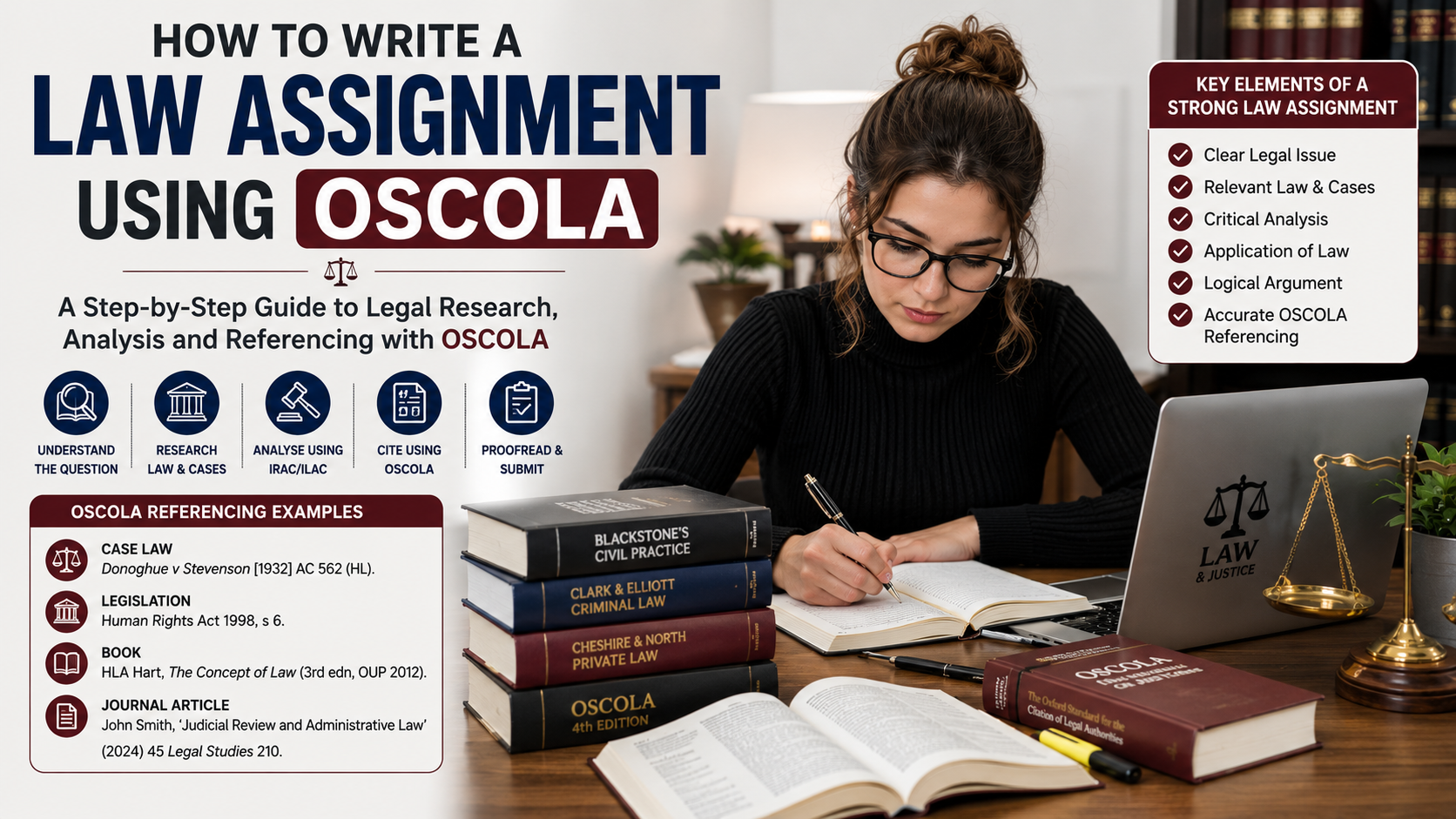
Whether you're studying law in the UK, Australia, or another common law jurisdiction, this guide explains how to write a high-quality law assignment using OSCOLA referencing.
What Is a Law Assignment?
A law assignment is an academic assessment that evaluates your understanding of legal principles, legislation, judicial decisions, legal reasoning, and your ability to apply the law to real or hypothetical scenarios.
Common law assignment topics include:
Contract Law
Criminal Law
Tort Law
Constitutional Law
Human Rights Law
Company Law
Employment Law
Family Law
Property Law
Public Law
International Law
Commercial Law
Unlike many university assignments, law assignments require you to support legal arguments using primary legal authorities such as legislation and case law.
Why Is OSCOLA Referencing Important?
OSCOLA (Oxford Standard for the Citation of Legal Authorities) is one of the most widely used legal referencing styles in UK universities.
Correct OSCOLA referencing helps you:
Demonstrate academic integrity
Credit original legal sources
Avoid plagiarism
Improve the credibility of your legal arguments
Meet university assessment requirements
Incorrect citations can result in lost marks even if your legal analysis is strong.
Step 1: Understand the Assignment Question
Before researching, carefully read your assignment brief.
Ask yourself:
What legal issue must I address?
Which area of law applies?
Is this a problem question or an essay?
Which jurisdiction applies?
Is OSCOLA referencing required?
What is the required word count?
What are the assessment criteria?
Pay close attention to command words.
Command Word | Meaning |
|---|---|
Discuss | Present different legal viewpoints supported by authority |
Analyse | Examine legal principles critically |
Evaluate | Assess strengths and weaknesses of the law |
Explain | Clearly describe legal concepts |
Compare | Identify similarities and differences between legal rules |
Critically Assess | Evaluate competing legal arguments before reaching a reasoned conclusion |
Understanding these instructions ensures your assignment answers exactly what your lecturer expects.
Step 2: Conduct Legal Research
Strong law assignments rely on authoritative legal sources.
Use trusted legal databases such as:
Westlaw
Lexis+
HeinOnline
BAILII
Practical Law
Google Scholar (Legal)
Official Government Legislation Websites
Research should include:
Statutes
Case law
Law Commission reports
Academic journal articles
Legal textbooks
Government publications
Avoid relying on blogs, forums, Wikipedia, or unofficial legal summaries.
Step 3: Plan Your Assignment
Create a logical structure before writing.
Example outline:
Introduction
↓
Background to the Legal Issue
↓
Relevant Legislation
↓
Relevant Case Law
↓
Legal Analysis
↓
Application of Law
↓
Critical Evaluation
↓
Conclusion
Planning first improves clarity and logical flow.
Step 4: Write a Strong Introduction
Your introduction should:
Introduce the legal issue
Provide relevant background
Explain why the topic is important
State the purpose of the assignment
Outline what will be discussed
Example:
This assignment examines the principles of negligence under English tort law by analysing statutory provisions, leading case law, and academic commentary before evaluating the effectiveness of the current legal framework.
Step 5: Research Primary and Secondary Legal Sources
A strong law assignment balances different legal authorities.
Primary Sources
Acts of Parliament
Regulations
Case Law
Court Judgments
Secondary Sources
Legal textbooks
Journal articles
Law Commission reports
Academic commentary
Primary sources generally carry greater legal authority.
Step 6: Apply IRAC or ILAC
Many law schools recommend using structured legal analysis.
IRAC Method
Issue – Identify the legal issue.
Rule – Explain the relevant legal rule.
Application – Apply the law to the facts.
Conclusion – Reach a reasoned conclusion.
ILAC Method
Issue
Law
Application
Conclusion
Using these frameworks helps produce clear, logical legal arguments.
Step 7: Use OSCOLA Referencing Correctly
OSCOLA uses footnotes instead of in-text citations.
Examples:
Case
Donoghue v Stevenson [1932] AC 562 (HL).
Legislation
Human Rights Act 1998, s 6.
Book
HLA Hart, The Concept of Law (3rd edn, Oxford University Press 2012).
Journal Article
John Smith, 'Judicial Review and Administrative Law' (2024) 45 Legal Studies 210.
Always check punctuation, italics, and formatting because OSCOLA has strict citation rules.
Step 8: Demonstrate Critical Legal Analysis
High-scoring assignments do more than explain the law.
Critically evaluate:
Judicial reasoning
Strengths and weaknesses of legislation
Conflicting judgments
Academic opinions
Policy considerations
Law reform proposals
Support every argument with legal authority.
Step 9: Proofread Your Assignment
Before submitting:
✔ Check OSCOLA citations
✔ Verify footnotes
✔ Ensure consistent formatting
✔ Check grammar
✔ Review legal terminology
✔ Confirm word count
✔ Proofread carefully
Common Mistakes Students Make
Avoid these common errors:
Incorrect OSCOLA referencing
Weak legal analysis
Describing instead of evaluating
Missing case law
Relying only on textbooks
Ignoring legislation
Poor assignment structure
Unsupported legal arguments
Failing to answer the question
Tips for Achieving High Marks
Read the assignment brief carefully.
Use authoritative legal databases.
Support every argument with legal authority.
Apply IRAC or ILAC where appropriate.
Critically analyse rather than describe.
Use accurate OSCOLA footnotes.
Proofread every citation before submission.
Final Thoughts
Writing a law assignment using OSCOLA requires careful legal research, critical thinking, and precise referencing. By understanding the assignment brief, using authoritative legal sources, applying structured legal analysis such as IRAC, and following OSCOLA citation rules accurately, you can produce a professional, well-supported assignment that meets university standards.
Focus on building logical legal arguments, supporting every claim with legislation or case law, and maintaining consistent OSCOLA formatting throughout your work. These practices will help you improve both your grades and your legal writing skills.
Frequently Asked Questions
Everything you need to know about our services
Related Posts

How to Write a Business Management Assignment (2026 Guide)

How to Write a Mental Health Nursing Assignment
