How to Critically Evaluate Sources in a Master's Assignment
Introduction
One of the biggest differences between undergraduate and master's-level study is the expectation that students critically evaluate academic sources rather than simply summarise them. At postgraduate level, lecturers want to see that you can judge the quality of evidence, compare different viewpoints, identify strengths and limitations, and explain why certain sources are more reliable than others.
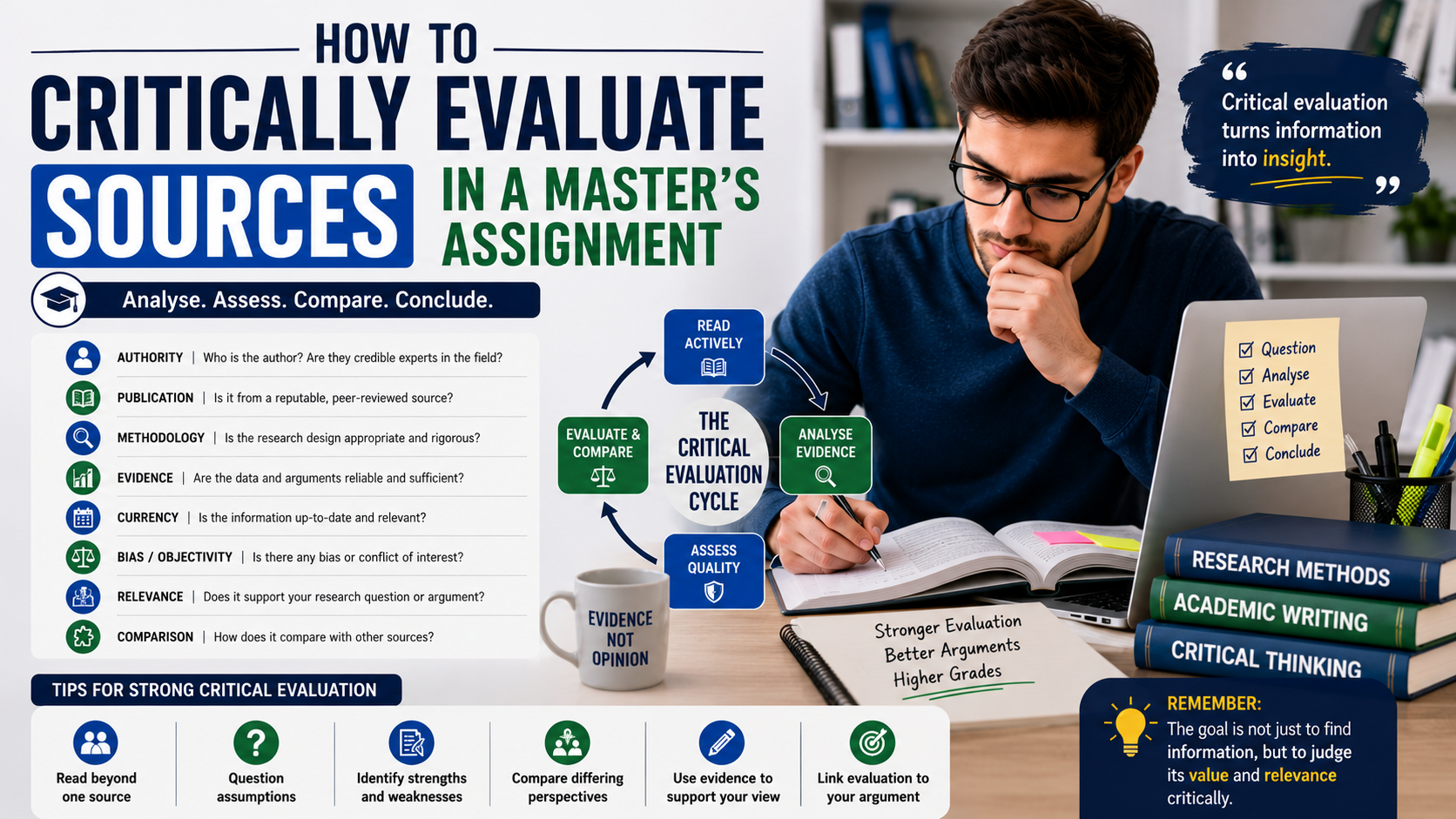
Many students lose marks because they describe what authors say without questioning the evidence or analysing its relevance. Critical evaluation is a core component of distinction-level master's assignments and demonstrates advanced academic thinking.
This guide explains how to critically evaluate sources, what lecturers expect, common mistakes to avoid, and practical techniques for improving the quality of your academic writing.
In this guide, you'll learn:
What Is Critical Evaluation?
Critical evaluation is the process of assessing the quality, credibility, relevance, strengths, and weaknesses of academic sources.
Rather than accepting every published opinion as fact, you examine:
How reliable the evidence is
Whether the research methods are appropriate
Whether conclusions are supported by data
How the source compares with other research
Critical evaluation goes beyond describing information—it involves informed academic judgement.
Why Is Critical Evaluation Important?
Master's programmes expect students to demonstrate independent thinking.
Critical evaluation helps you:
Produce stronger academic arguments
Use higher-quality evidence
Show analytical ability
Develop balanced discussions
Improve assignment grades
It is often one of the highest-weighted assessment criteria in postgraduate marking rubrics.
Critical Evaluation vs Description
Many students confuse these concepts.
Description
Description explains what an author says.
Example:
Smith (2023) argues that employee engagement improves productivity.
Critical Evaluation
Critical evaluation examines the strength of that argument.
Example:
Smith (2023) argues that employee engagement improves productivity. While the findings are supported by a large sample, the research focuses only on multinational organisations, limiting its application to small businesses. Similar findings reported by Jones (2022) strengthen the credibility of the conclusion.
Notice how evaluation discusses evidence rather than simply repeating it.
Step 1: Check the Author's Credibility
Ask:
Who wrote the source?
What are their qualifications?
Are they recognised experts?
Have they published extensively in this field?
Academic credibility matters.
Step 2: Evaluate the Publication
Prefer:
Peer-reviewed journals
Academic books
Government reports
Reputable research institutions
Be cautious with:
Personal blogs
Opinion websites
Unverified online content
Publication quality influences source reliability.
Step 3: Assess Research Quality
Consider:
Sample size
Research methodology
Data collection methods
Statistical analysis
Transparency
Strong research usually explains how conclusions were reached.
Step 4: Examine the Evidence
Ask yourself:
Is evidence sufficient?
Are claims supported by data?
Are references current?
Does the author acknowledge limitations?
Unsupported opinions are weaker than evidence-based arguments.
Step 5: Check Currency
In many subjects, recent research is particularly valuable.
For rapidly changing fields such as:
Business
Technology
Healthcare
Artificial Intelligence
Recent evidence is usually preferred.
Historical sources remain important where appropriate.
Step 6: Consider Bias
No research is completely free from bias.
Look for:
Funding sources
Political influences
Commercial interests
Selective reporting
Recognising potential bias strengthens your evaluation.
Step 7: Compare Multiple Sources
Never rely on one article alone.
Instead:
Compare findings.
Identify agreements.
Highlight disagreements.
Explain possible reasons for differences.
Comparison demonstrates broader understanding.
Questions to Ask When Reading Academic Sources
Useful questions include:
Is the evidence convincing?
Are conclusions justified?
Is the methodology appropriate?
What limitations exist?
Does newer research support these findings?
Can results be applied to my assignment?
These questions promote deeper analysis.
Evaluating Research Methodology
Consider whether the research design matches the research question.
Examples include:
Surveys
Interviews
Experiments
Case studies
Literature reviews
Each method has strengths and limitations.
Discussing methodology demonstrates postgraduate-level thinking.
Identifying Strengths
Strong academic sources often demonstrate:
Large sample sizes
Reliable methodology
Peer review
Recent evidence
Clear statistical analysis
Transparent reporting
Highlighting strengths shows balanced evaluation.
Identifying Limitations
Every study has limitations.
Examples include:
Small sample size
Geographic limitations
Short research duration
Limited participant diversity
Potential researcher bias
Acknowledging limitations strengthens academic discussion.
Using Evaluation in Your Writing
Instead of writing:
Brown (2021) found positive customer satisfaction.
Write:
Brown's (2021) findings indicate improved customer satisfaction; however, the study examined only one retail organisation, limiting wider generalisation. Later research by Ahmed (2023) involving multiple industries provides stronger evidence supporting similar conclusions.
Notice the deeper analytical approach.
Common Critical Evaluation Mistakes
Students frequently:
Summarise instead of analyse.
Use only one source.
Ignore methodological weaknesses.
Accept conclusions without questioning evidence.
Fail to compare authors.
These mistakes reduce marks.
Building Strong Academic Arguments
A strong argument typically follows this pattern:
Claim
↓
Evidence
↓
Critical evaluation
↓
Comparison with other studies
↓
Conclusion
This structure improves analytical quality.
Evaluating Quantitative Research
When analysing numerical studies, consider:
Sample size
Statistical reliability
Validity
Generalisability
Confidence intervals (where relevant)
Large datasets are not automatically better if methodology is weak.
Evaluating Qualitative Research
For interviews or case studies, examine:
Participant selection
Data interpretation
Research transparency
Credibility
Context
Qualitative studies provide valuable depth but may have limited generalisability.
Practical Evaluation Checklist
Before citing a source, ask:
✔ Is it peer reviewed?
✔ Is it current?
✔ Is the methodology appropriate?
✔ Are conclusions supported?
✔ Are limitations discussed?
✔ Does it strengthen my argument?
Tips for Writing Critically
To improve your academic writing:
Compare multiple authors.
Question assumptions.
Discuss strengths and weaknesses.
Explain why evidence matters.
Avoid unsupported opinions.
Use cautious academic language.
Critical writing is analytical rather than emotional.
Key Takeaways
Critical evaluation is essential in master's assignments.
Analyse evidence rather than simply describing it.
Assess credibility, methodology, and relevance.
Compare multiple academic sources.
Recognise strengths and limitations.
Build evidence-based academic arguments.
Strong evaluation leads to higher postgraduate grades.
Conclusion
Critical evaluation is one of the defining characteristics of master's-level academic writing. Rather than repeating information from journal articles and textbooks, successful postgraduate students assess the quality of evidence, compare competing perspectives, and develop balanced, evidence-based arguments.
By carefully examining credibility, methodology, bias, relevance, and research quality, you can strengthen every section of your assignment and demonstrate the independent academic judgement that universities expect from postgraduate students. Developing these evaluation skills not only improves assignment grades but also prepares you for professional research and evidence-based decision-making throughout your career.
Frequently Asked Questions
Everything you need to know about our services
