How to Write a Mental Health Nursing Assignment
Introduction
Mental health nursing assignments require more than simply describing psychological conditions. They assess your ability to apply nursing theories, evaluate evidence-based interventions, demonstrate therapeutic communication, and critically analyse patient-centred care.
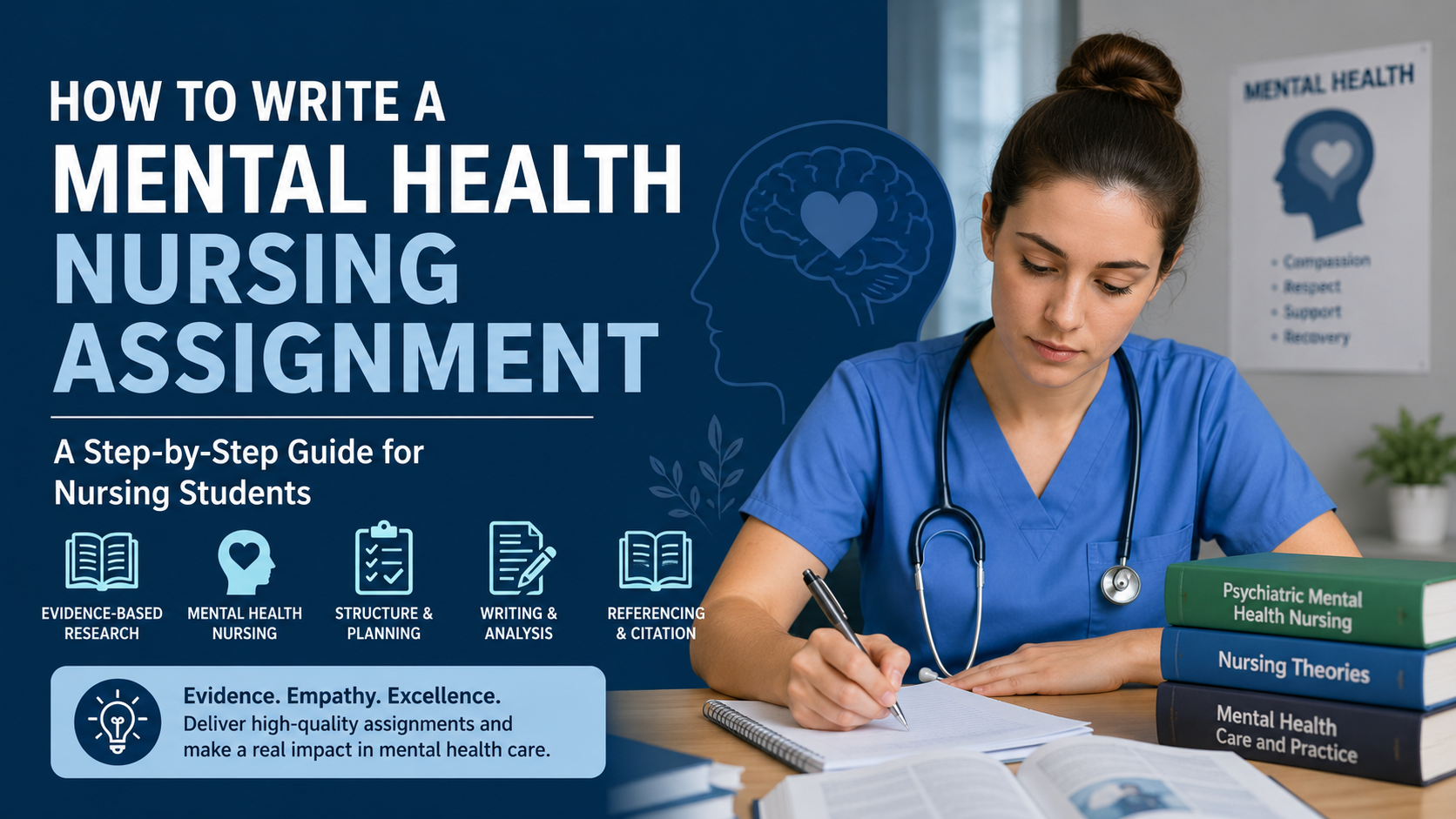
Whether you're studying in Australia, the UK, Canada, or another country, this guide explains how to write a high-quality mental health nursing assignment that meets university expectations.
What Is a Mental Health Nursing Assignment?
A mental health nursing assignment is an academic assessment that evaluates your understanding of mental illnesses, nursing interventions, recovery-oriented care, ethical practice, and evidence-based treatment.
Common topics include:
Depression
Anxiety disorders
Schizophrenia
Bipolar disorder
Personality disorders
Substance misuse
Suicide prevention
Trauma-informed care
Therapeutic communication
Recovery-oriented practice
Mental State Examination (MSE)
Risk assessment
Why Mental Health Nursing Assignments Matter
Mental health nurses work with vulnerable individuals experiencing emotional, psychological, and behavioural challenges.
Your assignment demonstrates that you can:
Apply nursing theory to real clinical situations
Think critically
Make evidence-based clinical decisions
Communicate professionally
Follow ethical and legal standards
Deliver person-centred care
Universities assess both your academic knowledge and clinical reasoning skills.
Step 1: Understand the Assignment Question
Read the assessment brief carefully before writing.
Ask yourself:
What is the topic?
What mental health condition am I discussing?
Which nursing model should I apply?
What referencing style is required?
Is critical analysis expected?
Do I need a case study?
Pay close attention to command words.
Command Word | Meaning |
|---|---|
Discuss | Present different viewpoints |
Analyse | Examine each component critically |
Evaluate | Assess strengths and weaknesses |
Compare | Explain similarities and differences |
Explain | Provide detailed information |
Critically Assess | Analyse evidence before making a judgement |
Step 2: Conduct Evidence-Based Research
Strong assignments rely on current research.
Use reliable databases including:
PubMed
CINAHL
Google Scholar
Cochrane Library
NICE Guidelines
WHO Publications
Government Health Websites
Use:
Peer-reviewed journals
Clinical guidelines
Mental health legislation
Nursing textbooks
Recent research (last five years)
Avoid:
Wikipedia
Blogs
Unverified websites
Outdated research
Step 3: Plan Your Assignment
Before writing, create an outline.
Example structure:
Introduction
↓
Background
↓
Mental Health Condition
↓
Assessment Findings
↓
Evidence-Based Nursing Interventions
↓
Recovery-Oriented Care
↓
Critical Analysis
↓
Recommendations
↓
Conclusion
Planning improves organisation and logical flow.
Step 4: Write a Strong Introduction
Your introduction should:
Introduce the topic
Explain its significance
Present the patient scenario (if applicable)
State the aim of the assignment
Outline the main sections
Example:
This assignment critically analyses nursing interventions for patients experiencing major depressive disorder. It examines evidence-based practice, recovery-oriented care, therapeutic communication, and the nurse's role in improving patient outcomes.
Step 5: Demonstrate Knowledge of Mental Health Conditions
Explain the condition clearly.
Include:
Definition
Causes
Risk factors
Signs and symptoms
Diagnosis
Impact on individuals and families
Support your discussion with academic literature.
Step 6: Apply Nursing Theories and Models
Universities expect students to connect theory with practice.
Common models include:
Recovery Model
Trauma-Informed Care
Peplau's Interpersonal Relations Theory
Tidal Model
Recovery Star
Person-Centred Care Framework
Nursing Process (ADPIE)
Explain why the chosen model is appropriate.
Step 7: Discuss Evidence-Based Nursing Interventions
Demonstrate how nurses provide safe and effective care.
Examples include:
Therapeutic communication
Medication management
Psychoeducation
Cognitive Behavioural Therapy (CBT) support
Risk assessment
Suicide prevention strategies
Crisis intervention
Family involvement
Relapse prevention planning
Always justify interventions using academic evidence.
Step 8: Include Critical Analysis
Many students lose marks because they only describe information.
Instead, critically evaluate:
Benefits of interventions
Limitations
Alternative approaches
Ethical considerations
Cultural factors
Clinical decision-making
Support every argument with research.
Step 9: Reference Correctly
Use the referencing style required by your university.
Common styles include:
APA 7th
Harvard
Vancouver
Reference:
Journal articles
Books
Clinical guidelines
Government reports
Professional nursing standards
Incorrect referencing may result in plagiarism penalties.
Step 10: Proofread Before Submission
Before submitting:
✔ Check grammar
✔ Improve sentence clarity
✔ Ensure logical flow
✔ Verify all citations
✔ Review formatting
✔ Confirm word count
✔ Run a plagiarism check
Common Mistakes to Avoid
Students often lose marks by:
Describing instead of analysing
Using outdated evidence
Poor assignment structure
Weak introduction
Missing nursing theory
Limited critical thinking
Incorrect referencing
Unsupported opinions
Lack of evidence-based practice
Avoiding these mistakes can significantly improve your grade.
Tips for Achieving High Marks
Answer the question directly.
Use recent peer-reviewed research.
Demonstrate critical thinking.
Link theory to practice.
Support every claim with evidence.
Follow university marking criteria.
Proofread multiple times before submission.
Final Thoughts
Writing a mental health nursing assignment requires strong research, critical thinking, evidence-based practice, and professional academic writing. By understanding the assignment requirements, planning your structure, applying nursing theories, and supporting your arguments with credible sources, you can produce a well-organised assignment that meets university standards.
Focus on delivering patient-centred, recovery-oriented, and evidence-based care throughout your discussion. This approach not only improves your academic performance but also reflects the skills expected of future mental health nurses.
Frequently Asked Questions
Everything you need to know about our services


