How to Write a Nursing Assignment
Introduction
Writing a nursing assignment is more than simply answering questions or summarising textbook chapters. Nursing assignments assess your understanding of healthcare theories, evidence-based practice, patient-centred care, ethical decision-making, and clinical reasoning. Whether you're studying for a diploma, undergraduate degree, or postgraduate nursing program, your assignments demonstrate your ability to apply theoretical knowledge to real-life healthcare situations.
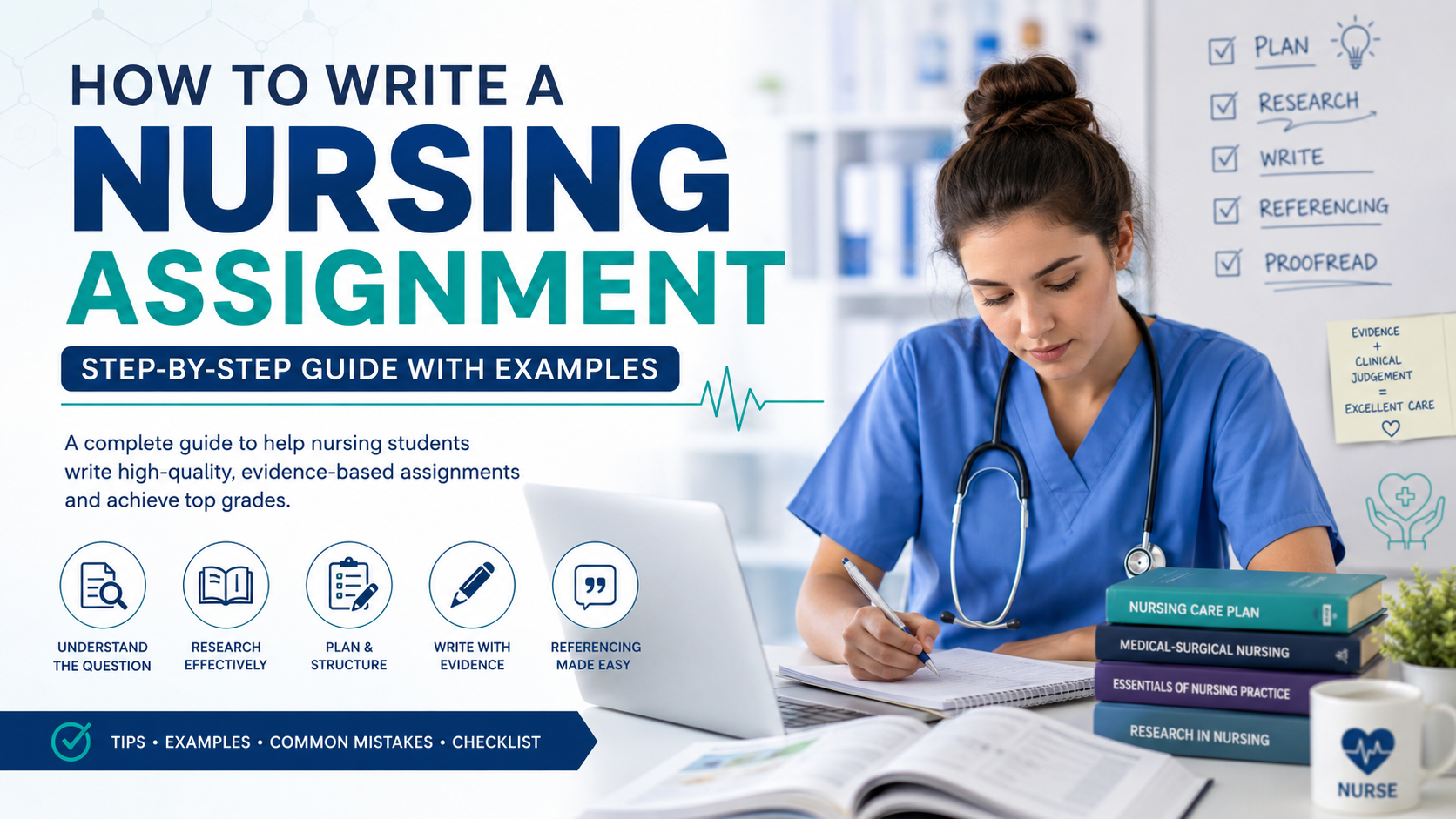
Many nursing students struggle because assignments often require extensive research, critical analysis, academic writing, and proper referencing. Balancing coursework with clinical placements, part-time work, and personal responsibilities can make the process even more challenging.
The good news is that writing a high-quality nursing assignment becomes much easier when you follow a structured approach. This guide explains every step—from understanding the assignment brief to proofreading your final draft—so you can produce well-organised, evidence-based work that meets university expectations.
What Is a Nursing Assignment?
A nursing assignment is an academic assessment designed to evaluate your knowledge, clinical reasoning, communication skills, and ability to apply nursing theories in professional practice.
Depending on your course, nursing assignments may include:
Essays
Case studies
Reflective journals
Care plans
Literature reviews
Evidence-based practice reports
Research papers
Health promotion projects
Patient assessment reports
Unlike general academic essays, nursing assignments require students to support arguments using credible healthcare research, clinical guidelines, and peer-reviewed journals.
Why Nursing Assignments Are Different
Nursing assignments focus on real healthcare situations rather than theoretical discussion alone.
They usually require you to:
Apply nursing theories
Evaluate patient care
Use clinical evidence
Demonstrate critical thinking
Follow ethical guidelines
Use recent research
Reference correctly
Universities expect nursing students to write professionally because documentation is an essential skill in healthcare practice.
Step 1: Understand the Assignment Question
Before researching anything, carefully read the assignment instructions.
Ask yourself:
What is the topic?
What is the required word count?
Which referencing style should I use?
What learning outcomes are being assessed?
Is critical analysis required?
Do I need to include recent journal articles?
Highlight command words such as:
Command Word | Meaning |
|---|---|
Discuss | Present different viewpoints |
Analyse | Break down the topic critically |
Evaluate | Assess strengths and weaknesses |
Compare | Explain similarities and differences |
Explain | Provide detailed information |
Critically Assess | Go beyond description and provide judgement |
Understanding these keywords helps you answer exactly what your lecturer expects.
Step 2: Conduct Thorough Research
Strong nursing assignments rely on evidence-based practice.
Use trusted academic databases such as:
PubMed
CINAHL
Google Scholar
Cochrane Library
NICE Guidelines
WHO publications
Government health websites
Aim to use:
Peer-reviewed journals
Recent studies (last 5 years where possible)
Clinical practice guidelines
Nursing textbooks
Avoid relying on blogs, Wikipedia, or outdated websites.
Step 3: Plan Your Assignment
Create an outline before writing.
Example:
Introduction
↓
Background
↓
Main Argument 1
↓
Main Argument 2
↓
Evidence
↓
Case Study
↓
Critical Analysis
↓
Recommendations
↓
Conclusion
Planning first saves time and improves logical flow.
Step 4: Write a Strong Introduction
The introduction should:
Introduce the topic
Explain why it matters
Provide background
State the assignment aim
Briefly outline the structure
Example:
Pressure injuries remain one of the most significant patient safety concerns in healthcare settings. This assignment critically examines evidence-based strategies for preventing pressure injuries, evaluates current nursing interventions, and discusses the importance of patient-centred care in improving clinical outcomes.
Step 5: Develop the Main Body
The body forms approximately 80% of your assignment.
Each paragraph should focus on one idea.
Use the PEEL structure:
Point
Introduce the idea.
Evidence
Support it using academic sources.
Explanation
Explain the evidence.
Link
Connect it to the assignment question.
Example:
Pressure injury prevention begins with comprehensive patient assessment. Research indicates that early risk identification significantly reduces hospital-acquired pressure injuries (Smith et al., 2024). Nurses should therefore conduct regular skin assessments and implement preventive interventions according to individual patient needs.
Step 6: Demonstrate Critical Thinking
Many students lose marks because they only describe information.
Instead of saying:
"Research shows regular repositioning helps."
Write:
"Although regular repositioning reduces pressure injury risk, recent evidence suggests that repositioning alone may not be sufficient without pressure-relieving support surfaces. Therefore, a combination of interventions provides more effective patient outcomes."
Critical thinking compares evidence rather than simply repeating it.
Step 7: Include Evidence-Based Practice
Evidence-based nursing combines:
Best research evidence
Clinical expertise
Patient preferences
Support every important statement with academic literature.
Avoid unsupported opinions.
Instead of:
"Nurses should communicate well."
Write:
"Effective nurse-patient communication improves treatment adherence and patient satisfaction (Brown & Lee, 2023)."
Step 8: Use Proper Nursing Assignment Structure
A typical nursing assignment includes:
Title Page
Include:
Student name
Student ID
Course
Module
Assignment title
Submission date
Table of Contents
Useful for longer assignments.
Introduction
10%
Main Body
80%
Conclusion
10%
Reference List
Include every cited source.
Step 9: Write an Effective Conclusion
The conclusion should:
Summarise key findings
Restate the assignment aim
Avoid introducing new information
End with a strong closing statement
Example:
Effective nursing assignments demonstrate evidence-based practice, critical thinking, and professional communication. By integrating current research with clinical knowledge, nursing students can produce academically strong assignments while developing skills essential for future nursing practice.
Nursing Assignment Example Structure
Introduction
↓
Patient Background
↓
Clinical Assessment
↓
Evidence-Based Intervention
↓
Critical Analysis
↓
Ethical Considerations
↓
Recommendations
↓
Conclusion
↓
References
Common Nursing Assignment Topics
Students frequently receive assignments on:
Patient safety
Infection prevention
Mental health nursing
Elderly care
Diabetes management
Pain management
Clinical leadership
Communication in nursing
Evidence-based practice
Ethical decision-making
Public health
Palliative care
Referencing in Nursing Assignments
Different universities require different referencing styles.
Common styles include:
APA 7th Edition
Harvard
Vancouver
OSCOLA (rare)
MLA (rare)
Always:
Cite every source
Use in-text citations
Include a reference list
Follow formatting guidelines consistently
Reference management tools such as Zotero, Mendeley, or EndNote can help organise citations.
Common Mistakes Students Make
Avoid these errors:
❌ Weak introduction
❌ No critical analysis
❌ Poor paragraph structure
❌ Outdated sources
❌ Lack of evidence
❌ Incorrect referencing
❌ Grammar mistakes
❌ Copying information
❌ Ignoring assignment criteria
❌ Poor proofreading
Tips to Score Higher in Nursing Assignments
Start early rather than waiting until the deadline.
Use recent peer-reviewed nursing journals.
Follow the marking rubric carefully.
Answer the assignment question directly.
Use academic language instead of conversational writing.
Support every claim with evidence.
Edit multiple times before submission.
Check plagiarism before uploading.
Proofread carefully.
Nursing Assignment Checklist
Before submitting, ask yourself:
✅ Did I answer the question?
✅ Is my introduction clear?
✅ Does every paragraph have evidence?
✅ Have I analysed rather than described?
✅ Are my references correct?
✅ Did I proofread?
✅ Is my formatting consistent?
✅ Have I followed university guidelines?
Final Thoughts
Writing a nursing assignment can seem overwhelming at first, but breaking the task into manageable steps makes the process much easier. Begin by understanding the assignment brief, conduct thorough research using credible healthcare sources, organise your ideas with a clear structure, and support every argument with evidence-based literature. Most importantly, demonstrate critical thinking by analysing and evaluating information rather than simply describing it.
By following these strategies consistently, you'll not only improve your assignment grades but also develop the analytical and professional communication skills that are essential for a successful nursing career.
Frequently Asked Questions
Everything you need to know about our services

