How to Write a Psychology Assignment (2026 Guide)
Introduction
Psychology assignments require more than simply describing theories or psychological concepts. Universities expect students to critically evaluate research, analyse human behaviour using evidence-based theories, interpret scientific findings, and present well-structured academic arguments supported by credible sources.
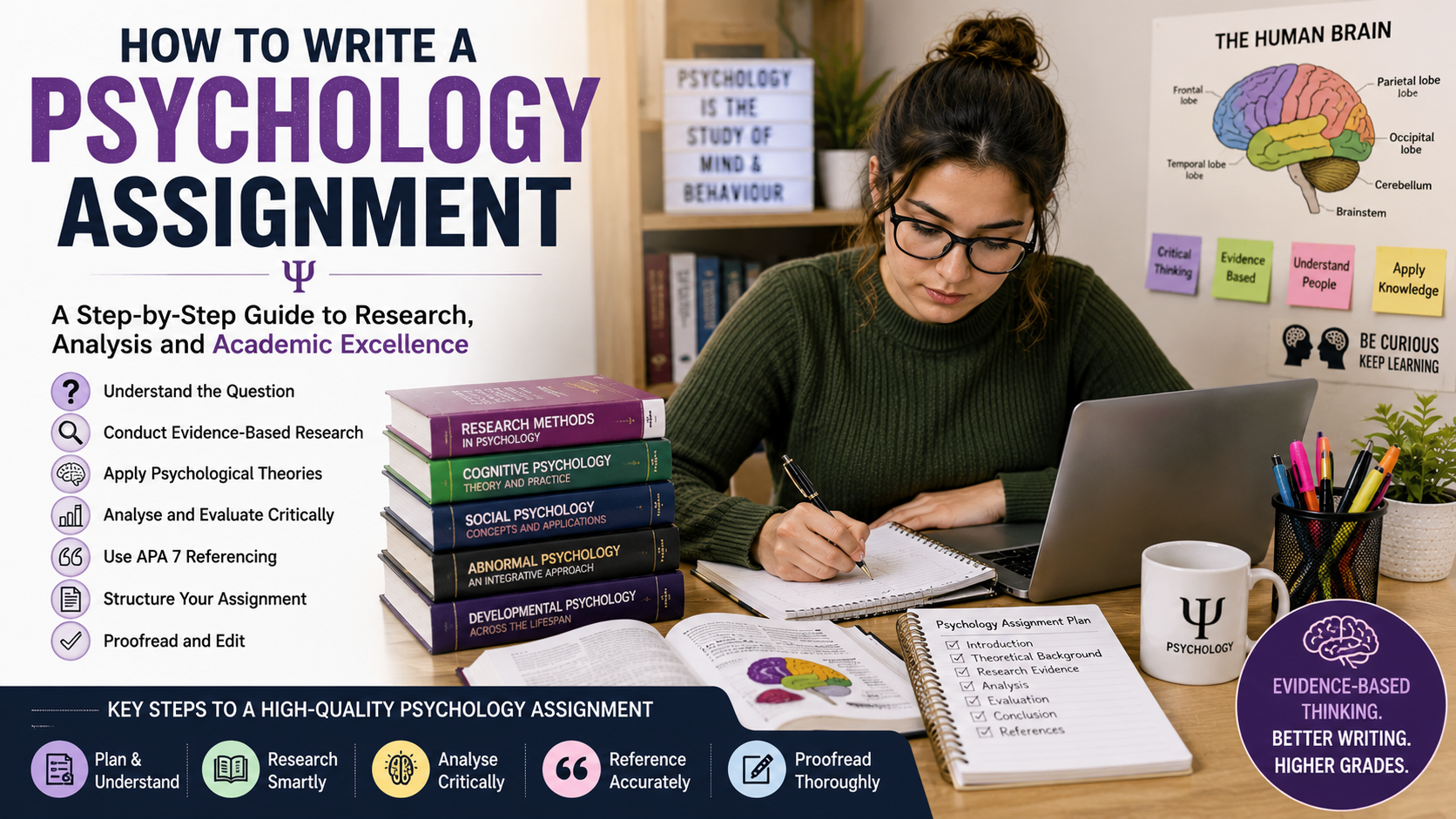
Whether you're studying psychology in Australia, the UK, Canada, or elsewhere, this guide explains how to write a high-quality psychology assignment that meets university expectations and helps you achieve higher grades.
What Is a Psychology Assignment?
A psychology assignment is an academic assessment that evaluates your understanding of psychological theories, research methods, human behaviour, cognitive processes, and evidence-based practice.
Depending on your module, you may be asked to:
Analyse a psychological theory
Evaluate research studies
Discuss mental health conditions
Interpret research findings
Write a case study
Critique journal articles
Apply psychology to real-life scenarios
Unlike many other assignments, psychology assessments require students to combine scientific evidence with critical analysis rather than personal opinions.
Why Psychology Assignments Are Important
Psychology assignments develop essential academic and professional skills, including:
Critical thinking
Scientific reasoning
Research skills
Academic writing
Evidence-based analysis
Ethical decision-making
Problem-solving
Communication skills
They also prepare students for research projects and professional practice.
Step 1: Understand the Assignment Question
Before beginning your research, carefully read the assignment instructions.
Ask yourself:
What is the topic?
What psychological theory should I discuss?
Is this an essay, report, literature review, or case study?
What is the required word count?
Which referencing style should I use?
What are the marking criteria?
Pay attention to command words.
Command Word | Meaning |
|---|---|
Discuss | Present different viewpoints supported by research |
Analyse | Break down the topic and examine each part critically |
Evaluate | Assess strengths, weaknesses, and supporting evidence |
Compare | Explain similarities and differences |
Explain | Provide detailed information supported by research |
Critically Assess | Present balanced judgement based on evidence |
Understanding these keywords helps you answer exactly what your lecturer expects.
Step 2: Conduct Evidence-Based Research
High-scoring psychology assignments rely on scientific research rather than opinions.
Use trusted academic databases such as:
PsycINFO
PubMed
Google Scholar
APA PsycArticles
ScienceDirect
JSTOR
Cochrane Library
Use sources including:
Peer-reviewed journal articles
Meta-analyses
Systematic reviews
Academic textbooks
Government reports
Professional psychology guidelines
Whenever possible, prioritise research published within the last five years.
Avoid blogs, Wikipedia, commercial websites, and unsupported claims.
Step 3: Plan Your Assignment
Create a clear outline before writing.
Example:
Introduction
↓
Background
↓
Relevant Psychological Theory
↓
Research Evidence
↓
Critical Analysis
↓
Application to the Topic
↓
Limitations
↓
Recommendations (if applicable)
↓
Conclusion
Planning helps your assignment remain logical and focused.
Step 4: Write a Strong Introduction
Your introduction should:
Introduce the topic
Provide relevant background
Explain why the topic is important
State the aim of the assignment
Briefly outline what will be discussed
Example:
This assignment critically evaluates cognitive behavioural therapy (CBT) as an evidence-based intervention for anxiety disorders by examining contemporary psychological research, theoretical frameworks, and clinical evidence.
Step 5: Apply Psychological Theories
Support your discussion using recognised psychological theories where appropriate.
Common theories include:
Cognitive Behavioural Theory (CBT)
Behaviourism
Psychodynamic Theory
Humanistic Psychology
Social Learning Theory
Attachment Theory
Cognitive Development Theory
Biological Psychology
Information Processing Theory
Ecological Systems Theory
Rather than simply describing theories, explain how they relate to your assignment topic.
Step 6: Use Scientific Evidence
Psychology is an evidence-based discipline.
Support your arguments with:
Randomised controlled trials
Longitudinal studies
Experimental research
Meta-analyses
Systematic reviews
Clinical guidelines
Peer-reviewed journal articles
Avoid making claims without academic evidence.
Step 7: Demonstrate Critical Analysis
High marks come from analysing evidence—not simply describing it.
Evaluate:
Research quality
Study limitations
Sample size
Reliability
Validity
Ethical considerations
Conflicting findings
Practical implications
Show why one study may provide stronger evidence than another.
Step 8: Reference Correctly
Most psychology departments require:
APA 7th Edition
Some universities may use Harvard referencing.
Ensure you reference:
Journal articles
Books
Government publications
Professional guidelines
Online academic resources
Incorrect referencing can lead to plagiarism penalties.
Step 9: Proofread Before Submission
Before submitting:
✔ Check grammar and spelling
✔ Verify APA formatting
✔ Review all references
✔ Improve clarity
✔ Check word count
✔ Ensure logical flow
✔ Run a plagiarism check
Common Mistakes Students Make
Avoid these common mistakes:
Weak introduction
Describing instead of analysing
Using outdated research
Relying on non-academic websites
Weak critical evaluation
Poor assignment structure
Incorrect APA referencing
Unsupported opinions
Ignoring assignment criteria
These mistakes often result in lower grades.
Tips for Achieving High Marks
Read the assignment brief carefully.
Use recent peer-reviewed journal articles.
Apply psychological theories appropriately.
Support every claim with evidence.
Analyse research critically.
Follow APA 7 guidelines.
Proofread thoroughly before submission.
Final Thoughts
Writing a psychology assignment requires careful planning, evidence-based research, and critical analysis. By understanding the assignment brief, using credible academic sources, applying recognised psychological theories, and supporting every argument with scientific evidence, you can produce a well-structured assignment that meets university expectations.
Focus on analysing research rather than describing it, use recent peer-reviewed studies, reference accurately using the required style, and proofread your work before submission. Following these strategies will help you improve both your academic writing skills and your psychology grades.
Frequently Asked Questions
Everything you need to know about our services
Related Posts

How to Write a Law Assignment Using OSCOLA (2026 Guide)

How to Write a Business Management Assignment (2026 Guide)
