How to Write an Assignment at the University of Manchester (2026 Guide)
Introuction
Writing a university assignment can seem challenging, especially if you're new to higher education or studying at the University of Manchester. Every assignment requires careful planning, independent research, critical thinking, and accurate referencing. Understanding what your lecturer expects is the first step towards producing high-quality academic work.
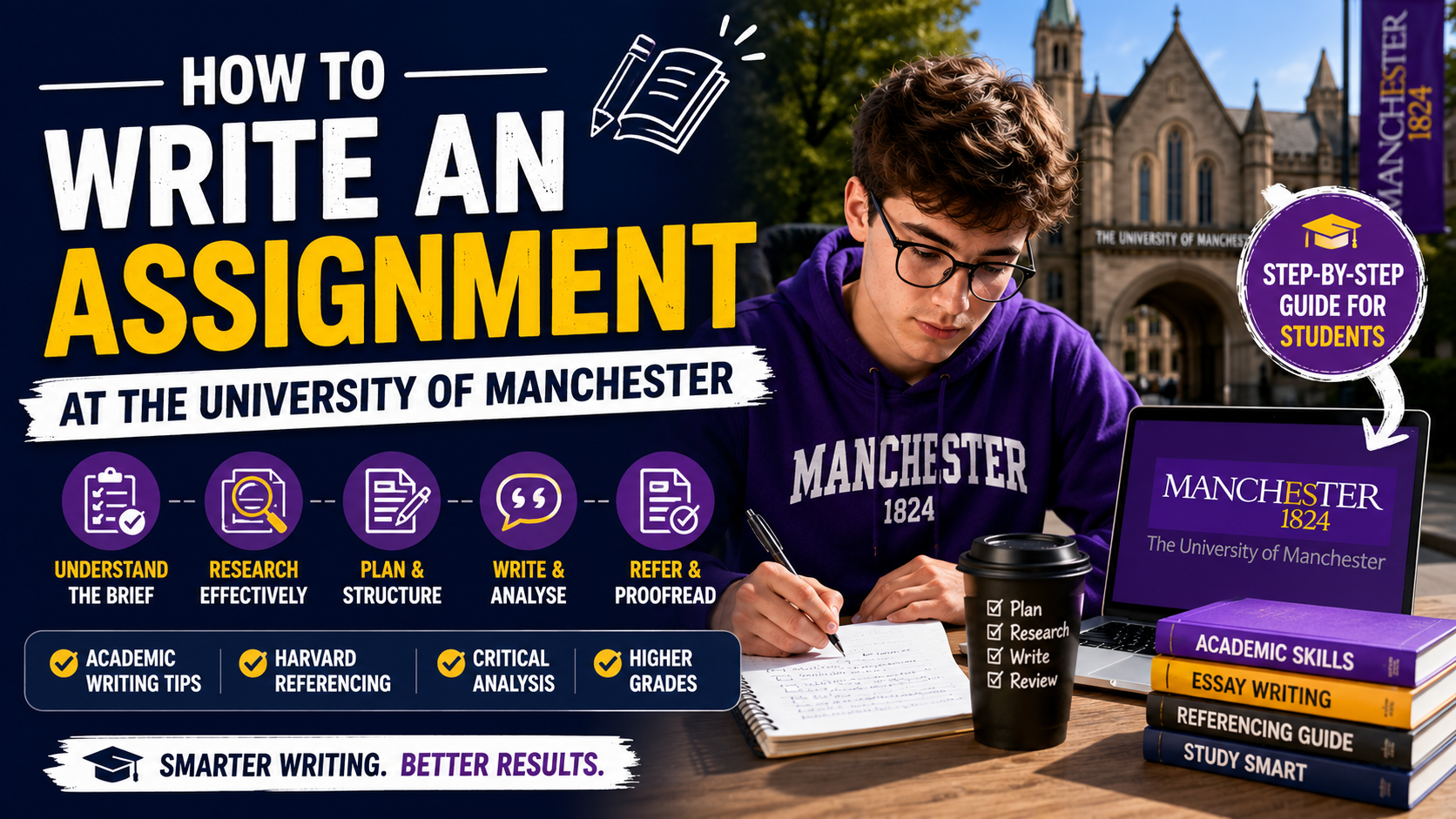
Whether you're writing an essay, report, literature review, case study, reflective assignment, or dissertation, this guide explains the assignment writing process step by step to help you produce well-structured, evidence-based work.
Understanding Assignment Requirements
Before you start writing, carefully read the assignment brief.
Pay attention to:
Learning outcomes
Word count
Assessment criteria
Submission deadline
Referencing style
Marking rubric
Highlight command words such as:
Analyse
Evaluate
Compare
Critically discuss
Explain
Justify
Assess
These words determine what your lecturer expects.
Step 1: Understand the Question
Many students lose marks because they misunderstand the assignment question.
For example:
Question
Evaluate the impact of artificial intelligence on higher education.
This requires you to:
Explain AI in higher education.
Discuss benefits.
Discuss limitations.
Evaluate evidence.
Reach a balanced conclusion.
Step 2: Conduct Academic Research
Use reliable academic sources such as:
University library databases
Peer-reviewed journal articles
Academic books
Government publications
Professional organisations
Avoid relying solely on blogs or unverified websites.
While AI tools can help explain concepts or suggest ideas, always verify information using credible academic sources and follow your university's guidance on AI use.
Step 3: Create an Assignment Plan
A simple outline could include:
Introduction
↓
Main Body
↓
Critical Analysis
↓
Discussion
↓
Conclusion
↓
Reference List
Planning before writing saves time and improves structure.
Step 4: Write a Strong Introduction
A good introduction should:
Introduce the topic.
Provide context.
State the purpose.
Outline the structure.
Aim for approximately 10% of your total word count.
Step 5: Develop the Main Body
The main body should be divided into logical sections with clear headings where appropriate.
Each paragraph should include:
Point → Main idea
Evidence → Academic source
Explanation → Interpretation
Critical Analysis → Strengths, weaknesses, comparisons
Link → Connect to the assignment question
Step 6: Demonstrate Critical Thinking
University assignments are not simply descriptive.
Show critical thinking by:
Comparing different viewpoints.
Evaluating evidence.
Identifying limitations.
Discussing implications.
Supporting arguments with research.
Step 7: Reference Correctly
Use the referencing style specified in your assignment brief.
Common styles include:
Harvard
APA
MLA
Chicago
OSCOLA
Vancouver
Check every in-text citation and bibliography entry carefully before submission.
Step 8: Write the Conclusion
An effective conclusion should:
Summarise the main findings.
Answer the assignment question.
Avoid introducing new evidence.
Reinforce the overall argument.
A conclusion is usually around 10% of the total word count.
Step 9: Edit and Proofread
Before submitting your assignment:
Check grammar and spelling.
Improve sentence clarity.
Verify references.
Ensure formatting is consistent.
Remove repetition.
Confirm the word count.
Reading your work aloud can help identify awkward phrasing and improve flow.
Assignment Structure Example
Section | Approximate Word Count (2,000-word Assignment) |
|---|---|
Introduction | 200 |
Main Body | 1,400 |
Critical Discussion | 200 |
Conclusion | 200 |
Always adapt the structure to your module requirements.
Common Assignment Mistakes
Avoid these frequent errors:
Misinterpreting the question.
Weak introduction.
Descriptive writing instead of critical analysis.
Poor paragraph structure.
Inconsistent referencing.
Limited use of academic sources.
Last-minute proofreading.
Tips for Achieving Higher Marks
Start your research early.
Use recent peer-reviewed sources where appropriate.
Link every paragraph back to the assignment question.
Write clearly and concisely.
Support claims with evidence.
Revise multiple drafts before submission.
Recommended Tools
Helpful resources include:
Google Scholar for academic research.
Zotero or Mendeley for reference management.
Grammarly for grammar and clarity.
Microsoft Word or Google Docs for writing.
Notion or Todoist for planning tasks.
Use these tools to support your workflow, but ensure the final submission reflects your own understanding and complies with your university's academic integrity and AI policies.
Final Thoughts
Writing a successful assignment at the University of Manchester involves more than simply answering the question. Careful planning, thorough research, critical analysis, and accurate referencing are all essential elements of high-quality academic work.
By understanding the assessment requirements, building a logical structure, supporting your ideas with credible evidence, and reviewing your work before submission, you can produce assignments that clearly communicate your knowledge while meeting university expectations.
Frequently Asked Questions
Everything you need to know about our services


