How to Complete a 2,000-Word Assignment in 24 Hours
A 2,000-word assignment due tomorrow can feel overwhelming. Whether you've been juggling multiple deadlines, working part-time, or simply underestimated how long the assignment would take, you're not alone.
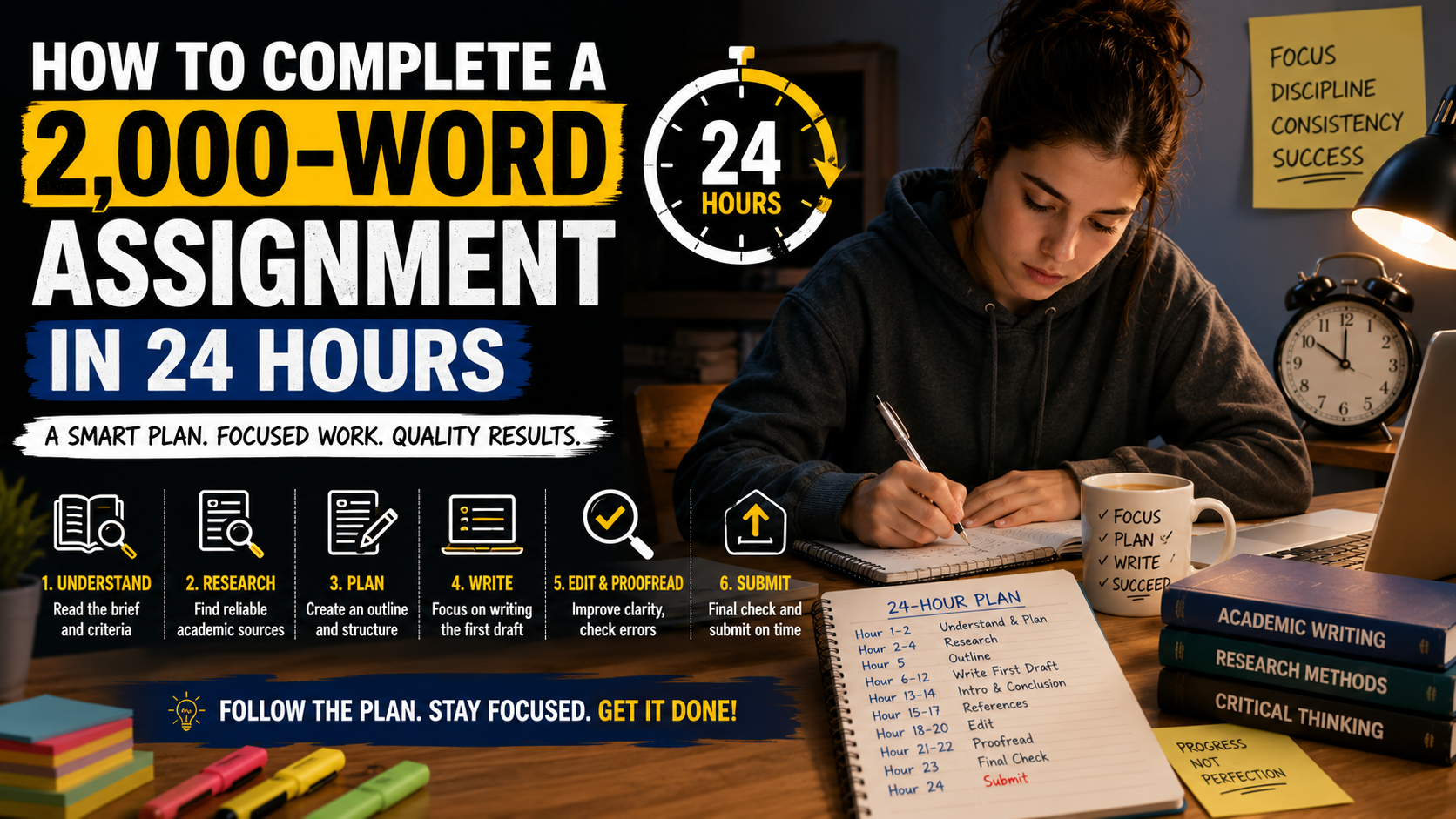
The good news? Completing a 2,000-word assignment in 24 hours is possible—provided you have a structured plan, avoid common distractions, and focus on quality over perfection.
This guide walks you through a realistic schedule that many university students can follow to submit a well-organised assignment on time.
Can You Really Write 2,000 Words in One Day?
Yes.
Most university students can write 2,000 words within 8–12 hours of focused work, assuming they understand the topic and have access to the required resources.
The challenge isn't typing 2,000 words—it's:
Understanding the assignment brief
Finding credible academic sources
Structuring arguments logically
Referencing correctly
Proofreading before submission
A good plan makes all the difference.
Before You Start: Read the Assignment Brief
Many students waste hours writing content that doesn't answer the question.
Before opening Google or your Word document, identify:
Command words (Analyse, Evaluate, Discuss, Compare, Explain)
Word count
Referencing style
Required number of academic sources
Submission format
Assessment criteria
Understanding exactly what your lecturer expects saves valuable time later.
Your 24-Hour Assignment Schedule
Hour 1: Understand the Question
Spend the first hour planning instead of writing.
During this hour:
Read the brief twice.
Highlight keywords.
Review the marking rubric.
Identify what each section should cover.
By the end of Hour 1, you should know exactly what you're writing.
Hours 2–4: Research Efficiently
Avoid reading entire textbooks.
Instead:
Use Google Scholar.
Search university library databases.
Download journal articles.
Save useful quotes.
Record references immediately.
Aim for:
8–15 credible academic sources
Recent journal articles where possible
Books only if highly relevant
Hour 5: Create an Outline
Don't start writing randomly.
A simple outline could look like:
Introduction (200 words)
Background
Context
Thesis statement
Main Body
Section 1 (450 words)
Section 2 (450 words)
Section 3 (450 words)
Section 4 (300 words)
Conclusion (150 words)
This roadmap prevents writer's block.
Hours 6–12: Write the First Draft
Start with the body paragraphs.
Many students struggle because they begin with the introduction.
Instead:
Write body paragraphs first.
Leave the introduction until later.
Finish with the conclusion.
Remember:
Don't edit while writing.
Your only goal is completing the first draft.
Use the PEEL Structure
Every paragraph should include:
Point
Introduce your main argument.
Evidence
Support it with academic research.
Explanation
Explain why the evidence matters.
Link
Connect back to the assignment question.
This structure improves clarity and academic quality.
Hour 13: Write the Introduction
Now that your arguments are complete, writing the introduction becomes much easier.
Include:
Topic background
Purpose of the assignment
Main argument
Structure overview
Keep it concise.
Hour 14: Write the Conclusion
Your conclusion should:
Summarise key findings
Reinforce your argument
Avoid introducing new evidence
Aim for around 150–200 words.
Hours 15–17: Add References
Incorrect referencing can cost easy marks.
Check:
In-text citations
Reference list
Alphabetical order
Formatting
Missing page numbers (if required)
Double-check every source you cited.
Hours 18–20: Edit for Quality
Now improve readability.
Look for:
Repeated words
Long sentences
Grammar mistakes
Weak transitions
Missing evidence
Read your assignment aloud.
Awkward sentences become much easier to spot.
Hour 21: Check Against the Rubric
Before submitting, compare your assignment with the marking criteria.
Ask yourself:
Did I answer every part of the question?
Is my argument supported?
Have I evaluated instead of described?
Did I stay within the word count?
This final comparison often boosts marks.
Hour 22: Proofread
Focus on:
Grammar
Spelling
Formatting
Headings
Citations
Page numbers
Tables and figures
Consistency
Avoid making major changes now.
Hour 23: Final Formatting
Check:
Font
Line spacing
Margins
Cover page
Student ID
File name
Save your work in multiple locations.
Hour 24: Submit Before the Deadline
Never wait until the final minute.
Technical issues happen.
Upload early and confirm your submission was successful.
Take a screenshot or save the confirmation email.
Common Mistakes That Waste Time
Avoid these:
❌ Spending three hours researching
❌ Editing every paragraph immediately
❌ Looking for perfect sources
❌ Constantly checking social media
❌ Ignoring the marking rubric
❌ Forgetting references
Time-Saving Writing Tips
Use a Timer
Work for 50 minutes.
Take a 10-minute break.
Write Before Editing
Perfection slows progress.
Finish first.
Improve later.
Turn Off Notifications
Every interruption breaks concentration.
Put your phone away while writing.
Use Academic Sources Only
Avoid relying on blogs or random websites.
Prioritise:
Peer-reviewed journals
University publications
Government reports
Academic books
Keep Your References Organised
Create your bibliography as you write.
Don't leave it until the end.
What If You Still Can't Finish?
If you've genuinely run out of time:
Complete the most heavily weighted sections first.
Finish referencing.
Proofread quickly.
Submit something rather than nothing.
A complete assignment with minor flaws usually scores better than an incomplete submission.
24-Hour Assignment Checklist
✔ Read the assignment brief
✔ Understand the marking criteria
✔ Gather academic sources
✔ Create an outline
✔ Write body paragraphs
✔ Write introduction
✔ Write conclusion
✔ Add citations
✔ Proofread
✔ Check formatting
✔ Submit early
Final Thoughts
Completing a 2,000-word assignment in 24 hours isn't ideal, but it's achievable with the right approach. The key is to stop aiming for perfection and focus on answering the assignment question clearly, supporting your arguments with credible academic sources, and following the marking criteria.
Most importantly, use this experience as motivation to start future assignments earlier. A little planning can significantly reduce stress and improve the quality of your work.
If you're facing a tight deadline and need guidance with planning, structuring, or understanding your assignment requirements, getting expert academic support can help you stay on track while maintaining academic integrity.
Frequently Asked Questions
Everything you need to know about our services
Related Posts

How to Write an Assignment Introduction That Impresses Professors

Assignment Editing Checklist: 20 Things to Review Before You Submit
