How Many References Do UK Universities Expect?
Introduction
One of the most common questions students ask before submitting an assignment is:
"How many references should I include?"
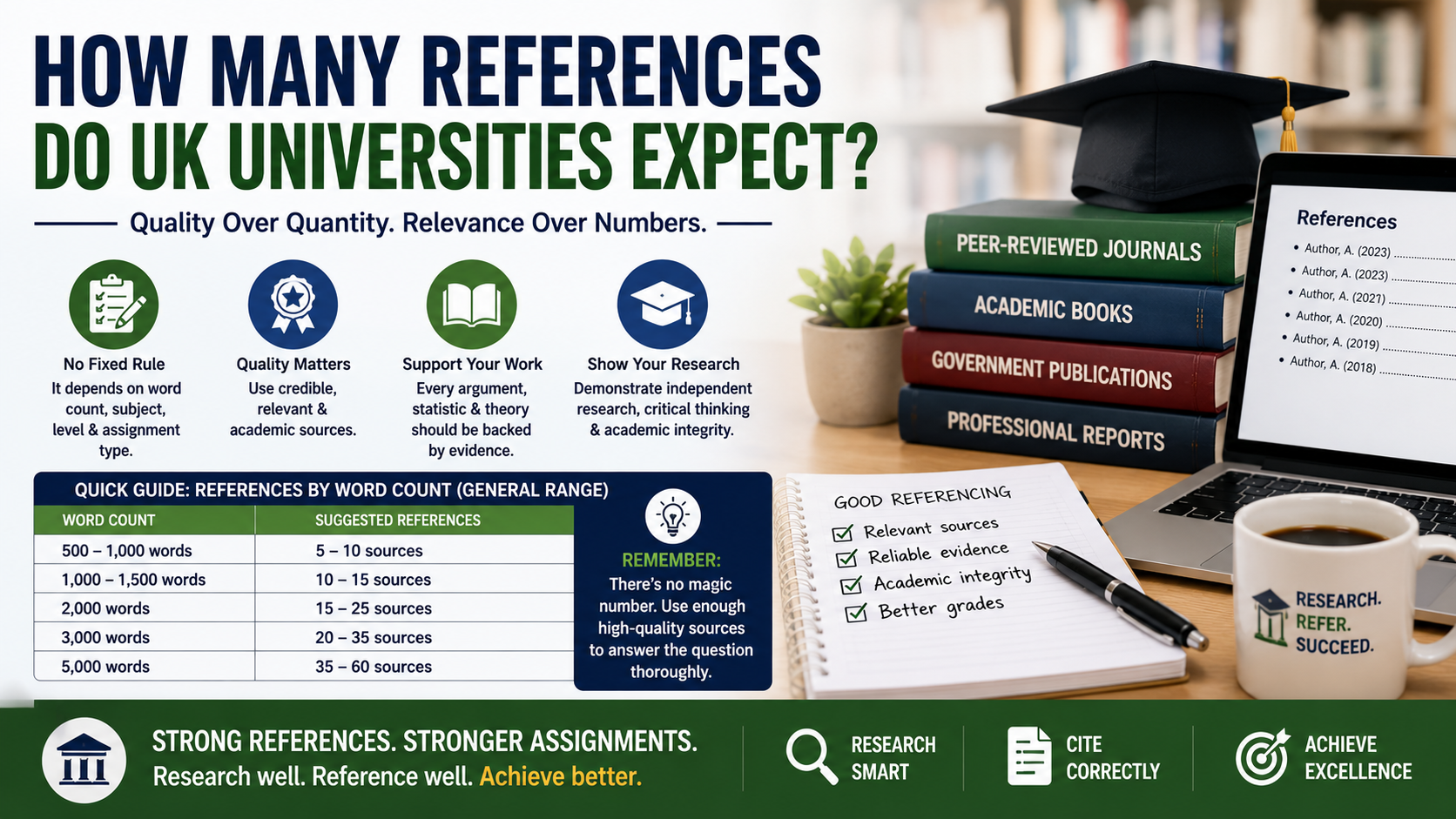
Unfortunately, there is no universal answer.
Unlike word counts or submission deadlines, UK universities rarely specify an exact number of references. Instead, lecturers assess the quality, relevance, credibility, and use of sources, rather than simply counting them.
Adding 100 references will not automatically earn higher marks, just as including only five references does not necessarily mean your assignment is weak.
In this guide, you'll learn:
Is There a Required Number of References?
In most UK universities, there is no fixed rule stating exactly how many references an assignment must contain.
Instead, lecturers expect students to include enough credible academic sources to:
Support arguments
Demonstrate research
Show understanding of the literature
Answer the assignment question effectively
The correct number depends on:
Word count
Subject area
Assignment type
Academic level
Module requirements
Always check your assignment brief first because some departments provide recommended reference ranges.
Why References Matter
References are much more than citations at the end of an assignment.
They demonstrate that you have:
Conducted independent research
Used credible academic evidence
Supported your arguments
Avoided plagiarism
Engaged with existing scholarship
Well-chosen references strengthen your credibility and improve the quality of your work.
Quality Matters More Than Quantity
One of the biggest misconceptions is that more references automatically mean higher marks.
This is not true.
Lecturers are interested in whether you use:
Relevant sources
Reliable research
Current evidence
Peer-reviewed literature
Twenty excellent academic references are usually stronger than fifty poor-quality sources.
Typical Reference Expectations by Word Count
Although universities differ, students often use the following as a general guideline.
500–1,000 Words
Suggested references:
5–10 academic sources
Suitable for:
Short essays
Reflective assignments
Discussion posts
1,000–1,500 Words
Suggested references:
10–15 sources
Common for:
Essays
Reports
Case studies
2,000 Words
Suggested references:
15–25 sources
This is one of the most common university assignment lengths.
Students are expected to demonstrate wider reading and stronger engagement with academic literature.
3,000 Words
Suggested references:
20–35 sources
Assignments at this length usually require:
Greater depth
More critical analysis
Broader literature coverage
5,000 Words
Suggested references:
35–60 sources
Research projects and dissertations often require substantial literature review.
Undergraduate vs Postgraduate Expectations
Undergraduate Students
Most undergraduate assignments demonstrate:
Understanding
Research skills
Academic writing
Critical thinking
Reference expectations are generally moderate.
Postgraduate Students
Master's-level work typically requires:
More extensive literature
Higher-quality sources
Greater critical analysis
Current research
As a result, postgraduate assignments often include significantly more references.
Assignment Type Also Matters
Different assessments require different levels of research.
Essays
Essays typically rely heavily on academic literature.
Students usually include:
Journal articles
Books
Academic theories
Reports
Reports often combine:
Academic research
Industry publications
Government reports
Literature Reviews
Literature reviews require the highest number of references because they focus on analysing existing research.
Case Studies
Case studies usually combine:
Academic theories
Real-world evidence
Organisational data
Reflective Assignments
Reflective work generally uses fewer references because personal reflection forms part of the discussion.
What Types of References Do Lecturers Prefer?
UK universities generally prefer:
Peer-Reviewed Journal Articles
These are considered the highest-quality academic sources.
Academic Books
Books provide detailed theoretical discussion.
Government Publications
Useful for:
Statistics
Policies
Official guidance
Professional Organisations
Examples include:
NHS
World Health Organization
Office for National Statistics
University Publications
Reliable university resources are also acceptable.
Sources Students Should Use Carefully
Some sources are acceptable only in limited situations.
These include:
News articles
Company websites
Professional blogs
While useful for current information, they should not replace academic literature.
Sources Usually Discouraged
Students should avoid relying heavily on:
Wikipedia
Random blogs
Unverified websites
Anonymous online content
These sources rarely meet academic standards.
How Often Should You Reference?
A common question is:
"Should every sentence have a citation?"
Not necessarily.
However:
Every major claim, statistic, theory, or borrowed idea should be supported by a reference.
Avoid long sections without citations.
Common Referencing Styles Used in UK Universities
Different universities require different citation styles.
The most common include:
Harvard
APA
MLA
OSCOLA
Chicago
Always follow the referencing style specified by your lecturer.
Common Referencing Mistakes
Students frequently lose marks because they:
Use too few sources
Cite unreliable websites
Reference inconsistently
Forget in-text citations
Include incomplete references
Good referencing demonstrates academic integrity.
Signs You May Need More References
Your assignment may require additional research if:
Several paragraphs contain no citations.
You rely on only one or two authors.
Most references are outdated.
Arguments are unsupported.
Broader reading often strengthens academic discussion.
Can Too Many References Be a Problem?
Yes.
Including unnecessary references simply to increase the total number can make writing:
Repetitive
Unfocused
Difficult to read
Every source should contribute meaningfully to your argument.
Tips for Choosing Strong References
Prioritise Recent Research
Where appropriate, use current literature published within the last five to ten years.
Use Multiple Authors
Avoid relying on a single source throughout your assignment.
Read Beyond Abstracts
Understanding the full paper improves critical analysis.
Balance Sources
Use:
Journal articles
Academic books
Government publications
rather than relying on only one source type.
Reference Management Software
Many students use software such as:
Zotero
Mendeley
EndNote
These tools help organise references and reduce formatting errors.
Quick Reference Checklist
Before submitting your assignment, ask:
✔ Have I used enough academic sources?
✔ Are most references peer-reviewed?
✔ Have I followed the required referencing style?
✔ Does every major argument have supporting evidence?
✔ Is my reference list complete?
If yes, your referencing is likely meeting university expectations.
Key Takeaways
UK universities rarely specify an exact number of references.
Quality is more important than quantity.
Reference expectations depend on assignment length and academic level.
Peer-reviewed journals remain the preferred source type.
Accurate and consistent referencing improves assignment quality.
Strong research supports stronger academic arguments.
Conclusion
There is no magic number of references that guarantees higher grades. Instead, UK universities expect students to use enough relevant, credible, and well-integrated academic sources to support their discussion.
Rather than focusing on reaching a particular number, concentrate on selecting high-quality evidence, engaging critically with the literature, and following your university's referencing guidelines.
Doing so will strengthen your assignments, demonstrate academic integrity, and improve your chances of achieving higher grades.
Frequently Asked Questions
Everything you need to know about our services


