Essay Writing Help for UBC Students
Introduction
Writing an academic essay at the University of British Columbia (UBC) can be challenging, especially when you are balancing lectures, readings, research, exams, part-time work, and multiple assignment deadlines.
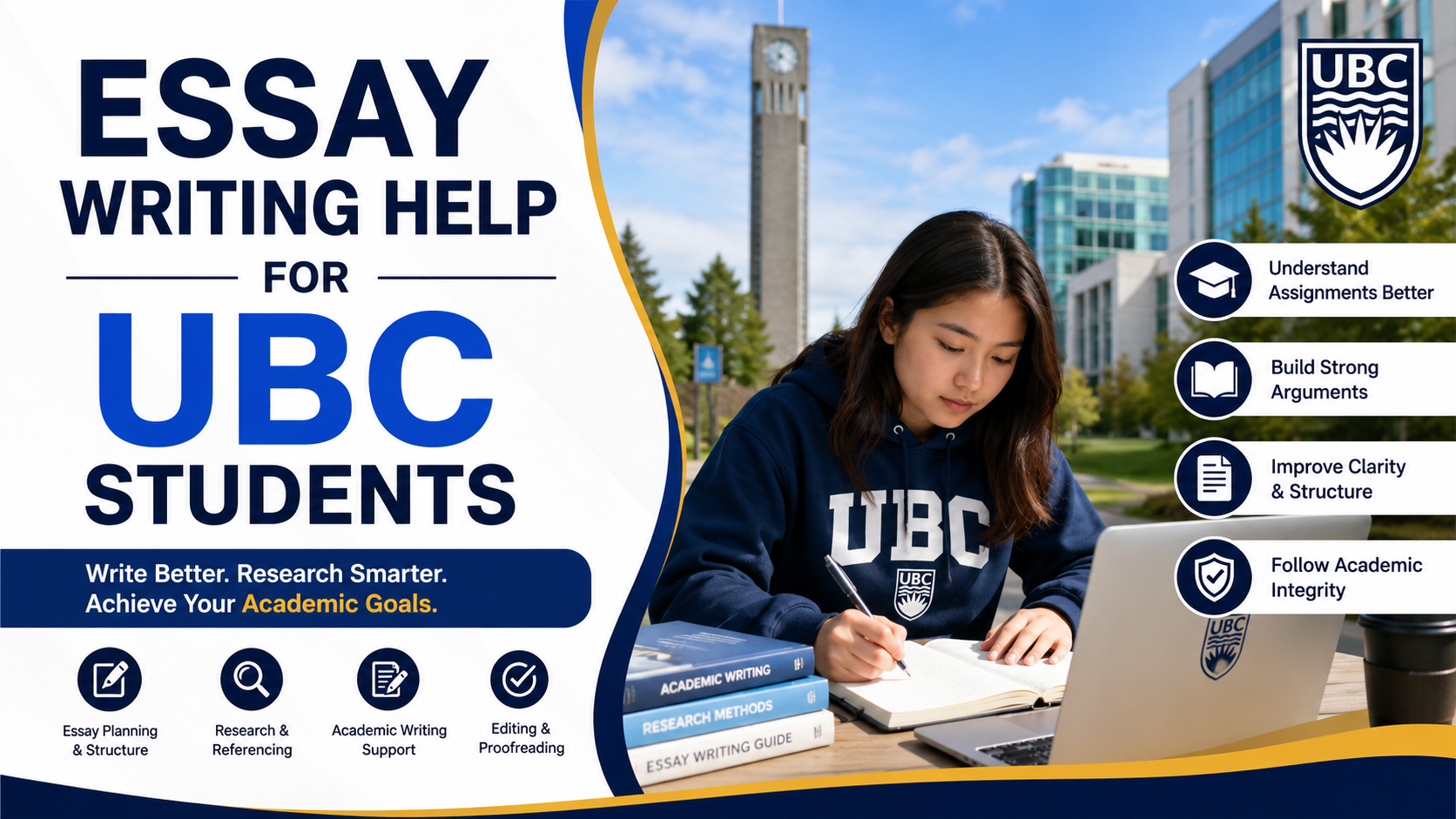
Whether you are an undergraduate student working on your first university essay or a graduate student preparing a research-based paper, strong academic writing requires more than simply putting information on a page. You need to understand the assignment, develop a clear argument, evaluate credible sources, structure your ideas logically, and reference those sources correctly.
That is where essay writing help for UBC students can be useful—provided the support helps you develop and improve your own work rather than submitting someone else's work as your own.
What Is Essay Writing Help for UBC Students?
Essay writing help can cover many different stages of the writing process.
For example, you may need help with:
Understanding an essay question
Choosing and narrowing a topic
Developing a thesis statement
Creating an essay outline
Finding credible academic sources
Organising research
Building stronger arguments
Improving paragraph structure
Editing grammar and clarity
Checking citations and references
Improving academic tone
Reviewing a draft before submission
The goal should be to make you a better and more confident academic writer.
UBC's Centre for Writing and Scholarly Communication (CWSC) provides writing consultations for students at different stages of their studies. Its consultations can focus on areas such as ideas, organisation, clarity, argument, and revision.
Why Do UBC Students Struggle With Essays?
University essays are considerably different from many high-school assignments.
At UBC, students may be expected to engage with scholarly literature, develop an independent argument, analyse evidence, and follow conventions specific to their discipline.
Common challenges include:
1. Understanding the Essay Question
Some essay questions look straightforward but contain several requirements.
For example, a question asking you to “critically evaluate” a theory is not simply asking you to explain the theory.
You may need to:
Explain the relevant concept.
Identify important scholarly perspectives.
Examine supporting evidence.
Discuss limitations or opposing viewpoints.
Compare different interpretations.
Reach a reasoned conclusion.
Understanding the instruction words in your assignment question can therefore make a major difference.
2. Developing a Strong Thesis
A thesis statement tells the reader what your essay is arguing.
A weak thesis might simply announce the topic:
This essay discusses the impact of social media on university students.
A stronger thesis makes a specific argument:
Although social media can facilitate academic collaboration and communication, excessive use may negatively affect students' concentration and study habits.
The second example gives the reader a position that the essay can actually analyse and defend.
3. Finding Reliable Academic Sources
University-level essays generally require more than a collection of websites.
Depending on your course, you may need to use:
Peer-reviewed journal articles
Academic books
Government publications
Institutional reports
Scholarly databases
Primary research
Course readings
UBC Library provides research resources and subject-specific guides that can help students locate academic material and work with citations.
When researching, don't simply collect as many sources as possible. Focus on finding sources that directly support the argument you are developing.
How to Structure a UBC Essay
Although requirements vary between courses and disciplines, a basic academic essay commonly includes an introduction, body paragraphs, and conclusion.
Introduction
Your introduction should establish the topic and provide direction for the reader.
A useful introduction may include:
Background or context
The specific issue being discussed
The scope of the essay
Your central argument or thesis
A brief indication of how the argument will be developed
Avoid filling the introduction with unnecessary background information.
Body Paragraphs
Each body paragraph should contribute something meaningful to your overall argument.
A useful structure is:
Point → Evidence → Analysis → Connection
Start with a clear point.
Then introduce relevant evidence from an appropriate source.
After presenting the evidence, explain what it means and why it matters.
Finally, connect the analysis back to your thesis.
This is important because an essay should not become a collection of quotations. Your analysis should explain the significance of the evidence.
Conclusion
A strong conclusion should bring the argument together rather than simply repeat the introduction.
You can:
Restate the central argument in a fresh way
Summarise the major findings
Explain the broader significance
Identify implications or limitations where appropriate
Avoid introducing an entirely new argument in the conclusion.
What Does Good Essay Writing Help Look Like?
The most useful academic support is usually focused on improving your own writing process.
For example, instead of asking someone to write an essay that you submit for a grade, you could seek guidance on:
Topic selection:
Is the topic narrow enough for the required word count?
Research:
Are the sources credible and relevant?
Argument:
Does the evidence actually support the thesis?
Structure:
Does each paragraph have a clear purpose?
Analysis:
Does the essay explain the significance of the evidence?
Clarity:
Can the reader understand the argument easily?
Referencing:
Have sources been properly acknowledged according to the required style?
This approach can provide practical assistance while keeping the academic work your own.
UBC Students Should Understand Academic Integrity
Academic integrity is particularly important when seeking essay assistance.
UBC states that students should be careful about unauthorized assistance and collaboration. Its academic integrity guidance explains that having someone else complete assessed work for you can constitute academic misconduct, including when a student pays another person to do the work.
UBC also notes that collaboration rules can vary depending on the course and assignment. Students should therefore check the instructions provided by their instructor or syllabus before receiving outside assistance.
This means students should distinguish between academic support and having assessed work completed for them.
Safer Types of Essay Support
Depending on your instructor's rules, useful support may include:
Discussing how to approach an assignment
Learning academic writing techniques
Receiving feedback on your writing
Improving grammar and readability
Understanding referencing conventions
Learning how to conduct research
Reviewing an outline
Learning how to develop an argument
Practising essay planning
Always make sure the specific form of assistance is permitted for your assignment.
How to Write a Better Essay Under a Tight Deadline
If your essay deadline is approaching, avoid trying to write everything in one sitting.
Instead, divide the task into smaller stages.
Step 1: Read the Assignment Instructions
Identify:
The question
Word count
Deadline
Required sources
Referencing style
Assessment criteria
Any restrictions on collaboration or technology
Step 2: Break Down the Question
Underline the important instruction words.
For example:
Analyse
Compare
Evaluate
Critically discuss
Explain
Assess
Examine
Each instruction requires a different approach.
Step 3: Create a Preliminary Thesis
Write your initial answer to the question in one or two sentences.
You can refine it after conducting research.
Step 4: Research Strategically
Search for sources that address the specific parts of your question.
Keep track of:
Author
Publication year
Title
Key argument
Relevant evidence
Page numbers where applicable
Citation information
Doing this while researching can save significant time later.
Step 5: Build an Outline
Create headings for the major parts of your argument.
For example:
Introduction
Argument 1
Argument 2
Counterargument
Analysis
Conclusion
Your actual structure will depend on the assignment.
Step 6: Write the First Draft
Don't try to make every sentence perfect immediately.
Focus first on communicating your argument clearly.
You can improve wording, transitions, grammar, and formatting during revision.
Step 7: Revise
Revision should involve more than checking spelling.
Ask yourself:
Does my thesis answer the question?
Does every paragraph support my argument?
Have I analysed my evidence?
Are my sources relevant?
Are opposing perspectives addressed where appropriate?
Does the conclusion follow from the discussion?
Step 8: Proofread Before Submission
Check:
Grammar
Spelling
Formatting
Citations
Reference list
Headings
Word count
Assignment requirements
A final checklist can prevent avoidable mistakes.
Essay Writing Support at UBC
UBC itself provides several resources that students can use before looking for external academic support.
The Centre for Writing and Scholarly Communication offers writing consultations to UBC students and can provide feedback at different stages, from early ideas to near-final drafts. The centre describes its consultations as free, confidential, and focused on helping students revise and make decisions about their own writing.
UBC also provides writing and research guides covering areas such as literature reviews, research introductions, annotated bibliographies, discussions, and conclusions.
For UBC Okanagan students, the Student Learning Hub provides free writing and language support for undergraduate students.
Using these resources early can be particularly helpful if you are struggling with academic writing.
When Should You Seek Essay Writing Help?
You don't necessarily have to wait until the night before your deadline.
Consider getting writing support when:
You don't understand the assignment question.
You cannot develop a thesis.
Your research feels unfocused.
Your paragraphs lack structure.
You struggle to connect evidence with your argument.
English is not your first language.
Your essay feels repetitive.
You are unsure about academic tone.
You need feedback on a draft.
You repeatedly lose marks for organisation or clarity.
Getting support earlier gives you more time to apply the feedback yourself.
How Assignment Cart Can Help UBC Students
If you are looking for academic writing support outside university resources, Assignment Cart can be used as an additional learning and writing-support resource.
Students can seek guidance with areas such as:
Essay planning
Academic writing
Research organisation
Essay structure
Referencing guidance
Proofreading and editing
Dissertation and research writing
Understanding difficult academic topics
The important distinction is that students should use academic assistance to learn, improve, review, and develop their own work, while following the rules established by their UBC course and instructor.
Before using any external service, check whether the type of assistance is permitted for your particular assignment.
Final Thoughts
Writing a strong UBC essay is a process rather than a one-time task. The strongest essays usually combine a clear argument, relevant evidence, logical organisation, critical analysis, and careful revision.
If you are struggling, don't wait until the deadline to seek support. UBC already provides writing and research resources, and students can also explore other forms of academic support where permitted.
Most importantly, make sure any assistance you receive complies with your course requirements and UBC's academic integrity expectations. The objective of essay writing support should be to help you become a stronger, more independent writer—not to replace your own academic work.
Frequently Asked Questions
Everything you need to know about our services
Related Posts

Essay Writing Help for University of Canterbury Students

Essay Editing Services for International Students in New Zealand
