Essay Writing Help for University of Canterbury Students
Introduction
Writing a university essay can be challenging, particularly when you are managing lectures, readings, tutorials, exams, part-time work and several assessment deadlines at the same time.
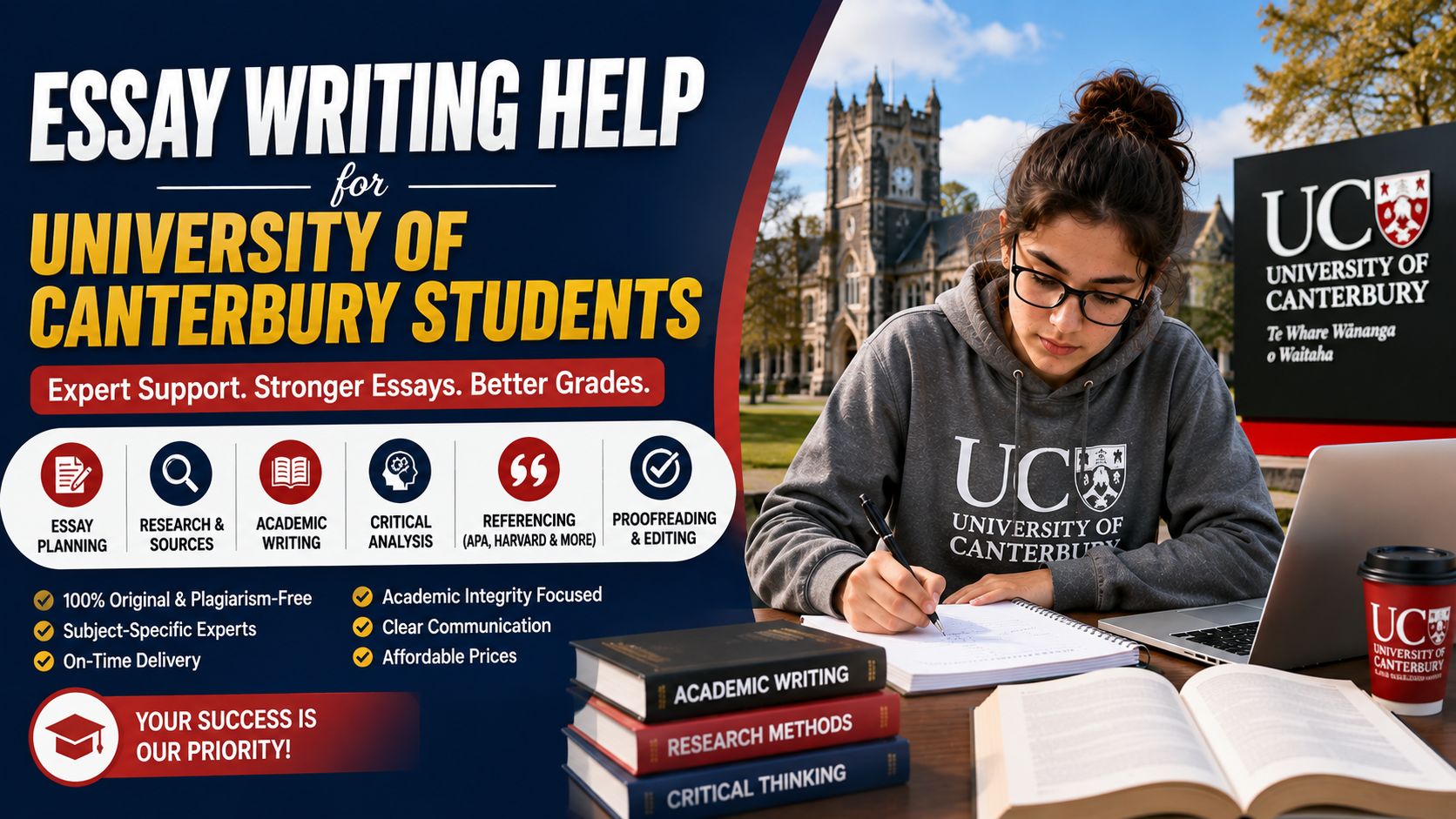
For students at the University of Canterbury (UC), essays can require much more than describing a topic. You may need to interpret a complex question, locate credible academic sources, develop an argument, analyse evidence, demonstrate critical thinking and use the referencing style required by your course.
If you are struggling with an essay, the most useful approach is to identify exactly where the difficulty lies. You may need support with understanding the question, researching sources, planning your argument, improving paragraph structure, developing critical analysis, referencing or proofreading.
This guide explains how University of Canterbury students can approach essay writing and where additional academic support may be useful.
What Is Essay Writing Help?
Essay writing help refers to academic guidance that helps students develop the skills needed to plan, research, write, analyse and revise university essays.
Support can include:
Understanding essay questions
Planning an essay
Developing a thesis statement
Finding academic sources
Creating an essay outline
Structuring paragraphs
Developing critical analysis
Integrating evidence
Paraphrasing
Referencing
Editing and proofreading
Understanding lecturer feedback
Improving academic vocabulary
Managing essay deadlines
The goal of responsible academic support should be to help you understand the task and improve your own academic work, rather than replace your responsibility for completing an assessment.
Essay Help for University of Canterbury Students
The University of Canterbury has its own Te Pokapū Pūkenga Ako | Academic Skills Centre (ASC), which provides free academic support to students from first year through PhD level.
The Academic Skills Centre offers individual consultations, workshops, seminars, lectures and online resources covering writing, study strategies, critical thinking, referencing and subject-specific academic communication.
UC also offers an Introduction to Essay Writing programme covering areas such as analysing essay topics, developing arguments, research and note-taking, planning, essay structure, introductions, body paragraphs and conclusions.
This makes the University's own academic-learning resources an important starting point if you are struggling with essay writing.
Why University Essays Can Be Difficult
University essays require students to make decisions rather than simply reproduce information.
You may need to decide:
What does the question actually ask?
Which information is relevant?
Which sources are credible?
What position should I take?
Which evidence supports my argument?
How should different sources be compared?
What are the limitations of the evidence?
How should the essay be structured?
What referencing style does the course require?
A common mistake is to begin researching before understanding the question.
A better process is:
Question → Requirements → Research → Argument → Outline → Draft → Analysis → Referencing → Editing
How to Understand a University Essay Question
Before researching, break the question into its essential components.
Look for:
1. Topic
What subject or issue are you being asked to discuss?
2. Command Word
What are you being asked to do?
3. Scope
What specific period, population, theory, organisation, country or issue should you focus on?
4. Evidence
What type of evidence is likely to be required?
5. Outcome
Are you expected to explain, compare, analyse, evaluate or argue?
Common university command words include:
Analyse
Evaluate
Discuss
Compare
Contrast
Explain
Examine
Critically assess
Justify
Assess
The command word is particularly important.
For example, "describe" generally requires explanation of characteristics or features, while "evaluate" requires a reasoned judgement supported by evidence.
How to Plan a University Essay
Do not begin by writing the introduction.
Start with an outline.
A simple planning process is:
Essay Question
↓
Main Argument
↓
Key Points
↓
Evidence
↓
Analysis
↓
Conclusion
For a 2,000-word essay, for example, your outline might look like:
Section | Purpose |
|---|---|
Introduction | Introduce topic and central argument |
Body 1 | First major argument |
Body 2 | Second major argument |
Body 3 | Third major argument |
Body 4 | Counterargument or alternative perspective |
Conclusion | Synthesis and final position |
The exact structure should always follow your assessment instructions.
UC's Academic Skills Centre provides resources specifically covering essay structure, understanding essay questions, the writing process, paraphrasing and essay management.
How to Write a Strong Thesis Statement
Your thesis is the central position or argument of your essay.
A weak thesis might simply announce the topic:
This essay will discuss the effects of social media on students.
A stronger thesis takes a position:
Although social media can support communication and collaborative learning, its educational benefits depend heavily on how students use these platforms and the learning environment in which they are introduced.
The second version gives the reader an idea of the argument that the essay will develop.
A useful formula is:
Topic + Position + Reason/Qualification
Your thesis does not necessarily have to fit this exact formula, but it should provide a clear direction for your discussion.
How to Structure an Essay
A typical university essay contains three major components:
Introduction
The introduction should:
Introduce the topic
Provide relevant context
Establish the issue
Present your central argument
Explain the scope where necessary
Main Body
The body develops the argument through logically organised paragraphs.
Each paragraph should have a clear purpose.
Conclusion
The conclusion should:
Bring together the major arguments
Answer the essay question
Reinforce the overall position
Highlight implications where appropriate
Do not introduce a completely new major argument in the conclusion.
How to Write Effective Body Paragraphs
A useful paragraph structure is:
Point → Evidence → Analysis → Link
Point
Introduce the main idea.
Evidence
Use an appropriate academic source, example, statistic or research finding.
Analysis
Explain what the evidence means and why it matters.
Link
Connect the discussion back to the essay question and overall argument.
For example:
Point: Introduce the argument.
Evidence: Provide research supporting it.
Analysis: Explain the significance and limitations of the evidence.
Link: Show how this contributes to the overall thesis.
This approach helps prevent paragraphs from becoming simple summaries of academic sources.
Critical Analysis vs Description
One of the biggest challenges in university essay writing is moving from description to analysis.
Descriptive writing
The theory suggests that consumers make decisions based on several psychological factors.
This tells the reader what the theory says.
Analytical writing
The theory provides a useful explanation of consumer decision-making, but its emphasis on individual psychological factors may overlook the influence of social and cultural environments.
This goes further by evaluating the theory.
Critical analysis involves asking:
Why is this evidence important?
Is the source convincing?
What assumptions does the argument make?
Are there limitations?
Are there alternative explanations?
Do other researchers disagree?
How does the evidence relate to the essay question?
A useful framework is:
Claim → Evidence → Interpretation → Evaluation → Implication
How to Find Academic Sources
Strong essays require appropriate evidence.
Depending on your subject, useful sources may include:
Peer-reviewed journal articles
Academic books
Government publications
Official statistics
Research reports
Professional organisations
University publications
Primary sources
Scholarly databases
Do not assume that every result appearing in a search engine is an appropriate academic source.
Before using a source, consider:
Authority: Who produced it?
Currency: Is the information sufficiently recent?
Relevance: Does it directly support your argument?
Evidence: Does the source provide credible support?
Purpose: Why was the material produced?
How to Use Sources in an Essay
A common mistake is to add citations without explaining them.
Instead of:
Social media use has increased among university students (Author, 2025).
Move towards:
Research indicates that social media use has become increasingly integrated into university students' everyday communication (Author, 2025). However, the educational value of these platforms depends on whether students use them for collaborative learning or primarily for non-academic engagement.
The second example uses the source as part of an argument rather than treating the citation as the argument itself.
Think of academic sources as evidence for your thinking, not substitutes for your thinking.
Literature Review Essay Help
Some essays require substantial engagement with academic literature.
A literature-based essay should not simply present:
Source 1 says X.
Source 2 says Y.
Source 3 says Z.
Instead, synthesise the research.
For example:
Theme → Evidence → Comparison → Evaluation → Implication
Look for:
Agreements
Disagreements
Different methodologies
Theoretical differences
Research gaps
Limitations
Emerging findings
A strong literature discussion demonstrates how sources relate to each other.
How to Write an Essay Introduction
A practical introduction structure is:
Background
Introduce the broader issue.
Context
Narrow the discussion towards the specific topic.
Problem or Debate
Identify the issue being examined.
Thesis
Present your central argument.
Scope
Explain what the essay will cover if necessary.
Avoid filling the introduction with information that does not contribute to your argument.
The introduction should prepare the reader for the discussion that follows.
How to Write an Essay Conclusion
A strong conclusion does more than repeat the introduction.
Use it to synthesise your argument.
A useful structure is:
Main Finding → Key Evidence → Overall Judgement → Implication
Ask:
What has the essay demonstrated?
Then answer the question directly.
If the essay asks you to evaluate an issue, the conclusion should provide your overall evaluation.
Referencing Help for UC Students
Referencing is an essential part of university academic writing.
UC's Academic Skills Centre provides resources covering APA referencing, paraphrasing, plagiarism, when to reference and other academic-writing skills.
Your course or lecturer should determine which referencing style you need to use.
Before submitting an essay, check:
In-text citations
Reference list
Author names
Publication dates
Titles
Journal or book details
DOI or URL where required
Formatting
Consistency
Keep track of your sources while researching rather than trying to reconstruct your references immediately before submission.
UC's current academic-integrity guidance specifically recommends keeping track of sources throughout the writing process.
Paraphrasing and Academic Writing
Paraphrasing does not mean changing a few words from the original sentence.
Effective paraphrasing requires you to:
Understand the original idea.
Put the source aside.
Explain the idea in your own wording and sentence structure.
Compare your version with the source.
Cite the original source.
If the wording or structure remains too close to the original, it may still constitute inappropriate copying.
When exact wording is important, use a quotation and cite the source according to your required referencing style.
Essay Writing Help for International Students
International students may face additional challenges when adapting to academic writing expectations.
These can include:
Academic vocabulary
Essay structure
Critical analysis
Paraphrasing
Referencing
Understanding command words
Developing arguments
Managing large reading loads
UC's Academic Skills Centre provides support for students at different stages, including English-language learners and students adjusting to university academic requirements.
The University also provides an English Language Support Programme among its Academic Skills Centre workshops.
If English is an additional language for you, focus on developing academic writing gradually rather than trying to improve everything at once.
Essay Help for Postgraduate Students
Postgraduate essays generally require deeper engagement with research and more sophisticated analysis.
You may need to:
Compare competing theories
Critically evaluate research
Identify methodological limitations
Synthesize literature
Develop an independent argument
Identify research gaps
Connect theory with practice
Postgraduate students should avoid assuming that more citations automatically mean a stronger essay.
The quality of your synthesis and analysis is usually more important than simply increasing the number of references.
UC's Academic Skills Centre provides academic support through to PhD level and offers postgraduate-focused support and workshops.
Essay Writing Help for Different Subjects
Essay expectations vary significantly between disciplines.
Business Essays
Business essays may involve:
Management theories
Marketing
Finance
Accounting
Strategy
Organisational behaviour
Entrepreneurship
A useful approach is:
Theory → Evidence → Business Application → Analysis → Recommendation
Law Essays
Law essays may require:
Legislation
Case law
Legal principles
Authority
Legal reasoning
Critical analysis
Always follow the legal citation and structural requirements for your course.
Psychology Essays
Psychology essays commonly require:
Academic research
Psychological theories
Empirical evidence
Critical evaluation
Methodological discussion
Avoid simply describing theories without evaluating supporting evidence.
Engineering Essays
Engineering students may need to combine technical knowledge with academic analysis.
Assignments can involve:
Technical reports
Design analysis
Research
Engineering ethics
Sustainability
Technology evaluation
Computer Science Essays
Computer science writing may involve:
Technology evaluation
Algorithms
Artificial intelligence
Cybersecurity
Software engineering
Human-computer interaction
Technical claims should be supported with appropriate evidence.
Education Essays
Education essays may involve:
Learning theories
Teaching approaches
Educational policy
Classroom practice
Research evidence
Critical reflection
Connect theory to evidence and educational practice rather than simply describing concepts.
How to Manage an Essay Deadline
If your deadline is approaching, create a simple schedule.
Day 1: Understand
Read the question and marking criteria.
Day 2: Research
Find the most relevant academic sources.
Day 3: Plan
Create your thesis and essay outline.
Day 4–5: Draft
Write the main body first if that helps you establish your argument.
Day 6: Revise
Improve structure and analysis.
Day 7: Proofread
Check referencing, grammar and formatting.
If you have less time, use the same sequence but compress the stages.
The important point is to avoid spending the entire available period researching without producing a plan or draft.
What to Do If You Are Struggling With an Essay
First identify the specific problem.
Problem: "I don't understand the question."
Focus on breaking down the command words and scope.
Problem: "I can't find sources."
Use academic databases and university library resources.
Problem: "I have sources but no argument."
Identify the major themes, disagreements and evidence within the literature.
Problem: "My essay is descriptive."
Add comparison, evaluation, limitations and implications.
Problem: "My paragraphs don't connect."
Return to your thesis and make sure every paragraph contributes to it.
Problem: "My word count is too high."
Remove repetition, unnecessary background and sentences that do not contribute to your argument.
Problem: "My essay doesn't flow."
Review the order of your arguments and add clear transitions between ideas.
Common Essay Writing Mistakes
1. Not Answering the Question
A well-written essay can still fail to meet the assessment requirements if it does not answer the question directly.
2. Writing Too Much Background
Background should support your argument rather than consume the entire word count.
3. Relying on Description
University essays often require analysis and evaluation.
4. Using Weak Sources
Prioritise credible academic and professional evidence.
5. Citation Dumping
Adding several citations without explaining their significance does not automatically demonstrate critical thinking.
6. Poor Paragraph Structure
Every paragraph should have a clear purpose.
7. Weak Thesis
If the central argument is unclear, the rest of the essay may become unfocused.
8. Incorrect Referencing
Check every citation and reference before submitting.
9. Leaving Proofreading Until the Final Minutes
Editing requires time.
10. Ignoring Assessment Criteria
Use the marking rubric as a checklist while revising.
Academic Integrity and Essay Writing at UC
Academic integrity is particularly important when seeking essay-writing support.
The University of Canterbury states that academic integrity involves acting honestly, ethically and fairly and respecting others in teaching and learning.
UC's current student guidance identifies copying someone else's work, submitting work written by another person, using AI tools when they are not allowed and failing to reference sources properly as potential academic-integrity issues.
This means students should be careful when choosing external essay services.
Appropriate academic support can help you:
Understand the question
Develop an essay plan
Learn academic writing techniques
Improve your argument
Understand feedback
Develop research skills
Improve referencing
Proofread your own writing
However, submitting an essay written by another person as your own is not appropriate.
UC explicitly distinguishes between receiving feedback and support and submitting work produced by someone else.
Can University of Canterbury Students Use ChatGPT for Essays?
There is no single blanket rule that applies identically to every UC assessment.
The University's current Gen-AI guidance states that lecturers and course coordinators can impose additional restrictions or requirements, and that course-specific advice takes precedence. Students should check their course outline or assessment brief and ask the course coordinator if they are unsure.
Depending on the assessment, AI use may be:
Fully excluded
Restricted to particular uses
Permitted
Unrestricted
Required
If AI is permitted, students may also be required to disclose how they used it. UC provides examples of AI acknowledgement statements for assignments.
Therefore, do not assume that ChatGPT can write or rewrite your essay simply because it is technically capable of doing so.
Always check your specific assessment instructions first.
How to Use AI Responsibly for Essay Preparation
Where your course permits it, AI may potentially be useful for learning activities such as:
Generating study questions
Explaining difficult concepts
Brainstorming possible research directions
Helping you identify areas to investigate
Supporting revision
Checking language under permitted conditions
However, AI-generated information can be inaccurate, incomplete or biased. UC advises students to critically evaluate AI output rather than relying on it automatically.
Never assume that an AI-generated citation is genuine.
Verify:
Author
Title
Publication
Date
DOI
URL
Actual content of the source
And follow any AI acknowledgement requirements specified by your course.
How Academic Essay Support Can Help
If you are struggling with an essay, targeted academic guidance can help you address the specific stage where you are stuck.
Essay Planning
Turn the assignment question into a workable structure.
Research Guidance
Identify appropriate academic sources and search strategies.
Argument Development
Clarify your thesis and main points.
Academic Writing
Improve clarity, paragraph structure and academic style.
Critical Analysis
Move beyond description and evaluate evidence.
Referencing
Check citations and reference formatting.
Proofreading
Identify grammar, punctuation, clarity and structural problems.
Feedback Interpretation
Turn lecturer comments into practical improvements for future assignments.
The most useful support is targeted at improving your understanding and writing ability.
Choosing Essay Writing Help Carefully
If you are considering external essay support, look for a service that:
Respects academic integrity
Helps you understand difficult concepts
Provides clear academic guidance
Avoids fabricated references
Does not promise guaranteed grades
Does not encourage contract cheating
Protects your information
Clearly explains what its service includes
Encourages independent learning
Be cautious of providers that promise to write and submit your assessment for you.
The University of Canterbury's current guidance identifies ghost-writing, including having another person or paid service write work that you submit as your own, as unacceptable.
A Practical Essay Writing Workflow
Use this workflow whenever you receive a new essay:
1. Read
Read the question and assessment instructions carefully.
2. Analyse
Identify the topic, command word, scope and requirements.
3. Research
Find credible and relevant academic sources.
4. Plan
Develop a thesis and outline.
5. Draft
Write your argument section by section.
6. Analyse
Evaluate evidence rather than simply describing it.
7. Reference
Cite sources accurately.
8. Revise
Check whether every section contributes to the question.
9. Proofread
Review grammar, clarity, formatting and citations.
10. Submit
Check the final file and submission requirements.
Essay Writing Help for University of Canterbury Students
Writing a strong university essay is a process rather than a single activity.
Start with:
Understand → Research → Plan → Argue → Analyse → Reference → Revise
If you are struggling, identify the specific problem rather than simply searching for someone to "write my essay."
You might need help understanding the question, finding appropriate sources, developing a thesis, organising paragraphs, strengthening critical analysis, improving academic language or checking your references.
University of Canterbury students can also access the free Academic Skills Centre, which provides individual consultations, workshops and online resources for writing and study strategies.
The University's current academic-integrity guidance also makes it clear that support and feedback are different from submitting work written by someone else.
If you use external academic support, choose guidance that helps you develop your own skills and keeps your work consistent with your course's academic-integrity requirements.
Final Thoughts
Essay writing becomes much more manageable when you have a clear process.
Before you begin writing, understand the question.
Then:
Research → Plan → Develop an Argument → Analyse Evidence → Reference → Edit
Do not focus only on making your essay sound academic. Focus on answering the question with a clear argument supported by credible evidence.
If you are struggling with critical analysis, ask what the evidence means, why it matters, whether there are limitations and whether alternative perspectives exist.
If you are struggling with structure, create an outline before writing.
If you are struggling with referencing, keep track of your sources from the beginning.
And if you are considering using AI, check your assessment instructions first. UC's current guidance makes clear that AI requirements can differ between courses and assessments.
With the right planning, research and academic support, you can develop stronger essay-writing skills and become more confident in completing university assessments.
Frequently Asked Questions
Everything you need to know about our services


