Reflective Essay Writing Help for Nursing Students
Introduction
Reflective essays are an important part of nursing education because they encourage students to examine their experiences, decisions, communication, professional behaviour, and clinical learning.
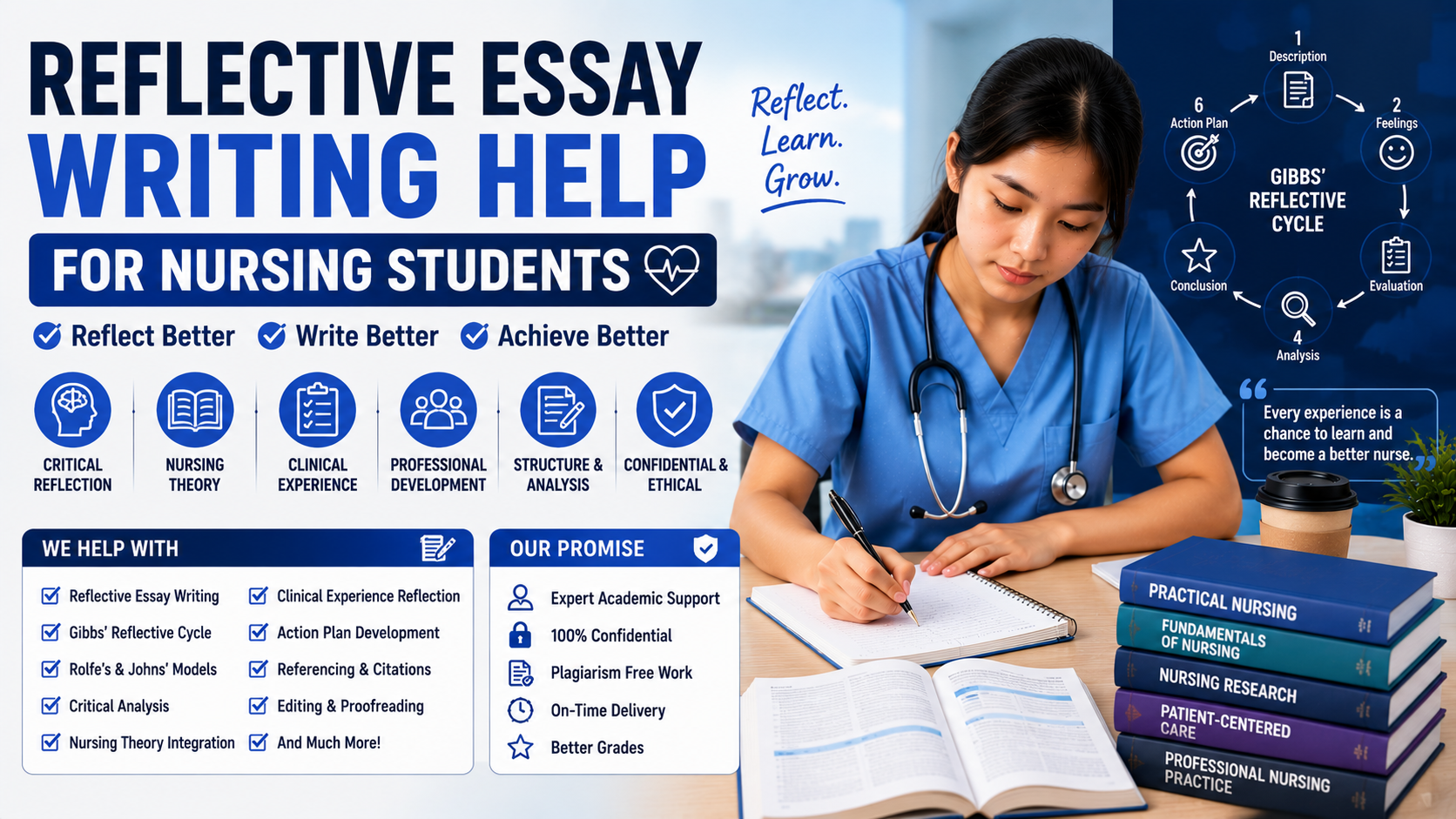
Unlike a conventional essay, a reflective essay is not simply a description of what happened. Nursing students are often expected to explain what happened, how they responded, why they responded that way, what they learned, and how the experience will influence their future professional practice.
This combination of personal reflection, nursing knowledge, academic evidence, and critical analysis can make reflective assignments challenging.
Students may need to reflect on clinical placements, patient interactions, communication challenges, teamwork, ethical situations, professional development, or a particular incident while maintaining confidentiality and following academic requirements.
Academic editing, proofreading, structural feedback, and reflective writing guidance can help nursing students improve the presentation and critical depth of their own work.
Why Reflective Essays Are Challenging for Nursing Students
Reflective writing requires a different approach from traditional academic writing.
A nursing reflective essay may need to combine:
Personal experience
Clinical learning
Nursing theory
Professional standards
Evidence-based practice
Critical analysis
Ethical considerations
Patient-centred care
Future professional development
One of the biggest challenges is finding the right balance.
An essay that only describes the clinical experience may lack critical analysis, while an essay that focuses entirely on theory may fail to demonstrate genuine reflection.
A strong reflective essay connects experience, theory, evidence, analysis, and future learning.
What Is a Reflective Essay in Nursing?
A reflective essay asks you to examine an experience and consider its significance.
For example, a nursing student might reflect on:
Communication with a patient
Working with a multidisciplinary team
Managing a challenging interaction
Responding to patient anxiety
Medication-related learning
Time management during placement
Professional communication
Cultural considerations
Ethical decision-making
Patient safety
Leadership experiences
The exact subject depends on the assignment.
The important point is that reflection should go beyond explaining what happened.
Reflective Essay vs Traditional Nursing Essay
A traditional nursing essay may ask you to investigate a topic using academic literature.
A reflective essay may instead ask you to examine your own learning or experience.
Traditional Nursing Essay | Reflective Nursing Essay |
|---|---|
Focuses primarily on a topic | Focuses on an experience or learning event |
Uses academic literature extensively | Combines reflection with academic evidence |
Usually uses third-person academic writing | May use first person where appropriate |
Analyses concepts and evidence | Analyses experience, decisions, and learning |
Often develops a theoretical argument | Connects experience with theory and future practice |
Some reflective assignments require a combination of personal reflection and formal academic discussion.
Always follow the specific assignment instructions.
Common Reflective Essay Topics for Nursing Students
Nursing students may be asked to reflect on:
Patient communication
Therapeutic communication
Teamwork
Clinical decision-making
Leadership
Patient safety
Medication administration
Professional boundaries
Ethical dilemmas
Cultural competence
Patient-centred care
Health education
Conflict management
Time management
Clinical confidence
Interprofessional collaboration
Emotional responses during placement
Choosing a suitable experience is important.
A useful reflective experience usually provides enough material for you to analyse what happened and identify meaningful learning.
Reflective Essay Writing Help With Gibbs' Reflective Cycle
Gibbs' Reflective Cycle is one of the commonly used frameworks for structured reflection.
It contains six stages:
Description
Feelings
Evaluation
Analysis
Conclusion
Action plan
The framework can help nursing students organise their thoughts.
However, students should avoid mechanically answering six headings without developing meaningful analysis.
The framework should support the reflection rather than replace critical thinking.
Description
The description explains what happened.
Keep this section focused.
You may need to explain:
Where the experience occurred
What the situation involved
Who was involved
What happened
What your role was
Avoid including unnecessary details.
In nursing assignments, patient confidentiality must always be protected.
Feelings
This stage considers your emotional response.
You might reflect on feelings such as:
Anxiety
Uncertainty
Confidence
Frustration
Empathy
Concern
Relief
Responsibility
The purpose is not simply to state that you felt nervous.
Instead, consider why you experienced that emotion and whether it influenced your behaviour or decision-making.
Evaluation
Evaluation examines what went well and what could have been improved.
You might consider:
Communication
Teamwork
Patient response
Your clinical approach
Professional behaviour
Decision-making
Support received
Try to avoid making unsupported statements.
Academic evidence can help you evaluate the significance of the experience.
Analysis
Analysis is often the most important part of reflective nursing writing.
This is where you connect your experience with:
Nursing theory
Clinical evidence
Professional standards
Research
Ethical principles
Communication theory
Patient-centred care
For example, if you are reflecting on communication with a distressed patient, you could examine the communication approach you used and compare it with evidence-based nursing communication principles.
This moves the essay beyond simple storytelling.
Conclusion
The conclusion should identify what you learned.
Ask yourself:
What would I do differently?
What did the experience teach me?
What skills need improvement?
Did my understanding change?
What will I take forward into practice?
The conclusion should emerge from the preceding analysis.
Action Plan
The action plan explains how you will apply the learning in the future.
For example, you might plan to:
Improve communication skills
Seek feedback from supervisors
Practise clinical skills
Review relevant nursing literature
Improve time management
Develop confidence
Strengthen knowledge in a particular clinical area
A strong action plan should be specific and realistic.
Reflective Essay Writing Help With Rolfe's Model
Another framework nursing students may encounter is Rolfe's reflective model.
It is commonly organised around three questions:
What?
What happened?
So What?
Why does the experience matter?
Now What?
What will you do differently in the future?
The simplicity of the model can make it useful for shorter reflective assignments.
However, students should still demonstrate sufficient critical analysis and evidence where required.
Johns' Model of Reflection
Johns' Model of Reflection provides another structured approach to reflective practice.
It encourages students to examine different aspects of an experience, including:
Context
Personal responses
Professional knowledge
Ethical considerations
Influencing factors
Alternative actions
The appropriate reflective framework depends on the assignment instructions and module requirements.
Critical Reflection in Nursing
Critical reflection goes beyond describing your feelings.
It involves questioning your assumptions, decisions, actions, and responses.
For example:
Descriptive reflection:
I felt nervous when speaking with the patient.
More critical reflection:
My uncertainty affected the way I communicated with the patient, which made me recognise the importance of adapting communication techniques to individual needs and seeking appropriate support when confidence is limited.
The second approach examines the significance of the experience and identifies learning.
Connecting Reflection With Nursing Theory
Academic evidence is important in many nursing reflective assignments.
Relevant concepts might include:
Therapeutic communication
Person-centred care
Clinical decision-making
Professional identity
Emotional intelligence
Leadership
Teamwork
Patient safety
Evidence-based practice
The theory should help explain the experience.
Avoid adding academic sources simply to increase the number of citations.
Reflective Essay Writing and Patient Confidentiality
Confidentiality is particularly important in nursing reflective writing.
Students should avoid including identifiable patient information unless explicitly permitted and ethically appropriate.
Depending on institutional requirements, identifying details may need to be anonymised or removed.
Avoid including unnecessary:
Names
Addresses
Exact dates
Hospital identifiers
Patient numbers
Other identifying information
Always follow your university, placement provider, and professional requirements.
Nursing Reflective Essay Structure
A reflective nursing essay may include:
Introduction
Introduce the experience and explain the reflective approach being used.
Reflection
Describe the relevant experience and your response.
Critical Analysis
Connect the experience with nursing evidence, theory, and professional practice.
Learning
Explain what you learned from the experience.
Action Plan
Describe how you intend to apply the learning in future practice.
Conclusion
Summarise the main learning points.
The exact structure should always follow your assignment brief.
How to Start a Reflective Nursing Essay
The introduction should establish the purpose of the essay.
You may briefly introduce:
The experience being reflected upon
Why the experience was significant
The reflective framework used
The main area of learning
Avoid explaining every detail of the experience in the introduction.
How to Use First Person in Reflective Writing
Reflective writing often allows first-person language because you are discussing your own experience.
Examples include:
I recognised...
I felt...
I realised...
I observed...
I learned...
I would approach the situation differently...
However, academic tone should still be maintained.
Using first person does not mean the writing should become conversational or informal.
Common Reflective Essay Mistakes
Nursing students frequently make mistakes such as:
Describing rather than analysing
Spending too many words explaining what happened
Focusing only on emotions
Failing to connect experience with theory
Using reflective frameworks mechanically
Providing insufficient academic evidence
Including confidential patient information
Making unsupported claims
Writing a weak action plan
Failing to identify genuine learning
Repeating the same point
Poor referencing
Weak paragraph structure
Submitting without proofreading
A final academic review can help identify these issues.
How to Improve Critical Reflection
To strengthen your reflective essay, ask questions such as:
Why did I respond this way?
What influenced my decision?
What assumptions did I make?
What evidence supports my approach?
What could I have done differently?
How did the patient respond?
How did communication affect the situation?
What did I learn about my professional practice?
What does nursing literature suggest?
How will this influence my future practice?
These questions can help turn a simple narrative into critical reflection.
Reflective Essay Referencing
Depending on the assignment, students may need to reference:
Nursing journals
Clinical research
Academic books
Professional guidelines
Evidence-based practice resources
Relevant professional standards
Nursing theories
Use the referencing style required by your university.
Common styles in nursing education include APA and Harvard, although requirements vary between institutions.
Reflective Essay Editing and Proofreading
Reflective essays can be difficult to edit because they combine personal experience with academic analysis.
Academic editing can help improve:
Structure
Clarity
Critical analysis
Paragraph organisation
Academic tone
Grammar
Sentence flow
Referencing
Confidentiality checks
Action-plan clarity
Proofreading should be completed after substantive revisions.
How AssignmentCart Can Help Nursing Students
AssignmentCart provides ethical academic support for nursing students working on reflective assignments.
Support can include:
Reflective essay proofreading
Academic editing
Reflective framework guidance
Critical analysis feedback
Nursing literature review
Referencing checks
Structure reviews
Academic writing improvement
Formatting checks
Final proofreading
The focus is on helping students improve their own reflective work while maintaining academic integrity and patient confidentiality.
Why Choose AssignmentCart for Reflective Essay Support?
Students seeking academic support can benefit from:
Nursing-focused academic specialists
Experienced academic editors
Reflective writing support
Constructive feedback
Confidential document handling
Flexible turnaround options
Referencing reviews
Detailed proofreading
Academic structure checks
Responsive customer support
Whether you are writing a clinical reflection, placement reflection, professional development essay, or nursing reflective report, academic feedback can help identify areas that need improvement.
Ethical Academic Support for Nursing Students
Academic support should complement your own learning and clinical development.
AssignmentCart can help students:
Improve reflective writing
Clarify their analysis
Structure their experiences effectively
Connect reflection with academic evidence
Strengthen critical thinking
Improve referencing
Review confidentiality considerations
Improve grammar and presentation
Develop clearer action plans
Receive constructive feedback
Students remain responsible for their final work and should ensure that all academic support complies with their university's academic integrity requirements.
Reflective Essay Submission Checklist
Before submitting your nursing reflective essay, check:
✔ Have you answered the exact assignment question?
✔ Have you selected an appropriate experience?
✔ Have you protected patient confidentiality?
✔ Have you identified the reflective framework required?
✔ Have you explained the relevant experience clearly?
✔ Have you explored your feelings and responses?
✔ Have you evaluated what went well and what did not?
✔ Have you demonstrated critical analysis?
✔ Have you connected your reflection with nursing evidence?
✔ Have you discussed relevant professional considerations?
✔ Have you identified meaningful learning?
✔ Is your action plan specific and realistic?
✔ Have you avoided unnecessary description?
✔ Are your sources credible?
✔ Are your citations accurate?
✔ Does your reference list match your citations?
✔ Have you followed the required word count?
✔ Have you checked formatting?
✔ Have you proofread the final document?
Final Thoughts
Reflective essays are an important part of nursing education because they encourage students to connect clinical experiences with professional development, evidence-based practice, and future learning.
A successful reflective essay should not simply describe what happened. It should demonstrate self-awareness, critical analysis, academic evidence, professional learning, and a realistic plan for future improvement.
For nursing students balancing clinical placements, coursework, examinations, and other responsibilities, academic editing and proofreading can provide valuable support during the final stages of an assignment.
If you need support with reflective essay editing, nursing academic writing, critical reflection, reflective framework guidance, referencing, structure, or proofreading, AssignmentCart provides ethical academic support designed to help students improve their own work.
Frequently Asked Questions
Everything you need to know about our services


