Essay Editing Services for International Students in New Zealand
Introduction
Writing university essays in a second language can be challenging, particularly when you are adapting to a new academic system, unfamiliar referencing expectations, and different approaches to critical analysis.
For international students studying in New Zealand, essay editing services can provide useful support with grammar, clarity, academic style, structure, referencing consistency, and presentation—provided that the assistance follows the academic-integrity rules of the student's university.
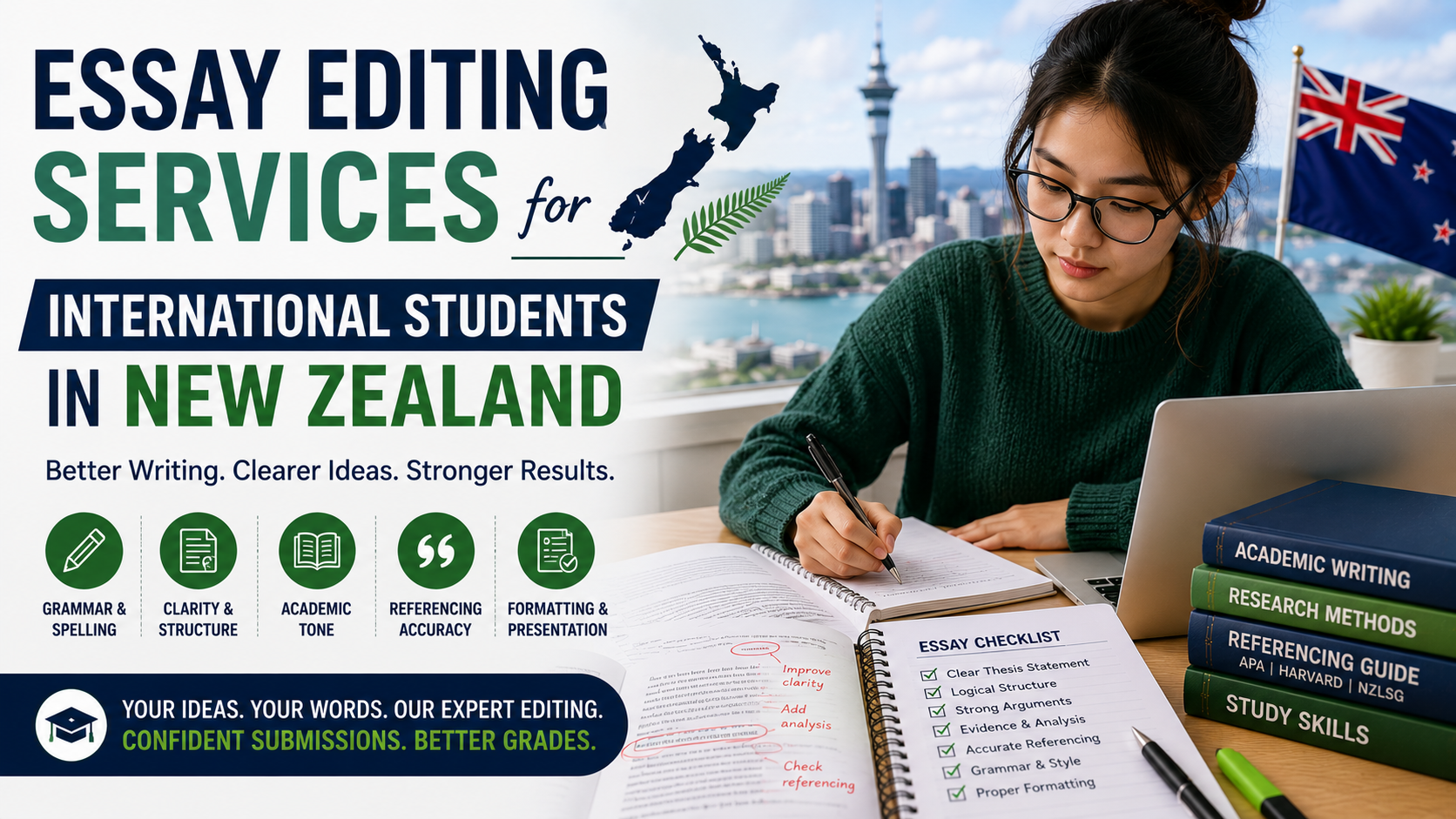
The purpose of responsible essay editing is not to write an assignment for a student. Instead, an editor can help identify language and presentation problems in the student's existing work so that the student can make informed decisions and submit work that reflects their own learning.
New Zealand universities also provide academic writing support themselves. For example, the University of Otago's Student Academic Skills service offers assistance with essay writing, editing, referencing and other academic skills, while the University of Canterbury's Academic Skills Centre provides consultations and resources covering writing, critical thinking, citations and academic communication.
What Are Essay Editing Services?
Essay editing involves reviewing an existing student-written essay and identifying problems that may affect its clarity, accuracy, readability or presentation.
Depending on the service and university rules, editing may cover:
Grammar
Spelling
Punctuation
Sentence clarity
Academic tone
Word choice
Repetition
Paragraph coherence
Referencing consistency
Formatting
Tables and figures
Citation presentation
Overall readability
The key distinction is between editing an existing essay and writing an essay on behalf of a student.
A student should remain responsible for the ideas, research, analysis, arguments and final submitted work.
Why International Students May Need Essay Editing Support
Moving to a New Zealand university often involves adapting to a different academic culture.
A student may understand the subject extremely well but still struggle to communicate their ideas in the expected academic style.
Common challenges include:
Academic English
Students may understand English but find academic writing conventions more difficult.
An essay may contain:
Long sentences
Incorrect articles
Awkward expressions
Incorrect prepositions
Repeated vocabulary
Informal language
Grammar mistakes
These problems can make otherwise strong ideas harder to understand.
Critical Analysis
Many university essays require more than describing information.
Students may be expected to:
Compare perspectives
Evaluate evidence
Identify strengths and weaknesses
Explain relationships between studies
Develop an argument
Apply theory to a problem
Justify conclusions
Understanding the difference between description and critical analysis can take time, especially for students coming from educational systems with different writing conventions.
Referencing
International students may also need to adjust to referencing systems used by their programme.
Depending on the discipline, students may encounter:
APA
Harvard
Chicago
MLA
IEEE
NZLSG
Discipline-specific styles
Victoria University of Wellington, for example, notes that different disciplines use different referencing styles and advises students to check their course requirements.
What Does a Professional Essay Editor Check?
A responsible editor can examine several layers of an existing essay.
1. Grammar and Sentence Construction
The editor can identify problems such as:
Subject-verb agreement
Incorrect verb tense
Missing articles
Incorrect prepositions
Sentence fragments
Run-on sentences
Punctuation errors
For example:
Before:
The results shows that international students is facing several challenges.
After:
The results show that international students are facing several challenges.
The underlying idea remains the student's own.
2. Academic Language
Academic writing generally benefits from precise and appropriately formal language.
An editor may identify phrases that are:
Too informal
Ambiguous
Repetitive
Excessively conversational
Unnecessarily complicated
For example:
A lot of students find this thing really hard.
Could be identified as unnecessarily informal.
A more appropriate academic formulation might be:
Many students experience difficulties with this aspect of their studies.
However, students should remain responsible for deciding how they express their argument.
3. Clarity and Readability
An essay can contain correct grammar and still be difficult to read.
Editing can identify:
Overly long sentences
Unclear pronouns
Repeated points
Weak transitions
Ambiguous statements
Excessive jargon
The goal is to make the student's existing argument easier to understand.
The University of Auckland's coursework guidance specifically recognises clarity, grammar, spelling, punctuation, formatting and referencing as areas where third-party advice can be useful, while stating that third parties should not become the author of the assessment.
4. Paragraph Structure
Strong academic paragraphs usually have a clear purpose.
A paragraph may contain:
A topic or controlling idea
Supporting evidence
Explanation or analysis
A connection to the wider argument
An editor can identify paragraphs that appear:
Too long
Too short
Repetitive
Unfocused
Disconnected from the surrounding discussion
However, the student should make substantive decisions about restructuring their argument.
5. Referencing Consistency
Referencing is particularly important in university essays.
An editor may check whether:
In-text citations are consistently formatted
References appear in the reference list
Reference entries follow the required style
Dates and author names are consistent
URLs or DOIs are presented correctly where required
Quotations are appropriately cited
Page numbers are included where the style requires them
The student remains responsible for ensuring that the sources actually support the claims being made.
6. Formatting
Depending on the course requirements, editing support may also identify issues involving:
Font consistency
Heading formatting
Paragraph spacing
Page numbers
Tables
Figures
Captions
Margins
Reference-list formatting
Students should always follow their specific course outline or university instructions rather than relying on a generic formatting template.
Essay Editing vs Essay Writing
This distinction is extremely important.
Essay editing
The student writes the essay.
An editor reviews the student's existing work for permitted language and presentation issues.
Possible areas include:
Grammar
Spelling
Punctuation
Clarity
Readability
Formatting
Reference consistency
Essay writing
Another person creates the academic work that the student submits as their own.
This can create serious academic-integrity problems.
The University of Auckland defines contract cheating as having academic work completed on a student's behalf and describes it as a serious breach of academic integrity. It also notes that providing or advertising cheating services is an offence under New Zealand law.
Therefore, students should be extremely careful when choosing an online academic service.
What Can an Essay Editor Do?
A responsible editing service may help with:
Language
Grammar
Spelling
Punctuation
Sentence clarity
Word choice
Presentation
Formatting consistency
Headings
Tables
Figures
Page numbering
Referencing
Citation consistency
Reference-list formatting
Cross-reference checks
Readability
Repetition
Ambiguous wording
Excessively long sentences
Unclear transitions
Feedback
An editor may also point out potential issues for the student to consider rather than making substantive academic decisions on the student's behalf.
The University of Auckland's coursework guidelines explicitly say third parties may review and advise on clarity, grammar, spelling, formatting and referencing, but should not write or rewrite assessment activities for students.
What Should an Essay Editing Service Not Do?
International students should avoid services that promise to:
Write the complete essay
Rewrite the entire assignment
Create arguments for submission
Complete research for the student
Invent sources
Fabricate references
Generate fake evidence
Complete calculations
Produce a ready-to-submit assignment
Guarantee a grade
The final essay should represent the student's own learning and academic work.
This is especially important because New Zealand universities emphasise academic integrity and independent student work. The University of Canterbury, for example, describes academic integrity as doing one's own work honestly, fairly and ethically and warns that submitting work written by someone else can constitute academic misconduct.
Essay Editing for Students Who Speak English as an Additional Language
International students may benefit from language-focused editing because academic English contains conventions that are not always taught in general English courses.
Common language issues
Articles
Students may struggle with:
a, an, the
Prepositions
For example:
interested on the topic
instead of:
interested in the topic
Verb tense
Academic writing may require careful use of past and present tense depending on the context.
Countable and uncountable nouns
Words such as:
research
evidence
information
advice
can create difficulties because they are not always used in the same way as equivalent words in other languages.
Academic collocations
Students may know individual words but find combinations such as:
significant impact
empirical evidence
research findings
theoretical framework
methodological approach
less familiar.
A good editor can identify these issues without changing the student's underlying academic meaning.
How Essay Editing Can Improve Readability
Consider this sentence:
In this research there are many different factors that are very important and which can have a very significant impact on students who are studying at universities in New Zealand and these factors should therefore be considered.
The sentence contains a useful idea but is unnecessarily long.
An editor might identify:
Excessive length
Repetition
Weak sentence structure
Unnecessary wording
The student could then revise it into a clearer form, such as:
Several factors can significantly affect international students studying at New Zealand universities.
The goal is not to make the essay sound artificially sophisticated. It is to make the student's meaning clearer.
Editing an Essay Without Losing the Student's Voice
International students sometimes worry that professional editing will make their essays sound unnatural.
This is a legitimate concern.
A good editing process should preserve:
The student's meaning
The student's argument
The student's evidence
The student's disciplinary perspective
The appropriate academic level
Editing should improve communication rather than replace the student's voice.
How to Choose Essay Editing Services in New Zealand
Before paying for an editing service, international students should ask several questions.
1. Does the service edit or write?
Look for a clear distinction between editing and assignment writing.
If a company promises a “100% original ready-to-submit essay,” that is a warning sign.
2. Does the service understand academic integrity?
A legitimate service should be willing to work within your university's rules.
3. Are changes transparent?
Students should be able to see what has been changed or suggested.
4. Can the service handle your referencing style?
Ask whether the editor understands the style required by your course.
5. Is subject knowledge appropriate?
A law essay, nursing essay and computer science essay may have very different conventions.
6. Does the service guarantee grades?
No responsible editor can guarantee a particular grade.
7. What happens to your document?
Students should understand how their files are stored, accessed and deleted.
University Support Should Be Your First Resource
Before paying for an external service, international students should explore the academic support available at their university.
For example, the University of Otago's Student Academic Skills service provides free support for enrolled students, including help with essay writing, editing, referencing and study skills.
The University of Canterbury's Academic Skills Centre offers individual consultations and resources covering academic writing, critical thinking, citations, essay structure, paraphrasing and referencing.
The University of Auckland also provides English Language Enrichment services and academic learning support.
These services can be particularly valuable for international students because they help develop independent academic-writing skills rather than simply correcting one assignment.
Essay Editing and Academic Integrity
Academic integrity should be considered before using any third-party editing service.
The University of Auckland's coursework guidelines state that students may seek third-party advice, but the final work must remain the student's own and third parties must not become the author of the assessment.
The university also advises students to retain drafts, rough notes or other evidence showing that their submitted work is original.
This creates a useful principle:
Get help with communication, not with creating the academic work.
Students should also check the specific rules of their institution and course because requirements can differ.
What About AI Essay Editing?
AI tools can be useful for language assistance, but students need to check their university's rules before using them.
AI can potentially help identify:
Grammar problems
Spelling issues
Sentence clarity
Repetition
Formatting problems
However, students should be careful about asking AI to:
Write their essay
Generate their argument
Create evidence
Invent references
Rewrite the entire assessment
Produce text they submit without checking applicable rules
The University of Auckland's third-party coursework guidelines explicitly include AI-driven assistance within their discussion of third-party assistance and state that students must ensure assistance does not compromise academic integrity.
University policies can change, so students should check their current course and institutional requirements before using AI.
Essay Editing for Different Academic Disciplines
Editing requirements can vary significantly by subject.
Business and Management
Editors may need to pay attention to:
Case-study terminology
Models and frameworks
Evidence
Report structure
Strategic analysis
Nursing and Health Sciences
Important areas may include:
Clinical terminology
Evidence-based writing
Referencing
Professional language
Research interpretation
Law
Law essays often require careful attention to:
Legal terminology
Authorities
Case citations
Statutory references
Legal argument
Engineering
Technical writing may involve:
Equations
Units
Tables
Figures
Technical terminology
Experimental results
Computer Science
Editing may involve:
Technical terminology
System descriptions
Methodology
Results
Tables and figures
References to technical literature
Psychology and Social Sciences
Common considerations include:
Research literature
Theoretical frameworks
Methodology
Statistical reporting
APA referencing
The editor's role should remain focused on communication and presentation rather than changing the academic substance.
Essay Editing for Undergraduate and Postgraduate Students
The level of academic writing expected can differ.
Undergraduate essays
Students may be expected to demonstrate:
Understanding of course concepts
Use of appropriate sources
Basic critical analysis
Structured academic writing
Master's essays
Students may be expected to demonstrate:
Deeper critical analysis
Independent evaluation
Stronger engagement with research literature
More sophisticated argumentation
Application of theory
Therefore, editing should be appropriate to the student's academic level.
Essay Editing for International Students Under Time Pressure
Deadlines can make editing particularly useful.
If an essay is due soon, avoid trying to perfect everything simultaneously.
Use a priority system.
Priority 1: Academic requirements
Check:
Did you answer the question?
Did you follow the assignment instructions?
Is the argument clear?
Is sufficient evidence provided?
Are sources properly acknowledged?
Priority 2: Structure
Check:
Introduction
Paragraph sequence
Topic sentences
Transitions
Conclusion
Priority 3: Language
Check:
Grammar
Spelling
Sentence clarity
Academic tone
Priority 4: Presentation
Check:
Formatting
References
Page numbers
Tables
Figures
This approach prevents students from spending an hour fixing formatting while missing a major requirement in the assignment question.
A Practical Essay Editing Checklist
Before submitting an essay, international students can use this checklist.
Assignment requirements
Have I answered the exact question?
Have I followed the required word count?
Have I followed the assignment instructions?
Have I used the required structure?
Argument
Is my main argument clear?
Does each paragraph contribute to the argument?
Have I explained my evidence?
Have I included critical analysis?
Sources
Are my sources credible?
Have I cited borrowed ideas?
Are quotations clearly identified?
Does every in-text citation have a corresponding reference?
Is the reference list consistent?
Language
Have I checked grammar?
Have I checked spelling?
Are sentences clear?
Have I removed unnecessary repetition?
Is the tone appropriate?
Final presentation
Are headings consistent?
Are tables and figures labelled correctly?
Are page numbers correct?
Is the document easy to read?
Have I followed the course formatting requirements?
How Much Does Essay Editing Cost in New Zealand?
The cost of professional editing varies depending on factors such as:
Word count
Academic level
Subject
Editing depth
Deadline
Referencing requirements
Formatting requirements
Language complexity
A short proofreading job will normally require less work than a detailed academic-language review of a long Master's assignment.
Students should request a clear quotation before submitting their documents.
They should also confirm exactly what is included.
For example:
Basic proofreading
Grammar, spelling and punctuation.
Academic language editing
Grammar, clarity, sentence structure and academic expression.
Comprehensive editing
Language, clarity, consistency, formatting and referencing checks.
The service description should make clear that editing does not mean writing the assessment for the student.
Is Essay Editing Worth It for International Students?
It can be useful when the student already understands the subject and has completed their own academic work but wants help presenting it clearly.
The greatest potential benefits are often:
Better readability
Fewer language errors
More consistent formatting
Cleaner referencing
Greater confidence before submission
Better understanding of recurring language problems
However, editing should complement—not replace—the student's own development as an academic writer.
For international students, the long-term goal should be to become increasingly confident in writing academic English independently.
Final Thoughts
For international students, writing a university essay in New Zealand involves more than translating ideas into English. Students need to understand the expectations of academic argument, critical analysis, evidence, referencing and discipline-specific communication.
Essay editing services can provide useful language and presentation support when used responsibly.
The safest approach is to ensure that:
The student writes the original assessment.
The student's ideas and arguments remain their own.
Sources are properly acknowledged.
The editor focuses on permitted language and presentation support.
University and course rules are checked before using external assistance.
The student remains responsible for the final submitted work.
International students should also take advantage of free university support where available. Academic skills centres and language advisers can help develop writing skills that remain useful throughout a degree, rather than only improving one assignment.
Ultimately, the best essay editing support is not about making someone else's essay look like yours. It is about helping your own academic work communicate your ideas more clearly, accurately and professionally.
Frequently Asked Questions
Everything you need to know about our services


