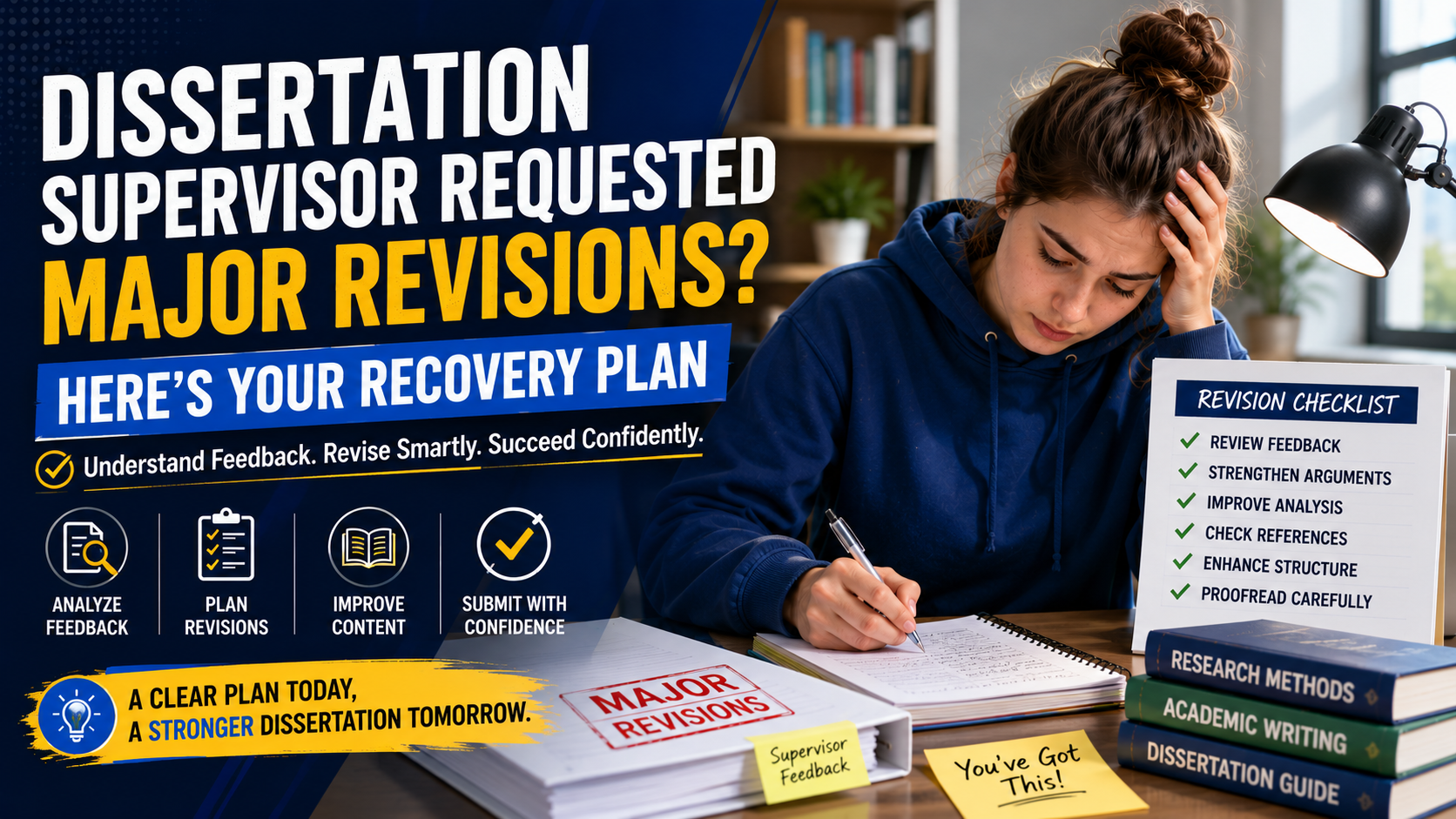
Dissertation Supervisor Requested Major Revisions? Here's Your Recovery Plan
Introduction
Opening your supervisor's email only to see "Major Revisions Required" can be discouraging. After investing weeks—or even months—into your dissertation, receiving extensive feedback may feel like a setback.
However, major revisions are a common part of the dissertation process. They often indicate that your supervisor believes your work has potential but needs significant improvements before it meets the required academic standard.
Whether you're studying in the UK, Ireland, Australia, New Zealand, Singapore, or Canada, knowing how to respond strategically can make the difference between a disappointing grade and a successful dissertation.
This guide explains how to interpret supervisor feedback, create a structured revision plan, and improve your dissertation efficiently.
What Do "Major Revisions" Actually Mean?
Major revisions usually mean your dissertation requires substantial improvements in one or more areas, such as:
Research question
Literature review
Critical analysis
Methodology
Data analysis
Discussion chapter
Academic writing
Referencing
Overall structure
Importantly, this does not necessarily mean your dissertation is failing. It often means your supervisor sees potential but expects further development.
Don't Panic—Read the Feedback Carefully
Your first instinct may be to feel frustrated or overwhelmed. Instead:
Read every comment slowly.
Avoid making immediate edits.
Highlight recurring issues.
Separate major concerns from minor corrections.
Create a revision checklist.
Many supervisors repeat the same concern in different sections. Identifying patterns helps you prioritise effectively.
Step 1: Categorise Every Comment
Instead of tackling revisions randomly, organise feedback into categories.
For example:
Research Focus
Research question unclear
Objectives too broad
Weak justification
Literature Review
Limited critical evaluation
Missing recent studies
Poor synthesis
Methodology
Weak justification
Sampling concerns
Limited explanation
Results
Insufficient interpretation
Missing analysis
Weak evidence
Writing Quality
Grammar
Clarity
Structure
Flow
Breaking feedback into categories makes large revisions feel much more manageable.
Step 2: Prioritise Structural Changes First
Many students begin correcting grammar immediately.
This is usually the wrong approach.
Instead, revise in this order:
Research question
Dissertation structure
Literature review
Methodology
Analysis
Discussion
Conclusion
Referencing
Grammar and proofreading
Otherwise, you'll likely edit sections that later need rewriting.
Step 3: Clarify Anything You Don't Understand
Supervisor comments are sometimes brief.
Examples include:
"Needs stronger analysis."
"Expand this section."
"Weak argument."
"Not sufficiently critical."
If you're unsure what a comment means, ask your supervisor for clarification during office hours or by email. A short discussion can save hours of unnecessary revisions.
Step 4: Strengthen Your Literature Review
A common reason for major revisions is an underdeveloped literature review.
Improve it by:
Adding recent peer-reviewed studies
Comparing different viewpoints
Identifying research gaps
Critically evaluating findings
Linking evidence directly to your research question
Avoid simply summarising articles one after another.
Step 5: Improve Critical Analysis
High-scoring dissertations explain why evidence matters.
Ask yourself:
Why is this important?
How does it compare with previous studies?
What assumptions exist?
What are the limitations?
What are the practical implications?
Critical thinking is often what separates average dissertations from excellent ones.
Step 6: Review Your Methodology
Supervisors frequently request revisions because methodology lacks justification.
Ensure you explain:
Why you chose your research method
Sampling strategy
Data collection process
Ethical considerations
Reliability
Validity
Research limitations
Readers should understand exactly how your research was conducted.
Step 7: Revisit Your Data Analysis
If your dissertation includes primary research:
Review:
Tables
Graphs
Statistical interpretation
Themes
Coding
Findings
Don't simply present results—interpret what they mean in relation to your research objectives.
Step 8: Update Your References
Check every citation carefully.
Common issues include:
Missing references
Inconsistent formatting
Incorrect page numbers
Broken citations
Outdated sources
Always use the referencing style required by your university, such as Harvard, APA, OSCOLA, MLA, Chicago, or IEEE.
Step 9: Proofread Only After Major Changes
Leave proofreading until the end.
Check:
Grammar
Spelling
Sentence flow
Formatting
Headings
Tables
Figure numbering
Appendix references
Final polishing should come after all substantive revisions are complete.
When Should You Seek Professional Dissertation Support?
If the revision workload feels overwhelming, academic guidance can help you work through the feedback more effectively.
Students often seek support for:
Understanding supervisor comments
Literature review improvements
Dissertation structure
Research methodology
Data analysis guidance
Referencing corrections
Academic editing
Proofreading
Ethical academic support should help you improve your own dissertation while complying with your university's academic integrity requirements.
How AssignmentCart Can Help
AssignmentCart supports students during the dissertation revision process by providing:
Dissertation chapter reviews
Literature review guidance
Methodology support
Research feedback
Proofreading and editing
Referencing assistance
Academic writing improvements
Quality review before submission
Our experts help you understand the feedback, strengthen weak areas, and present your work more effectively.
Recovery Plan Checklist
Before resubmitting your dissertation, ensure you have:
✔ Addressed every supervisor comment
✔ Improved your research question
✔ Strengthened the literature review
✔ Enhanced critical analysis
✔ Justified your methodology
✔ Improved discussion and conclusions
✔ Corrected referencing
✔ Proofread the final document
✔ Verified formatting requirements
✔ Completed a final quality check
Final Thoughts
Receiving major revisions from your dissertation supervisor can be frustrating, but it is also an opportunity to produce a much stronger piece of academic work.
Approach the feedback methodically, prioritise structural improvements, seek clarification where necessary, and leave enough time for careful revision.
With persistence, organisation, and the right academic support, many students turn major revisions into successful final submissions.
Frequently Asked Questions
Everything you need to know about our services


