Dissertation Proposal Help for Canadian Universities
Introduction
Writing a dissertation proposal is often the first major step toward completing a Master's dissertation or doctoral research project. For many Canadian university students, the proposal can feel more difficult than expected because it requires them to explain what they want to research, why the topic matters, what existing research says, how they plan to investigate the problem and why their proposed methodology is appropriate.
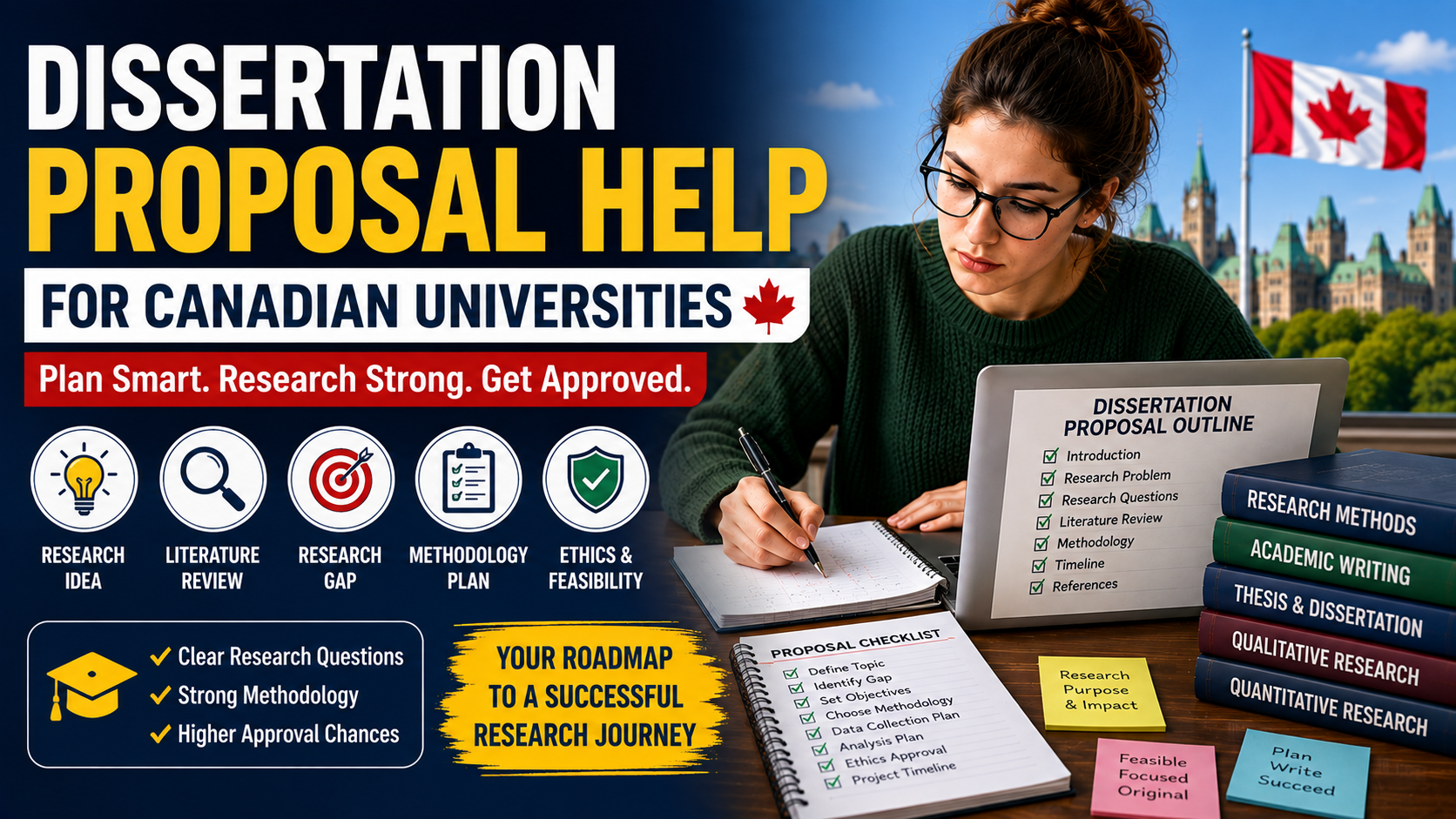
A dissertation proposal is not simply a shorter version of the final dissertation. It is a research plan that demonstrates that the proposed study is relevant, feasible, academically grounded and methodologically appropriate.
For Canadian graduate students, dissertation proposal help can provide useful guidance with research questions, literature searches, research gaps, methodology, proposal structure, academic writing, referencing and supervisor feedback.
However, students should remain responsible for their own research ideas, academic decisions, analysis and intellectual contribution. University-specific requirements should always take priority.
Quick Answer: What Is Dissertation Proposal Help?
Dissertation proposal help provides academic guidance to graduate students who need support planning, structuring, reviewing or improving a dissertation or thesis research proposal.
Support may include:
Research topic development
Research question refinement
Proposal structure
Literature review guidance
Research-gap identification
Research objectives
Methodology planning
Sampling guidance
Data-collection planning
Data-analysis planning
Ethical considerations
Academic referencing
Academic proofreading
Supervisor-feedback interpretation
The exact proposal requirements vary between Canadian universities, graduate programs and departments.
What Is a Dissertation Proposal?
A dissertation proposal is a formal document that explains a proposed research project before the research is completed.
Depending on the university and discipline, it may explain:
The research topic
Research background
Research problem
Research rationale
Research questions
Research objectives
Existing literature
Research gap
Theoretical or conceptual framework
Proposed methodology
Data collection
Data analysis
Ethical considerations
Expected contribution
Limitations
Timeline
References
The proposal allows supervisors, committees or departments to assess whether the proposed research is sufficiently focused, academically relevant and feasible.
Why Is a Dissertation Proposal Important?
A strong proposal gives your research project direction.
It can help establish:
A Clear Research Problem
The reader should understand exactly what problem your research intends to investigate.
Focused Research Questions
Your questions should be specific enough to guide the research.
A Defensible Research Gap
The proposal should demonstrate what existing research has not adequately addressed.
Appropriate Methodology
Your proposed methods should logically connect to the research questions.
Research Feasibility
The project should be realistic in terms of time, resources, participants, data and ethical requirements.
Academic Contribution
The proposal should explain why the research could be useful to the academic field, professional practice, policy or another relevant area.
Dissertation Proposal Requirements at Canadian Universities
There is no single dissertation-proposal format used by every Canadian university.
Requirements can differ according to:
University
Faculty
Department
Degree
Research discipline
Master's or PhD program
Supervisor
Research design
Thesis or dissertation format
Some programs may require a relatively concise research proposal, while others may require detailed sections covering theory, methodology, ethics, literature and research contribution.
Therefore, students should always check their graduate-school handbook, department guidelines, thesis requirements and supervisor instructions before finalising a proposal.
What Should a Canadian Dissertation Proposal Include?
Although requirements differ, many proposals contain several common components.
1. Proposal Title
Your title should communicate the subject and scope of the proposed research.
A good title should be:
Specific
Clear
Relevant
Manageable
Consistent with the research question
Weak title
Social Media and Students
More focused title
The Relationship Between Social Media Use and Academic Engagement Among Undergraduate Students in Canadian Universities
The second title provides a clearer indication of the population and variables being studied.
2. Research Background
The background introduces the broader context of the research problem.
You may discuss:
The broader issue
Relevant developments
Existing evidence
Important concepts
The practical or academic context
Why the topic deserves investigation
Avoid turning the background into an extremely broad essay.
The goal is to move logically toward the specific research problem.
3. Research Problem
The research problem identifies the issue your study intends to investigate.
A strong research problem should explain:
What is currently known?
What remains uncertain?
Why is the uncertainty important?
Who or what is affected?
Why does further research matter?
A vague research problem can make every later part of the proposal difficult.
4. Research Rationale
The rationale explains why the proposed study should be conducted.
Your rationale may involve:
A theoretical gap
An empirical gap
A methodological gap
A population gap
A geographical gap
A practical problem
A policy issue
Conflicting findings
For example, previous research may have examined a particular issue among large organisations but paid limited attention to small Canadian businesses.
That difference could potentially provide a rationale for further research.
5. Research Questions
Research questions are among the most important parts of a dissertation proposal.
They should be:
Clear
Specific
Researchable
Consistent with the research problem
Appropriate for the proposed methodology
Example
How do international Master's students experience academic adjustment during their first year at Canadian universities?
Possible supporting questions could explore:
Academic challenges
Institutional support
Language-related experiences
Social adjustment
Coping strategies
Your questions should not be so broad that they cannot realistically be answered within the scope of the dissertation.
6. Research Objectives
Research objectives explain what the study intends to accomplish.
A proposal might include objectives such as:
To examine...
To identify...
To evaluate...
To compare...
To explore...
To assess...
Your objectives should directly support your research questions.
A useful test is:
Can I clearly explain which research question each objective addresses?
If not, your proposal may need restructuring.
Research Questions vs Research Objectives
These terms are often confused.
Research Questions | Research Objectives |
|---|---|
Ask what the research wants to discover | Explain what the research intends to accomplish |
Usually written as questions | Usually written as statements |
Guide the investigation | Translate the research purpose into actions |
Answered through research findings | Achieved through the research process |
For example:
Research question:
How does remote work affect employee wellbeing?
Research objective:
To examine the relationship between remote work and employee wellbeing.
They should work together.
7. Literature Review
The literature review establishes the scholarly foundation for the proposed research.
It should demonstrate that you understand:
Major studies
Important theories
Existing debates
Research findings
Methodological approaches
Contradictory evidence
Existing limitations
The research gap
A proposal literature review should not simply list papers.
Instead, it should show how existing research leads logically toward your proposed study.
8. Identifying the Research Gap
A research gap is an area where existing scholarship remains incomplete, limited, contradictory or insufficient.
Possible gaps include:
Population Gap
A population has received limited research attention.
Geographic Gap
Existing research focuses on other countries or regions.
Methodological Gap
Previous research has relied heavily on one methodological approach.
Theoretical Gap
Existing studies have not adequately examined a particular theoretical perspective.
Empirical Gap
Existing evidence is insufficient or contradictory.
Temporal Gap
The existing evidence may not adequately reflect recent developments.
A good proposal should explain the gap rather than simply stating:
“There is a lack of research.”
9. Theoretical or Conceptual Framework
Some graduate proposals require a theoretical or conceptual framework.
A theoretical framework may involve established theories relevant to the research problem.
A conceptual framework may show how important concepts or variables are expected to relate to one another.
For example, a business dissertation might examine relationships among:
Leadership → Employee Engagement → Job Satisfaction
The framework should be connected to your research questions and proposed methodology.
Do not include a theory simply because it sounds academically sophisticated.
Explain why it is relevant.
10. Research Methodology
The methodology section explains how you intend to conduct the research.
It may include:
Research philosophy
Research approach
Research design
Population
Sampling
Sample size
Data collection
Research instruments
Data analysis
Ethics
Validity and reliability
Trustworthiness
Methodological limitations
Your methodology should answer an important question:
How will this research design enable me to answer my research questions?
Qualitative Dissertation Proposal Methodology
Qualitative research may be appropriate when the research aims to understand:
Experiences
Perceptions
Meanings
Social processes
Behaviours
Personal perspectives
Potential methods include:
Interviews
Focus groups
Observations
Case studies
Document analysis
The proposal should explain why the selected qualitative design is appropriate.
Quantitative Dissertation Proposal Methodology
Quantitative research may be appropriate when the study investigates:
Relationships
Differences
Patterns
Numerical measurements
Statistical associations
Effects
Potential methods include:
Surveys
Experiments
Secondary datasets
Statistical modelling
The proposed statistical analysis should match the research questions, variables and study design.
Mixed-Methods Dissertation Proposals
Mixed-methods research combines qualitative and quantitative approaches.
For example, a student might propose:
A quantitative survey to identify broad patterns.
Follow-up interviews to explore those patterns in greater depth.
However, mixed methods should not be selected merely because it seems more comprehensive.
The proposal should explain why both forms of evidence are necessary.
11. Sampling Strategy
Your proposal should explain who or what will be studied.
Depending on the research design, sampling may involve:
Probability Sampling
Simple random sampling
Stratified sampling
Systematic sampling
Cluster sampling
Non-Probability Sampling
Purposive sampling
Convenience sampling
Snowball sampling
Quota sampling
The proposal should explain why the selected strategy is appropriate.
12. Sample Size
There is no universal sample size for every dissertation proposal.
Sample-size considerations depend on:
Research design
Population
Research questions
Statistical requirements
Sampling strategy
Available resources
Qualitative research considerations
Research scope
For quantitative research, formal sample-size calculations may be relevant.
For qualitative research, the rationale may involve information richness, research scope and saturation, depending on the methodology.
Avoid choosing a sample size simply because another dissertation used the same number.
13. Data Collection Plan
Explain how you expect to collect the evidence required for the study.
Potential sources include:
Surveys
Interviews
Focus groups
Observations
Experiments
Public datasets
Organisational records
Documents
Archival materials
Your proposal should explain:
What data will be collected?
From whom?
Where?
How?
When?
Why is the method appropriate?
14. Data Analysis Plan
A dissertation proposal should explain how the proposed data will be analysed.
Qualitative analysis may involve:
Thematic analysis
Content analysis
Narrative analysis
Framework analysis
Discourse analysis
Quantitative analysis may involve:
Descriptive statistics
Correlation
Regression
t-tests
ANOVA
Chi-square
Appropriate non-parametric procedures
Do not name statistical tests simply to make a methodology section appear advanced.
The proposed analysis should be connected to the research question and type of data.
15. Research Ethics
Research ethics are especially important when your project involves human participants.
Depending on the study, the proposal may need to address:
Informed consent
Voluntary participation
Confidentiality
Anonymity
Privacy
Data security
Potential risks
Participant withdrawal
Researcher responsibilities
Ethics approval
Students should follow their university's specific research-ethics process.
Do not begin research involving human participants before obtaining any required approval.
16. Feasibility
A proposal may be academically interesting but still unrealistic.
Consider:
Time
Can the research be completed within the degree timeline?
Participants
Can you realistically recruit the required participants?
Data
Will the necessary data be accessible?
Resources
Do you have the required software, equipment or funding?
Access
Can you obtain permission from organisations or institutions?
Skills
Do you have the skills required to conduct the proposed analysis?
A feasible dissertation is usually stronger than an unnecessarily ambitious one.
17. Expected Contribution
Your proposal should explain what the research may contribute.
Possible contributions include:
Academic Contribution
The research may extend or challenge existing scholarship.
Methodological Contribution
The study may apply an approach that has been underused in the research area.
Practical Contribution
The findings may provide useful insights for organisations or professionals.
Policy Contribution
The research may inform policy discussions or decision-making.
Avoid exaggerating your expected contribution.
A Master's dissertation does not need to “solve” an entire field.
18. Dissertation Proposal Timeline
Some proposals include a research timeline.
For example:
Stage | Potential Period |
|---|---|
Topic refinement | Month 1 |
Literature search | Months 1–2 |
Proposal development | Months 2–3 |
Ethics approval | Months 3–4 |
Data collection | Months 4–6 |
Data analysis | Months 6–7 |
Dissertation writing | Months 7–9 |
Editing and final review | Month 9 |
The actual timeline should reflect your university's deadlines and research requirements.
Common Dissertation Proposal Mistakes
1. Topic Is Too Broad
A broad topic can create an unmanageable research project.
2. Research Questions Are Vague
Questions that cannot be clearly answered create problems throughout the dissertation.
3. Literature and Research Gap Are Disconnected
The proposal should show how the literature leads to the proposed research.
4. Methodology Does Not Match the Questions
The research design should logically support the questions.
5. No Methodological Justification
Simply naming a method is not enough.
6. Unrealistic Scope
Too many participants, locations, variables or research objectives can make the project impossible to complete.
7. Weak Academic Sources
Prioritise relevant and credible scholarly research.
8. Poor Referencing
Every citation should accurately represent its source.
9. Ignoring Ethics
Ethical considerations should be planned before data collection.
10. Writing the Proposal Like the Final Dissertation
A proposal describes what you intend to investigate. It should not pretend that future research has already been conducted.
Dissertation Proposal Help for Master's Students
Master's students may seek proposal support when they are struggling with:
Narrowing their research topic
Developing research questions
Finding a research gap
Structuring the proposal
Developing objectives
Choosing methodology
Planning sampling
Designing data collection
Understanding supervisor feedback
Improving academic writing
Checking references
Professional academic support can provide feedback, explanation, proofreading, editing, research-method guidance and structural review.
Students should remain responsible for their own research decisions and intellectual contribution.
Dissertation Proposal Help for PhD Students
PhD proposals can require greater depth because doctoral research is expected to make a meaningful original contribution.
A doctoral proposal may therefore require stronger discussion of:
Scholarly debates
Theoretical positioning
Research gap
Original contribution
Methodological justification
Research feasibility
Ethical considerations
Expected significance
PhD students should pay particular attention to their university's doctoral research requirements and supervisor expectations.
Dissertation Proposal Help for International Students in Canada
International graduate students may experience additional challenges when preparing a dissertation proposal in Canada.
These may include:
Different academic conventions
Research terminology
Academic writing expectations
Canadian research-ethics procedures
Proposal structures
Citation expectations
Supervisor feedback
Understanding discipline-specific research standards
However, Canadian universities do not necessarily use identical proposal requirements.
International students should consult their:
Graduate school
Department
University library
Writing centre
Supervisor
Program handbook
What Professional Dissertation Proposal Help Can Include
Depending on the provider and permitted academic-support model, services may include:
Proposal Structure Review
Checking whether the proposal follows a logical progression.
Research Question Feedback
Reviewing whether questions are focused and researchable.
Literature Review Feedback
Checking whether relevant literature supports the proposed research.
Research-Gap Review
Assessing whether the proposed gap is clearly explained.
Methodology Guidance
Helping students understand potential methodological options and their implications.
Academic Editing
Improving grammar, clarity, academic tone and readability in the student's existing work.
Referencing Review
Checking citation and reference-list consistency.
Supervisor Feedback Support
Helping students understand requested revisions and turn feedback into an actionable revision plan.
What Dissertation Proposal Help Should Not Do
Responsible academic support should not:
Fabricate research
Invent references
Create fake participants
Manufacture research data
Invent ethics approval
Falsify research findings
Guarantee a grade
Guarantee proposal approval
Misrepresent someone else's research
Replace the student's intellectual contribution
Your university's academic-integrity and AI policies should always be followed.
How to Choose Reliable Dissertation Proposal Help in Canada
If you are considering professional support, look beyond price.
Check Academic Expertise
Does the provider understand graduate-level research?
Check Subject Knowledge
Research conventions differ between disciplines.
Check Methodology Experience
The adviser should understand research design and methodological reasoning.
Check Service Scope
Know whether you are purchasing:
Consultation
Feedback
Editing
Proofreading
Research guidance
Formatting
Check Confidentiality
Understand how your proposal and research information will be handled.
Check Academic Integrity
Avoid providers that offer fabricated research or guaranteed grades.
Check Pricing
Make sure you understand exactly what is included.
Questions to Ask Before Hiring Dissertation Proposal Support
Before purchasing a service, ask:
Does the adviser have graduate research experience?
Are they familiar with my subject?
Can they review my research questions?
Can they provide feedback on my research gap?
Can they review my proposed methodology?
Can they explain supervisor feedback?
Is proofreading or editing included?
What does the quoted price cover?
How is confidentiality handled?
Does the service follow academic-integrity requirements?
Dissertation Proposal Checklist for Canadian Graduate Students
Before submitting your proposal, check:
The title clearly describes the research.
The research problem is specific.
The rationale explains why the research matters.
Research questions are clear and researchable.
Research objectives align with the questions.
Relevant literature has been reviewed.
The research gap is clearly established.
The theoretical or conceptual framework is appropriate.
The proposed methodology matches the research questions.
Sampling is explained.
Data collection is feasible.
Data analysis is appropriate.
Ethical considerations are addressed.
The project is realistically achievable.
The expected contribution is clearly explained.
The timeline is realistic.
Citations are accurate.
References are complete.
Supervisor feedback has been addressed.
The proposal follows your program's requirements.
Final Takeaway
Dissertation proposal help for Canadian university students focuses on turning a research idea into a clear, feasible and academically justified research plan.
A strong proposal should connect:
Research problem → research questions → literature → research gap → objectives → methodology → ethics → expected contribution
If you are struggling with your proposal, professional support can be useful for research guidance, structural feedback, methodology clarification, academic editing, proofreading and understanding supervisor comments.
The most important consideration is not simply finding the cheapest proposal service. Look for relevant graduate-level expertise, transparent service boundaries, accurate academic sources, confidentiality and strong academic-integrity standards.
Finally, check your own Canadian university's requirements before submitting. Proposal expectations can differ substantially between programs, and your supervisor's guidance should remain central to your research planning.
Frequently Asked Questions
Everything you need to know about our services


