Failed Your Dissertation? Recovery Guide for Singapore Students
Introduction
Receiving a failing grade or disappointing result for your dissertation can be one of the most stressful experiences of university life.
After months of research, writing, data collection, analysis, and revisions, seeing that your dissertation has not met the required academic standard can leave you wondering what went wrong and whether you can recover from it.
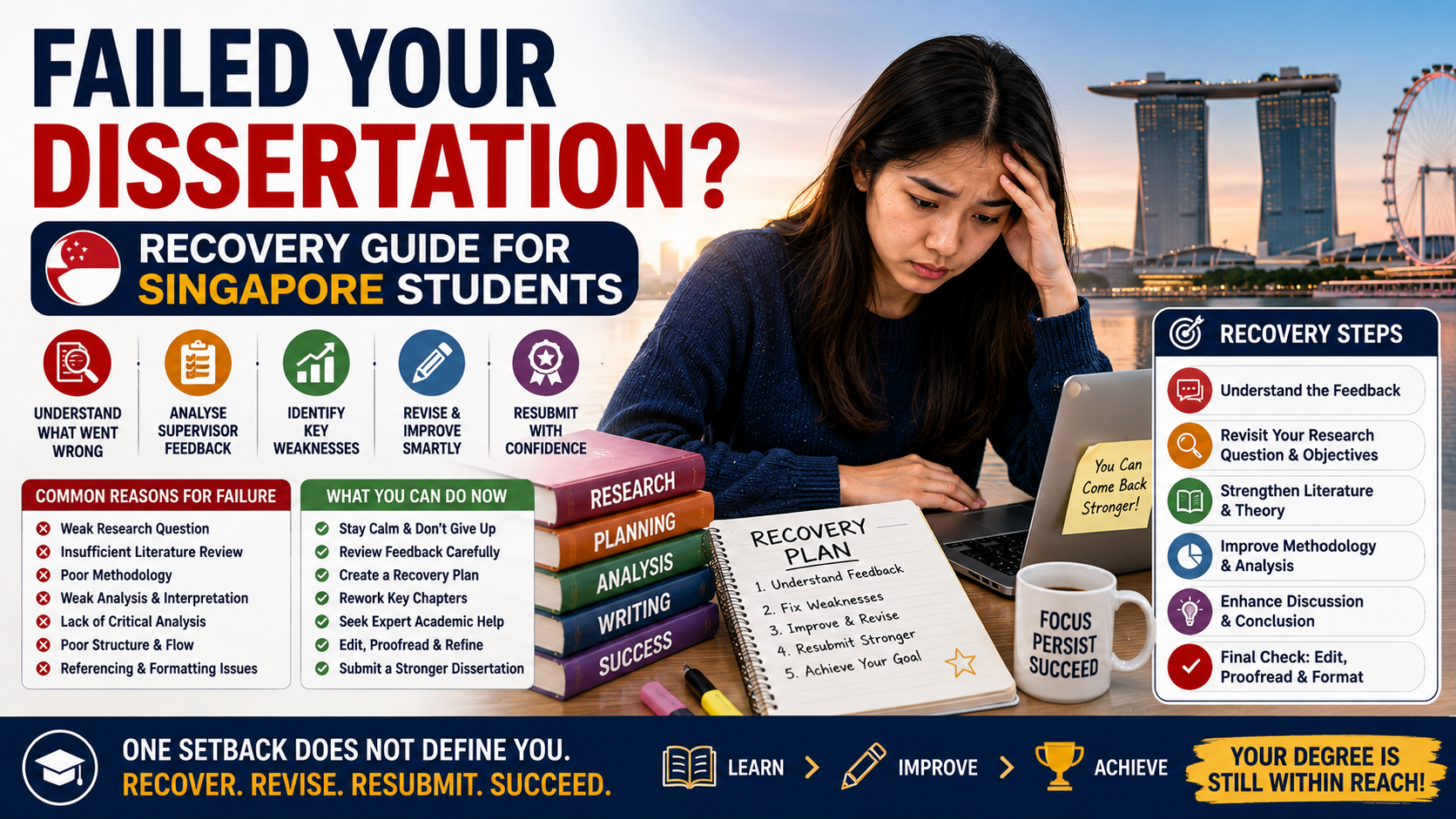
For Singapore university students, the situation can feel particularly difficult when a dissertation is connected to graduation requirements, final-year assessment, postgraduate progression, or a major research project.
However, failing a dissertation does not necessarily mean that your academic journey is over.
Depending on your university, programme, assessment outcome, and academic regulations, you may have opportunities to revise, resubmit, appeal, repeat, or otherwise address the weaknesses identified in your work.
The most important thing is to avoid panic and understand exactly what happened.
This guide explains what Singapore students can do after receiving a poor dissertation result, how to analyse supervisor or examiner feedback, how to rebuild weak chapters, and how professional dissertation editing and proofreading can support the recovery process.
What Does Failing a Dissertation Mean?
A failed dissertation generally means that the submitted research project did not meet one or more of the academic criteria required by your programme.
The specific consequences vary between universities and programmes.
Possible issues may include:
Weak research question
Poor literature review
Insufficient critical analysis
Inappropriate methodology
Weak data analysis
Poor interpretation of findings
Lack of connection between chapters
Inadequate academic sources
Weak conclusion
Poor academic writing
Referencing problems
Failure to follow dissertation requirements
Your first step should therefore be to determine why the dissertation received the result it did.
Do not assume that the entire dissertation is unusable.
Often, specific weaknesses can be identified and addressed through a structured revision process.
Step 1: Don't Panic After a Failed Dissertation
The first reaction to a failed dissertation may be frustration, embarrassment, or fear about graduation.
Give yourself some time to process the result, but avoid making decisions based purely on emotion.
A dissertation result is feedback about a particular piece of academic work.
It does not automatically define your ability as a researcher or student.
Instead of asking:
"Why did I fail?"
ask:
"Which assessment requirements did my dissertation fail to meet, and how can I address them?"
That change in perspective can make the recovery process much more manageable.
Step 2: Check Your University's Academic Regulations
Before revising your dissertation, find out what options are actually available to you.
Your university or programme may have specific rules concerning:
Dissertation resubmission
Reassessment
Resubmission deadlines
Maximum marks after reassessment
Repeat modules
Appeals
Academic progression
Graduation eligibility
Formatting requirements
Supervisor involvement
Singapore has several universities with different academic structures and regulations, so do not rely on advice from another student's programme.
Check your:
Programme handbook
Dissertation handbook
Student portal
Assessment regulations
Faculty guidance
Official communication about your result
If you are unsure, contact the relevant programme or academic office.
Step 3: Understand Why Your Dissertation Failed
This is the most important part of the recovery process.
Your dissertation result should normally be accompanied by some form of feedback, assessment comments, supervisor comments, examiner comments, or marking criteria.
Collect all available feedback.
Look for repeated concerns.
For example, you may find comments such as:
"Insufficient critical analysis"
"Research question lacks focus"
"Literature review is descriptive"
"Methodology is poorly justified"
"Findings are not adequately interpreted"
"Discussion does not engage with literature"
"Conclusion does not answer the research question"
"Limited academic sources"
"Weak methodological explanation"
These comments should become your dissertation recovery plan.
Create a Dissertation Recovery Table
Instead of reading feedback repeatedly without a plan, turn it into a correction table.
Problem | Chapter | Priority | Action |
|---|---|---|---|
Research question too broad | Introduction | High | Refine research focus |
Literature review descriptive | Chapter 2 | High | Increase synthesis and critical comparison |
Methodology poorly justified | Chapter 3 | High | Explain methodological choices |
Findings lack interpretation | Chapter 4 | High | Improve presentation and analytical links |
Discussion weak | Chapter 5 | High | Connect findings with literature |
Referencing inconsistent | All chapters | Medium | Complete citation review |
Grammar problems | All chapters | Low | Proofread after revisions |
This transforms a disappointing result into a list of specific tasks.
Step 4: Identify Whether the Problem Is Structural or Academic
Not every dissertation problem requires the same solution.
Some problems are primarily structural.
For example:
Poor chapter organisation
Repetitive sections
Weak transitions
Inconsistent terminology
Poor paragraph structure
Other problems are academic.
For example:
Weak research gap
Poor theoretical framework
Inadequate methodology
Insufficient critical analysis
Weak interpretation of findings
Academic weaknesses should be addressed before spending extensive time correcting grammar.
Step 5: Revisit Your Research Question
A weak research question can cause problems throughout the entire dissertation.
If the research question is too broad, the literature review may become unfocused.
The methodology may become difficult to justify.
The findings may cover too many issues.
The conclusion may fail to provide a direct answer.
Ask yourself:
Is the question specific?
Is it researchable?
Does it match the methodology?
Does it match the objectives?
Can the available data answer it?
Does the conclusion actually answer it?
Step 6: Check Research Question and Objectives Alignment
Your dissertation should have a logical chain:
Research Question → Objectives → Methodology → Findings → Discussion → Conclusion
If these components do not align, the dissertation can feel fragmented.
For example, suppose your research question investigates employee engagement, but one of your objectives focuses on customer satisfaction.
That objective may not contribute directly to answering the research question.
During recovery, check every objective.
Ask:
"Does completing this objective help answer my research question?"
If the answer is no, discuss the issue with your supervisor before making major changes.
Step 7: Rebuild a Weak Literature Review
A weak literature review is a common reason for poor dissertation results.
One major problem is excessive description.
For example:
Smith (2022) examined employee motivation. Jones (2023) investigated leadership. Lee (2024) studied employee engagement.
This tells the reader what researchers studied, but it does not necessarily demonstrate critical engagement.
A stronger literature review compares and evaluates the research.
Consider:
Where do researchers agree?
Where do they disagree?
Why might their findings differ?
What methodologies did they use?
What limitations exist?
Which populations were studied?
What theories were applied?
What remains unanswered?
Step 8: Strengthen the Research Gap
Your dissertation needs a clear reason for conducting the research.
A weak research gap might say:
"There is limited research on this topic."
This statement is usually too general.
Instead, identify precisely what existing research has not adequately addressed.
For example:
Existing studies have examined employee engagement across large organisations, but comparatively limited research has investigated how hybrid working influences engagement among employees in Singapore-based SMEs.
The gap should logically lead to your research question.
Step 9: Add Relevant Academic Literature
If your feedback says your dissertation lacks sufficient literature, don't simply add dozens of references.
Quality matters more than quantity.
Prioritise:
Peer-reviewed journal articles
Academic books
Major theoretical works
Recent empirical studies
Relevant systematic reviews
High-quality institutional sources where appropriate
Your sources should directly support your argument.
Avoid adding citations simply to increase the reference count.
Step 10: Improve Critical Analysis
"Needs more critical analysis" is one of the most common pieces of dissertation feedback.
Critical analysis involves more than describing academic research.
You should evaluate evidence.
Consider:
Comparison
Do different researchers reach the same conclusion?
Evaluation
How strong is the evidence?
Limitations
What weaknesses exist in the research?
Context
Do findings apply to your specific population or setting?
Methodology
Could different methods explain different results?
Implications
What do the findings mean for your research?
Step 11: Reassess Your Methodology
If your methodology chapter received poor feedback, revisit it carefully.
Check:
Research philosophy
Research approach
Research design
Sampling
Data collection
Data analysis
Research ethics
Reliability
Validity
Trustworthiness
Limitations
A common problem is describing the methodology without explaining why it was chosen.
For example:
"A qualitative approach was used."
A stronger methodology explains why qualitative research was appropriate for the research question and what advantages and limitations it created.
Step 12: Check Your Sampling Strategy
If your dissertation uses primary research, review your sampling carefully.
Ask:
Who was the target population?
How were participants selected?
Why was the sample size appropriate?
What were the inclusion criteria?
What were the exclusion criteria?
Could selection bias have occurred?
Are there limitations to generalising the findings?
If the original sampling process cannot be changed, you may need to acknowledge its limitations rather than pretending the limitation does not exist.
Step 13: Review Your Data Analysis
Weak data analysis can significantly reduce the quality of a dissertation.
For quantitative research, check:
Variable definitions
Statistical tests
Assumptions
Tables
Figures
Statistical significance
Effect interpretation
Research-objective alignment
For qualitative research, check:
Coding
Theme development
Evidence
Participant quotations
Interpretation
Theme relationships
Links to research objectives
Do not use statistical or qualitative techniques simply because they appear sophisticated.
The analysis method should be appropriate for the research question and data.
Step 14: Improve Your Findings Chapter
Your findings should clearly present what your research discovered.
Check whether:
Findings are logically organised
Tables are explained
Figures are labelled correctly
Themes are clearly presented
Findings relate to the research objectives
Important results are not buried
Unnecessary repetition is removed
Avoid mixing extensive interpretation into the findings if your dissertation structure separates findings and discussion.
Step 15: Rebuild the Discussion Chapter
A weak discussion can undermine otherwise useful research.
Your discussion should answer:
"What do these findings mean?"
For each major finding, compare it with existing literature.
Ask:
Does it support previous research?
Does it contradict previous research?
Why might the difference exist?
What theoretical explanation is possible?
What are the practical implications?
What does the finding mean for your research question?
This is where your dissertation demonstrates that you can interpret research rather than simply report it.
Step 16: Fix a Weak Conclusion
Your conclusion should provide a direct answer to the research question.
Check whether it:
Summarises the main findings
Addresses the objectives
Answers the research question
Explains the contribution
Acknowledges limitations
Provides evidence-based recommendations
Suggests future research
Avoid introducing entirely new arguments.
Step 17: Improve Your Dissertation Recommendations
Recommendations should come from your findings.
Weak:
"Companies should improve employee engagement."
Stronger recommendations identify:
Who should act
What should be changed
Why it matters
How it could be implemented
What outcome is expected
If your research does not provide enough evidence for a recommendation, do not make exaggerated claims.
Step 18: Check Your Dissertation Against the Marking Rubric
If your programme provides a dissertation marking rubric, use it as a recovery checklist.
Look at criteria such as:
Research knowledge
Literature engagement
Critical analysis
Methodology
Data analysis
Argument
Originality
Research contribution
Academic writing
Referencing
Presentation
For every criterion, ask:
"What evidence in my revised dissertation demonstrates this?"
This is more useful than simply trying to make the dissertation "sound better."
Step 19: Don't Rewrite Everything Without a Plan
One of the biggest mistakes after failing a dissertation is starting from page one and rewriting everything.
This can:
Waste time
Introduce new inconsistencies
Remove useful material
Create new referencing problems
Make the deadline harder to meet
Instead, identify the specific weaknesses.
Then revise systematically.
Step 20: Keep a Version of the Original Dissertation
Before making substantial changes, save your original document.
For example:
Dissertation_Original
Dissertation_Feedback
Dissertation_Major_Revisions
Dissertation_Chapter_Review
Dissertation_Final_Edit
Dissertation_Final
Version control is particularly important when multiple chapters are being revised simultaneously.
Step 21: Get a Fresh Review of the Revised Dissertation
After making corrections, you may be too familiar with the document to identify remaining weaknesses.
A fresh academic review can help identify:
Unclear arguments
Repeated ideas
Weak transitions
Unsupported claims
Inconsistent terminology
Referencing errors
Chapter-level inconsistencies
Remaining grammar problems
This is especially useful before resubmission.
Dissertation Editing vs Dissertation Rewriting
If you failed your dissertation, you may assume you need to rewrite the entire project.
Not necessarily.
Editing
Editing may improve:
Structure
Clarity
Academic language
Paragraph organisation
Critical analysis
Flow
Consistency
Rewriting
Rewriting may be necessary when there are fundamental problems with:
Research focus
Methodology
Data interpretation
Theoretical framework
Major chapter structure
The correct approach depends on the feedback you received.
Dissertation Proofreading After Major Corrections
Proofreading should generally happen after substantive revisions.
Otherwise, you may spend hours correcting sentences that later need to be rewritten.
Once major corrections are complete, check:
Grammar
Spelling
Punctuation
Sentence structure
Academic tone
Citations
References
Formatting
Tables
Figures
Page numbers
Contents page
What If Your Dissertation Failed Because of Academic Writing?
Sometimes a dissertation contains good research but presents it poorly.
Common problems include:
Long and confusing sentences
Repetition
Informal language
Weak paragraph structure
Poor transitions
Unclear claims
Excessive passive voice
Inconsistent terminology
Academic editing can improve clarity without changing the underlying research.
The objective should be to make your ideas easier for the reader to understand.
What If You Failed Because of Referencing?
Referencing problems can range from minor formatting issues to more serious academic concerns.
Review:
Citation consistency
Reference-list accuracy
Missing sources
Incorrect publication details
Citation-to-reference matching
Referencing style requirements
If your feedback raises concerns about academic integrity, plagiarism, or inappropriate source use, speak directly with your university.
Do not attempt to conceal or manipulate academic integrity issues.
What If You Failed Because of Plagiarism or Academic Integrity?
This situation is different from simply receiving a low dissertation mark.
If you have been contacted regarding:
Plagiarism
Fabricated data
Fabricated references
Contract cheating
Unauthorised collaboration
Academic misconduct
Inappropriate AI use
follow your university's formal process.
You may need to:
Read the allegation carefully
Attend a meeting
Provide evidence
Submit a formal response
Follow an appeal or review procedure
Do not alter evidence or attempt to hide academic misconduct.
Using AI During Dissertation Recovery
AI tools can be useful for certain academic support tasks, but their use must follow your university's policies.
Depending on your programme's rules, AI may potentially assist with:
Brainstorming
Grammar review
Understanding concepts
Creating revision checklists
Identifying unclear sentences
However, students should not assume that every use of generative AI is permitted.
Check your programme's current academic integrity and AI-use guidance before using AI to revise or produce dissertation content.
Your research, data, analysis, and academic decisions should remain your responsibility.
How Singapore Students Can Recover Strategically
A successful recovery plan can follow this sequence:
1. Understand the Result
Read the assessment feedback carefully.
2. Check Your Options
Confirm resubmission, reassessment, appeal, or progression procedures with your university.
3. Identify Major Weaknesses
Prioritise issues affecting research quality.
4. Revisit the Research Question
Make sure the project has a clear direction.
5. Correct the Literature Review
Strengthen synthesis, evaluation, and research gaps.
6. Review the Methodology
Justify the research approach and methods.
7. Improve Findings
Present evidence clearly.
8. Strengthen Discussion
Interpret findings and connect them with literature.
9. Rewrite the Conclusion
Answer the research question directly.
10. Edit and Proofread
Complete final language, referencing, and formatting checks.
Dissertation Recovery Timeline
Your available time will depend on your university's resubmission deadline.
A general revision structure might look like this:
Period | Priority |
|---|---|
Days 1–2 | Understand feedback and assessment criteria |
Days 3–5 | Research question and structural corrections |
Days 6–10 | Literature review and methodology |
Days 11–15 | Findings and analysis |
Days 16–20 | Discussion and conclusion |
Days 21–23 | References and formatting |
Days 24–25 | Editing |
Final stage | Proofreading and submission checks |
If your deadline is shorter, prioritise the corrections that affect the dissertation's academic outcome most significantly.
How Dissertation Editing Services Can Help After a Fail
Professional dissertation editing can provide an additional review of your existing work.
Depending on the service, support may include:
Chapter editing
Literature review editing
Methodology review
Critical analysis feedback
Discussion chapter review
Academic language editing
Structure and coherence review
Referencing checks
Dissertation proofreading
Formatting review
This type of support is particularly useful when you have already received detailed feedback but need another perspective while revising your own dissertation.
AssignmentCart Dissertation Recovery Support
AssignmentCart provides ethical academic support for students who need help improving their own dissertation after receiving a poor result.
Support can include:
Dissertation correction review
Supervisor feedback interpretation
Dissertation chapter editing
Literature review improvement
Methodology review
Critical analysis feedback
Findings and discussion review
Academic proofreading
Referencing checks
Formatting support
Final dissertation review
The objective is to help students understand and improve weaknesses in their existing work.
Students remain responsible for their research, data, analysis, arguments, and final submission.
Why Get a Second Review Before Resubmission?
After receiving a failing result, it is understandable to want to submit the revised dissertation as quickly as possible.
However, submitting without checking whether all major weaknesses have been addressed can create unnecessary risk.
A second review can help you ask:
Have I addressed the supervisor's main concerns?
Is the research question now clear?
Does the methodology support the research question?
Is the literature review sufficiently critical?
Are findings properly analysed?
Does the discussion interpret the findings?
Does the conclusion answer the research question?
Are references accurate?
Does the dissertation meet formatting requirements?
A final quality check can be particularly valuable when the resubmission is your opportunity to recover from the original result.
Failed Dissertation Recovery Checklist
Before resubmitting, ask yourself:
Research Focus
☐ Is the research question clear?
☐ Are the objectives aligned?
☐ Is the research scope manageable?
Literature
☐ Is the literature relevant?
☐ Have I demonstrated critical analysis?
☐ Have I compared different academic perspectives?
☐ Is the research gap clear?
Methodology
☐ Is the research approach justified?
☐ Is sampling clearly explained?
☐ Are data collection methods appropriate?
☐ Is data analysis explained?
☐ Are limitations acknowledged?
Findings
☐ Are the findings clearly presented?
☐ Are tables and figures accurate?
☐ Are findings linked to objectives?
Discussion
☐ Have I interpreted the findings?
☐ Have I compared them with previous research?
☐ Have I explained unexpected findings?
☐ Are implications discussed?
Conclusion
☐ Does the conclusion answer the research question?
☐ Are the objectives addressed?
☐ Are recommendations supported by findings?
☐ Are limitations acknowledged?
Final Quality
☐ Have supervisor/examiner comments been addressed?
☐ Has the marking rubric been reviewed?
☐ Are references consistent?
☐ Is formatting correct?
☐ Has the dissertation been proofread?
☐ Have university resubmission requirements been checked?
Final Thoughts: You Can Recover From a Failed Dissertation
Failing a dissertation can feel like the end of your academic journey, but the result should first be treated as a signal to understand what needs to change.
Do not immediately rewrite everything.
Start with the feedback.
Identify the major weaknesses.
Check your university's resubmission or reassessment rules.
Then work through the dissertation systematically.
Focus first on the issues that affect the academic quality of the research:
research question → literature → methodology → findings → discussion → conclusion.
Once those areas are addressed, complete the editing, referencing, formatting, and proofreading stages.
If you are a Singapore student facing dissertation resubmission after a poor result, professional academic editing and feedback support can provide an additional layer of review while keeping your own research and academic responsibility at the centre of the process.
A failed dissertation is a serious setback.
It does not have to be the final chapter.
Frequently Asked Questions
Everything you need to know about our services
Related Posts

Failed Your Dissertation in Ireland? What to Do Next

Dissertation Corrections After Supervisor Review
