Dissertation Supervisor Feedback? Here's How to Respond
Introduction
Receiving feedback from your dissertation supervisor can be both reassuring and overwhelming.
You may open your document and find comments about your research question, literature review, methodology, analysis, structure, academic writing, referencing, or conclusions. Some comments may be straightforward, while others can be difficult to interpret.
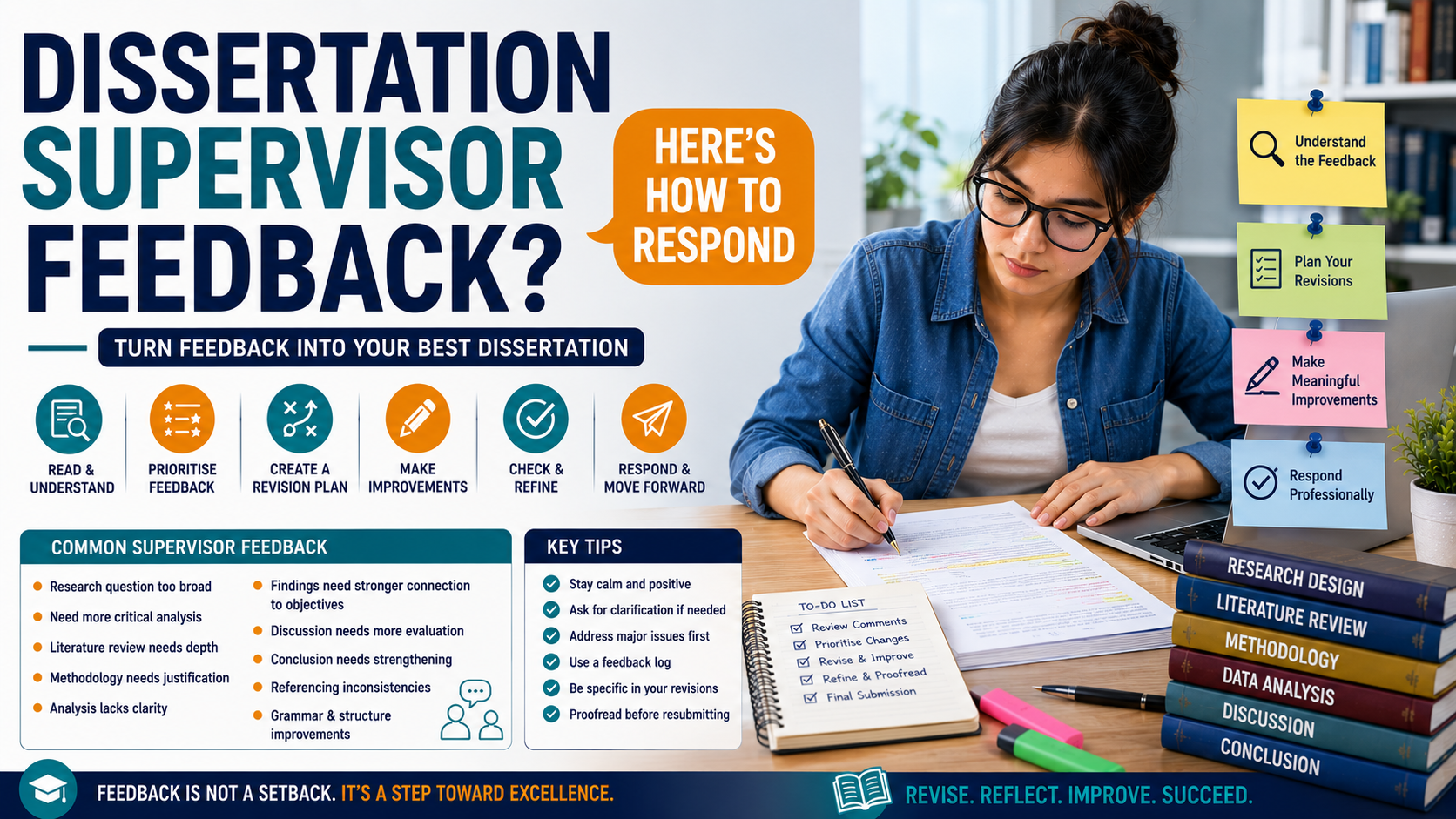
The most important thing is not to treat supervisor feedback as a list of criticisms.
Supervisor feedback is usually a roadmap for improving your dissertation before the final submission.
Whether your supervisor asks you to strengthen the literature review, clarify your methodology, improve your critical analysis, restructure chapters, or explain your findings more clearly, the best response is systematic rather than emotional.
This guide explains how to interpret dissertation feedback, prioritise revisions, respond professionally, and make meaningful improvements to your work.
What Does Dissertation Supervisor Feedback Mean?
Supervisor feedback can serve several purposes.
Your supervisor may be checking whether:
Your research question is sufficiently focused
Your objectives align with the research question
Your literature review demonstrates critical engagement
Your methodology is appropriate
Your research design is clearly explained
Your analysis answers the research objectives
Your findings are presented logically
Your discussion connects findings with previous research
Your conclusions are supported by evidence
Your academic writing is clear
Your referencing is consistent
Not every comment means that something is fundamentally wrong.
A comment such as "develop this further" may simply mean that the existing discussion needs more evidence or explanation.
A comment such as "unclear" may indicate that your argument needs restructuring rather than that the underlying research is incorrect.
Don't Respond Immediately
One of the most common mistakes students make is trying to revise everything immediately after receiving feedback.
Instead:
Read the feedback once.
Read it again carefully.
Group similar comments together.
Identify major issues.
Prioritise revisions.
Create an action plan.
Begin with the most important changes.
This prevents you from spending hours correcting minor grammar issues while major problems remain in your research structure.
Separate Major and Minor Feedback
Not all supervisor comments have the same importance.
A useful approach is to divide feedback into three categories.
Major Revisions
These can affect the overall quality or direction of the dissertation.
Examples include:
Research question needs narrowing
Methodology is not sufficiently justified
Literature review lacks critical analysis
Data analysis does not address the research objectives
Discussion needs substantial development
Chapter structure needs revision
These should receive priority.
Moderate Revisions
These improve individual sections.
Examples include:
Add more supporting literature
Explain a theoretical concept
Clarify a paragraph
Strengthen a transition
Explain a methodological decision
Minor Revisions
These include:
Grammar
Spelling
Formatting
Typographical errors
Citation formatting
Heading consistency
Minor corrections are important, but they should usually come after substantive revisions.
Create a Dissertation Feedback Table
A feedback table can make the revision process much easier.
Supervisor Feedback | Location | Priority | Required Action | Status |
|---|---|---|---|---|
Research question too broad | Introduction | High | Narrow research focus | Pending |
Literature needs more critique | Chapter 2 | High | Compare key studies | Pending |
Methodology needs justification | Chapter 3 | High | Explain methodological choices | Pending |
Findings unclear | Chapter 4 | Medium | Improve presentation | Pending |
Referencing inconsistent | Throughout | Low | Complete citation check | Pending |
This turns vague feedback into manageable tasks.
How to Respond to "Your Research Question Is Too Broad"
This is a common dissertation comment.
A broad question can make it difficult to:
Conduct a focused literature review
Collect relevant data
Analyse findings
Reach meaningful conclusions
If your supervisor says the question is too broad, review:
Population
Location
Industry
Variables
Time period
Research context
Research methodology
For example, instead of researching:
How does leadership affect employees?
A more focused question might examine:
How does transformational leadership influence employee engagement among employees in UK healthcare organisations?
The appropriate level of specificity depends on your research context and university requirements.
How to Respond to "You Need More Critical Analysis"
This is one of the most common dissertation feedback comments.
Critical analysis means going beyond summarising what other researchers have said.
Instead of:
Smith (2023) found that employee engagement improves productivity. Jones (2024) also found that engagement affects performance.
You could compare the studies by considering:
Whether they reached similar conclusions
Their research methods
Their samples
Their theoretical perspectives
Their limitations
Their research contexts
Why their findings may differ
The goal is to demonstrate that you understand the academic debate rather than simply reporting individual sources.
How to Improve a Literature Review After Feedback
If your supervisor says your literature review is too descriptive, consider reorganising it around themes, debates, and concepts rather than individual authors.
For example, instead of:
Smith
Discuss Smith's research.
Jones
Discuss Jones's research.
Brown
Discuss Brown's research.
Consider:
Theme 1: Employee Motivation
Compare relevant studies.
Theme 2: Leadership and Engagement
Evaluate different perspectives.
Theme 3: Organisational Culture
Compare evidence and identify disagreements.
Research Gap
Explain what existing research has not adequately addressed.
This usually creates a stronger academic narrative.
How to Respond to "Justify Your Methodology"
Your supervisor may want more than a description of your methodology.
For example, simply writing:
A quantitative research approach was selected.
does not explain why.
You should consider:
Why was the approach appropriate?
What research question does it address?
Why was this method selected instead of alternatives?
What are its strengths?
What are its limitations?
How does it support your research objectives?
The methodology should demonstrate a logical connection between:
Research question → Research design → Data collection → Analysis
How to Respond to Methodology Criticism
If your supervisor questions your methodology, do not automatically rewrite the entire chapter.
First identify what the comment actually concerns.
It could relate to:
Research philosophy
Research approach
Research design
Sampling
Data collection
Questionnaire design
Interview structure
Data analysis
Reliability
Validity
Ethics
Research limitations
Address the specific issue before making larger changes.
How to Respond to "Your Sample Needs More Explanation"
If your supervisor asks you to justify your sample, explain:
Who the participants were
Why they were selected
How they were recruited
The sampling method
The sample size
Inclusion criteria
Exclusion criteria
Potential sampling limitations
Avoid simply stating that the sample was "appropriate."
Explain why it was appropriate for the research question.
How to Respond to "Your Analysis Needs More Depth"
If your supervisor says your analysis lacks depth, first identify what is missing.
Possible problems include:
Findings are presented without interpretation
Results are not linked to research objectives
Statistical findings are not explained
Themes are not sufficiently developed
Academic literature is not connected to findings
Alternative interpretations are ignored
Your analysis should explain what your findings mean in the context of your research question.
How to Respond to "Your Discussion Repeats the Findings"
The findings and discussion chapters have different purposes.
The findings chapter primarily presents what you discovered.
The discussion explains:
Why the findings matter.
A strong discussion may:
Compare findings with previous research
Explain similarities
Explain differences
Connect findings with theory
Discuss practical implications
Address unexpected findings
Consider limitations
Explain the contribution of the research
Avoid simply repeating tables, statistics, or themes from the findings chapter.
How to Respond to "Connect Your Findings With the Literature"
This comment means your discussion needs stronger integration between your results and existing research.
For each major finding, consider:
What did the research find?
What does previous literature say?
Does your finding support previous research?
Does it contradict previous research?
Why might the results differ?
What does this mean for the research question?
This creates a more analytical discussion.
How to Respond to "Your Conclusion Is Too Weak"
A dissertation conclusion should not simply repeat the introduction.
It should answer the research question based on the evidence presented.
A strong conclusion may include:
Main findings
Direct answer to the research question
Research contribution
Practical implications
Limitations
Recommendations
Suggestions for future research
Do not introduce major new evidence that was not discussed earlier in the dissertation.
How to Respond to "You Need a Clearer Research Gap"
A research gap explains what existing research has not adequately addressed.
A weak gap might say:
There is limited research on this topic.
A stronger research gap identifies:
What previous research has established
Where disagreements exist
What populations or contexts are under-researched
Which methodological limitations remain
What specific question still requires investigation
Your research should then demonstrate how it addresses that gap.
How to Respond to Comments About Dissertation Structure
Your supervisor may suggest moving sections or restructuring chapters.
Do not immediately rewrite every paragraph.
First create an outline showing:
Introduction
Literature review
Methodology
Findings
Discussion
Conclusion
Then examine the logical flow between sections.
Ask:
Does each chapter perform its intended function?
For example, your methodology should explain how you conducted the research, while your discussion should interpret the findings.
How to Respond to "This Paragraph Is Unclear"
An unclear paragraph often contains too many ideas.
A useful paragraph structure is:
Main point → Evidence → Explanation → Critical analysis → Link
Start with the central point.
Then provide evidence.
Explain what the evidence demonstrates.
Critically evaluate it.
Finally, connect the discussion to the broader argument.
How to Respond to "Add More References"
Adding references does not automatically improve a dissertation.
First ask why additional sources are required.
You may need more literature because:
A claim is unsupported
A theoretical argument needs evidence
Recent research is missing
Opposing perspectives have not been considered
The literature review lacks breadth
A statement requires authoritative support
Focus on relevant and credible sources, not simply increasing the citation count.
How to Respond to "Use More Recent Sources"
Your supervisor may want your dissertation to engage with current research.
Review your existing literature and identify:
Older sources that remain foundational
Recent studies
Current academic debates
New evidence
Recent industry or policy developments where appropriate
Do not remove important foundational research simply because it is old.
Instead, balance foundational literature with relevant recent scholarship.
How to Respond to Supervisor Feedback on Academic Writing
If your supervisor comments on your writing style, look for patterns.
Common issues include:
Long sentences
Repetition
Informal language
Weak transitions
Unclear arguments
Excessive passive voice
Poor paragraph structure
Unsupported claims
Inconsistent terminology
Do not correct individual sentences without identifying the underlying pattern.
If every paragraph has the same problem, revise your writing approach throughout the chapter.
How to Respond to "This Needs More Evidence"
When a supervisor asks for more evidence, determine what type of evidence is missing.
It could be:
Academic literature
Empirical research
Statistical data
Company evidence
Government data
Industry reports
Primary research findings
The appropriate evidence depends on the claim being made.
How to Deal With Conflicting Supervisor Comments
Sometimes feedback can appear contradictory.
For example:
One comment asks you to add more detail.
Another asks you to reduce the word count.
The solution is usually not to ignore either comment.
Instead, identify the underlying issue.
Your supervisor may want more analytical depth but less descriptive material.
In that situation, replace unnecessary description with concise critical analysis.
If you genuinely cannot determine what the supervisor means, ask for clarification.
How to Ask Your Dissertation Supervisor for Clarification
A professional clarification message should be:
Specific
Concise
Respectful
Focused on the feedback
Instead of:
I don't understand your comments.
Ask about the specific issue.
For example:
Could you please clarify whether the main concern with Chapter 2 is the organisation of the literature review or the depth of critical analysis? I want to make sure I address the feedback appropriately.
This demonstrates that you have reviewed the feedback and are actively trying to improve the dissertation.
Should You Reply to Every Supervisor Comment?
Not necessarily.
Some comments are instructions, while others may be suggestions or observations.
If your university uses a formal feedback or response document, follow its requirements.
Otherwise, you may simply incorporate the feedback into your revised dissertation and discuss significant changes during your next supervision meeting.
Create a Dissertation Revision Plan
After receiving feedback, create a revision schedule.
For example:
Day 1: Feedback Review
Read all comments and categorise them.
Day 2: Research Question and Structure
Address major structural concerns.
Days 3–5: Literature Review
Strengthen critical analysis and research gaps.
Days 6–7: Methodology
Improve methodological justification.
Days 8–10: Findings and Discussion
Strengthen interpretation and literature integration.
Day 11: Conclusion
Ensure the conclusion answers the research question.
Day 12: References and Formatting
Complete citation and formatting checks.
Day 13: Proofreading
Review language, grammar, consistency, and presentation.
Day 14: Final Review
Check the dissertation against the supervisor feedback and submission requirements.
Adjust the timeline according to your deadline.
Keep a Supervisor Feedback Log
A feedback log can be particularly useful when you receive multiple rounds of supervision comments.
Track:
Date of feedback
Chapter
Supervisor comment
Interpretation
Action taken
Revision completed
Questions requiring clarification
This creates a clear record of your progress.
Don't Delete Supervisor Comments Immediately
Keep a copy of the original document before making revisions.
A useful workflow is:
Original Draft → Feedback Version → Revised Draft → Final Draft
This allows you to compare changes and recover material if necessary.
Dissertation Editing After Supervisor Feedback
Once major revisions are complete, academic editing can help improve the revised document.
An editing review may focus on:
Logical flow
Chapter structure
Argument clarity
Critical analysis
Literature integration
Academic tone
Paragraph structure
Repetition
Transitions
This is particularly useful when extensive revisions have caused inconsistencies between chapters.
Dissertation Proofreading Before Submission
Proofreading should usually be the final stage.
Check:
Grammar
Spelling
Punctuation
Headings
Tables
Figures
Page numbers
Contents page
References
Citations
Formatting
Abbreviations
Terminology
Also check that changes made during revision have not created contradictions elsewhere.
How AssignmentCart Can Help After Supervisor Feedback
AssignmentCart provides ethical academic support for students who have received dissertation feedback.
Support can include:
Dissertation editing
Dissertation proofreading
Chapter structure review
Critical analysis feedback
Literature review editing
Methodology presentation review
Discussion chapter feedback
Academic writing improvement
Referencing checks
Formatting reviews
The purpose is to help students improve their own dissertation following supervisor guidance.
Why Dissertation Feedback Support Can Be Useful
After receiving extensive feedback, students can sometimes struggle to determine where to begin.
Academic support can help you:
Organise supervisor comments
Identify recurring writing problems
Improve chapter structure
Strengthen critical analysis
Clarify arguments
Improve academic language
Check referencing
Review consistency
Proofread the revised dissertation
This can make the revision process more systematic.
Ethical Academic Support
Supervisor feedback should remain the foundation of your dissertation revisions.
Academic support should complement that feedback rather than replace your own academic decisions.
AssignmentCart can help students with:
Editing
Proofreading
Structure
Academic language
Referencing
Presentation
Constructive feedback
Students remain responsible for their research, arguments, data, interpretation, and final submission.
Always follow your university's academic integrity and supervision requirements.
Dissertation Supervisor Feedback Checklist
Before your final submission, check:
✔ Have you addressed the major supervisor comments?
✔ Did you review the research question?
✔ Are your research objectives aligned with the question?
✔ Have you strengthened the literature review?
✔ Have you improved critical analysis?
✔ Is the research gap clear?
✔ Have you justified your methodology?
✔ Does your analysis address the research objectives?
✔ Have you strengthened the discussion?
✔ Have you connected findings with existing literature?
✔ Does the conclusion answer the research question?
✔ Are recommendations supported by your findings?
✔ Have you resolved unclear sections?
✔ Have you checked all citations?
✔ Does the reference list match the citations?
✔ Have you checked tables and figures?
✔ Have you maintained consistent terminology?
✔ Have you followed the university's formatting requirements?
✔ Have you completed a final proofreading review?
Final Thoughts
Receiving dissertation supervisor feedback is an important part of the research process.
Instead of seeing comments as a list of problems, treat them as a revision roadmap.
Start with major issues such as your research question, methodology, literature review, analysis, discussion, and conclusion. Then address smaller issues such as writing style, referencing, formatting, and proofreading.
The strongest response to supervisor feedback is not simply making every change as quickly as possible.
It is understanding why the change has been requested, deciding how it affects your dissertation, making the revision carefully, and checking whether the change improves the overall argument.
If you need support with dissertation editing, proofreading, structure, critical analysis, literature review improvement, referencing, or final presentation after receiving supervisor feedback, AssignmentCart provides ethical academic support designed to help students improve their own work.
Frequently Asked Questions
Everything you need to know about our services


