Dissertation Due in 48 Hours? Emergency Dissertation Help
Introduction
Having a dissertation due in 48 hours can feel overwhelming. You may still have chapters to complete, references to organise, data to analyse, formatting problems to fix, or a draft that needs urgent proofreading.
At this stage, panic is unlikely to help. What you need is a clear plan that separates the essential work from tasks that can wait.
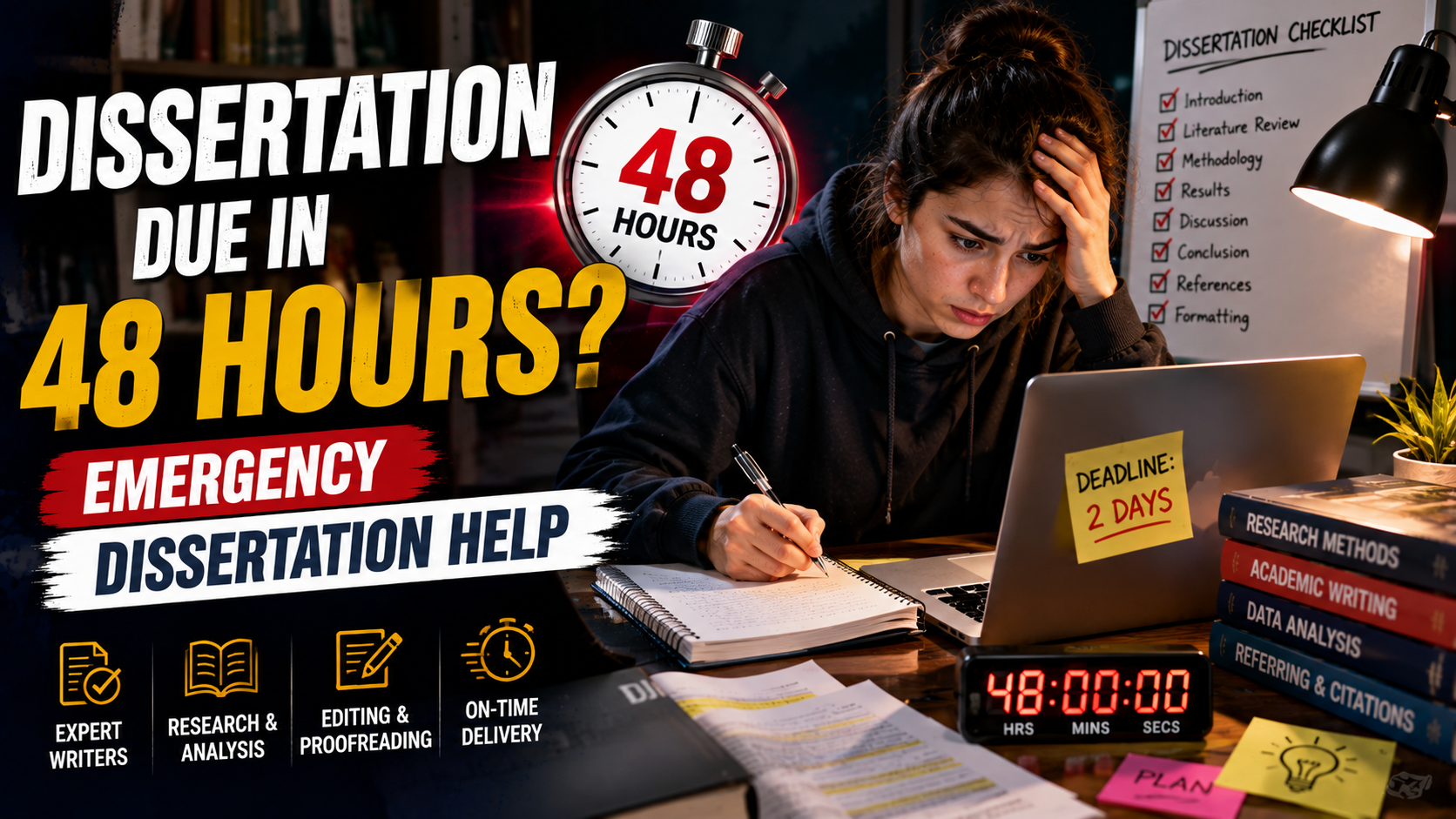
If your dissertation deadline is approaching quickly, emergency dissertation help may also be useful for appropriate academic support such as proofreading, editing, formatting, referencing checks, research guidance, or feedback on the structure of your existing work.
This guide explains what to do when you have only 48 hours remaining and how to make the most of the time available.
What Should You Do If Your Dissertation Is Due in 48 Hours?
The first thing to remember is that you do not have 48 hours of uninterrupted working time.
You need to reserve time for:
Reviewing your dissertation
Completing missing sections
Checking your analysis
Reviewing references
Formatting the document
Proofreading
Preparing the final file
Submitting successfully
Start by determining exactly where your dissertation stands.
Ask yourself:
What is already finished, what is incomplete, and what is absolutely essential before submission?
This simple assessment can prevent you from wasting hours rewriting sections that are already acceptable.
Step 1: Check Your Dissertation Requirements
Before making changes, review the official dissertation requirements provided by your university.
Check:
Submission deadline
Word-count requirements
Required chapters
Formatting rules
Referencing style
Research requirements
Dissertation structure
Appendices
Tables and figures
Submission format
File naming requirements
Assessment criteria
If your department has provided a dissertation handbook or marking rubric, keep it open while reviewing your document.
Your university's requirements should take priority over generic dissertation advice.
Step 2: Assess Your Dissertation in 15 Minutes
Don't immediately start editing.
First, create a quick status report.
Dissertation Section | Status |
|---|---|
Title | Complete / Needs work |
Abstract | Complete / Needs work |
Introduction | Complete / Needs work |
Literature Review | Complete / Needs work |
Methodology | Complete / Needs work |
Results/Findings | Complete / Needs work |
Discussion | Complete / Needs work |
Conclusion | Complete / Needs work |
References | Complete / Needs work |
Appendices | Complete / Needs work |
Formatting | Complete / Needs work |
This gives you a realistic picture of what remains.
If eight sections are already complete and only two need substantial attention, your situation is very different from having an almost entirely unfinished dissertation.
Step 3: Prioritise the Highest-Impact Problems
With only 48 hours remaining, you need to prioritise.
Start with problems that could seriously affect whether the dissertation meets the submission requirements.
For example:
Missing required chapters
Major gaps in analysis
Weak connection to the research question
Missing references
Incomplete results or findings
Significant formatting problems
Grammar and spelling issues
Minor wording preferences
Don't spend an hour changing a heading while an important chapter remains incomplete.
Step 4: Create a 48-Hour Dissertation Plan
Your schedule should depend on how much work remains.
A possible plan might look like this:
Time | Priority |
|---|---|
Hours 48–44 | Review requirements and identify missing work |
Hours 44–32 | Complete the most important unfinished sections |
Hours 32–24 | Review analysis, evidence and argument |
Hours 24–18 | Complete conclusion and abstract |
Hours 18–14 | References, tables, figures and appendices |
Hours 14–8 | Structural editing and formatting |
Hours 8–4 | Detailed proofreading |
Final 4 hours | Final checks, file preparation and submission |
You should also allow yourself adequate rest.
Trying to work continuously for 48 hours can reduce concentration and increase the likelihood of careless mistakes.
Step 5: Focus on Your Research Question
A dissertation should have a clear connection between the research question, methodology, findings, discussion, and conclusion.
When reviewing your dissertation, ask:
Does every major section contribute to answering my research question?
For example:
Introduction
Does it clearly establish the research problem and objectives?
Literature Review
Does it demonstrate what existing research says and identify the relevant gap or debate?
Methodology
Does it explain how the research was conducted and why the chosen approach was appropriate?
Findings
Does it present the results clearly?
Discussion
Does it interpret the findings and connect them to the literature?
Conclusion
Does it directly answer the research question based on the evidence presented?
This alignment can be more important than making every sentence sound perfect.
Step 6: Complete Missing Sections Strategically
If a chapter is incomplete, don't immediately try to make it perfect.
First, make sure the essential content is present.
For example, if your discussion chapter is incomplete, establish:
Main findings
Interpretation of findings
Connection to previous research
Implications
Limitations where relevant
Recommendations where appropriate
You can then return to improve the writing.
A complete, coherent draft gives you something to edit.
Step 7: Don't Start Completely New Research Unless Necessary
One of the easiest ways to lose time is to keep expanding your research.
If you already have enough relevant academic literature to support your dissertation, focus on using it effectively.
Ask:
Does this source directly relate to my research question?
Does it support my argument?
Have I explained its relevance?
Have I connected it to other literature?
A dissertation is not necessarily stronger simply because it contains a very large number of references.
The quality, relevance, analysis, and integration of the literature matter.
Step 8: Check Your Literature Review
Your literature review should do more than list studies.
Look for evidence of:
Comparison
Contrast
Critical analysis
Research trends
Gaps
Methodological differences
Conflicting findings
Relevant theoretical perspectives
Instead of simply writing that one researcher found X and another found Y, explain why the difference matters.
For example:
Study A found X, while Study B reported Y. This difference may be related to differences in sample characteristics, methodology, research setting, or measurement approach.
The exact explanation will depend on your field and evidence.
Step 9: Review Your Methodology
Your methodology chapter should clearly explain how your research was conducted.
Depending on your project, check whether you have adequately addressed:
Research approach
Research design
Participants or sample
Data collection
Data analysis
Research instruments
Ethical considerations
Limitations
Justification for methodological choices
Do not add methodological claims simply because they sound academic.
Make sure everything accurately reflects what you actually did.
Step 10: Check Your Findings or Results
If you have completed your research, review whether your results are presented clearly.
Check:
Tables
Figures
Statistical results
Themes
Categories
Participant information
Supporting evidence
Make sure tables and figures are labelled correctly and referenced in the text where required.
Avoid introducing interpretations into a results section if your dissertation structure requires interpretation to appear in the discussion chapter.
Follow your department's guidelines.
Step 11: Strengthen the Discussion
The discussion is often one of the most important sections of a dissertation because it demonstrates your ability to interpret your findings.
Ask:
What do the findings mean?
How do they relate to previous research?
Do they support or contradict earlier studies?
Why might the results differ?
What are the practical or theoretical implications?
What limitations should be acknowledged?
Avoid simply repeating your results.
The discussion should help the reader understand the significance of those results.
Step 12: Don't Forget the Conclusion
A rushed dissertation can sometimes have a strong main body but a weak conclusion.
Your conclusion should provide a clear final response to the research question.
Depending on your discipline, it may include:
Main findings
Overall answer to the research question
Key implications
Research limitations
Recommendations
Suggestions for future research
Don't introduce completely new evidence in the conclusion unless your dissertation guidelines specifically require it.
Step 13: Complete Your Abstract Last
If your abstract is still unfinished, consider writing it after the main dissertation is complete.
Your abstract should accurately reflect what the dissertation actually contains.
Depending on your university's requirements, it may summarise:
Research problem
Aim
Methodology
Key findings
Main conclusion
Implications
Check your department's specific word limit and format.
Step 14: Check Your References
Reference management can become a major problem when you're rushing.
Review your dissertation for:
Missing citations
Incorrect citations
Sources in the reference list that aren't cited
Citations missing from the reference list
Inconsistent formatting
Incorrect publication details
Broken or incomplete references
Use the referencing style required by your university.
Do not rely entirely on automatic citation tools without checking the results.
What Is Emergency Dissertation Help?
Emergency dissertation help refers to academic support requested when a student has a very short period before a dissertation deadline.
Depending on the provider and the student's requirements, support may include:
Dissertation proofreading
Academic editing
Structural feedback
Referencing checks
Formatting
Research guidance
Presentation review
Language and clarity improvements
The type of support available depends on the provider, academic discipline, dissertation length, deadline, and complexity.
If you need urgent support, provide the exact deadline rather than simply saying that the dissertation is "urgent."
When Is Dissertation Editing More Useful Than Rewriting?
If you already have a complete dissertation, rewriting everything can be an inefficient use of your remaining time.
Instead, identify the largest weaknesses.
For example, you may have:
Strong research but weak academic language
Good findings but a poorly organised discussion
Correct content but inconsistent references
A complete dissertation with grammar problems
Strong chapters but weak transitions
A well-written dissertation with formatting inconsistencies
In these situations, targeted editing may be much more useful than starting from scratch.
What Can Dissertation Proofreading Help With?
Proofreading is particularly useful near the end of the dissertation process.
A proofreading review can identify issues such as:
Grammar and Spelling
Correct obvious language errors.
Sentence Clarity
Identify confusing or unnecessarily complicated sentences.
Consistency
Check terminology, headings, formatting, abbreviations, and other recurring elements.
Academic Presentation
Identify problems with structure and presentation that may be visible during a final review.
References
Identify obvious inconsistencies between citations and the bibliography or reference list.
Proofreading should be treated as a final quality-control stage rather than a replacement for conducting your own research and analysis.
What If Your Dissertation Is Not Finished?
If significant sections remain incomplete, don't immediately assume that the entire dissertation needs to be rewritten.
Create three lists:
Must Complete
Work that is necessary for the dissertation to satisfy the assignment requirements.
Should Improve
Problems that could meaningfully improve the quality of the dissertation.
Nice to Have
Minor improvements that can wait if time becomes limited.
This approach helps you protect your remaining time.
Can You Get Emergency Dissertation Help Within 48 Hours?
Availability varies.
Some academic support providers may offer urgent services depending on:
Subject
Academic level
Dissertation length
Type of support
Complexity
Deadline
Current workload
A completed dissertation requiring proofreading may be easier to accommodate within 48 hours than a large unfinished dissertation requiring extensive research and development.
If your deadline is approaching, provide your exact requirements immediately.
What Information Should You Provide?
If you are requesting urgent dissertation support, provide:
Dissertation topic
Research question
Academic level
Subject or discipline
Word count
Exact deadline
University requirements
Referencing style
Dissertation guidelines
Existing draft
Specific areas requiring assistance
If you only need proofreading, make that clear.
If you need structural feedback, identify the chapters that concern you.
Specific information helps determine what kind of support is realistic.
How Much Does Emergency Dissertation Help Cost?
The cost of urgent academic support varies according to the service.
Factors may include:
Dissertation length
Academic level
Subject
Complexity
Deadline
Type of support
Research requirements
Editing requirements
A proofreading request for a completed dissertation can have very different requirements from extensive support for a dissertation that is still incomplete.
Request a quote based on the actual work required rather than relying on a generic price.
What If Your Dissertation Is Due Tomorrow?
If you have approximately 24 hours left, prioritise the most important elements.
Focus on:
Required chapters
Research question alignment
Findings and analysis
Discussion
Conclusion
References
Formatting
Proofreading
Submission
Don't spend hours making minor stylistic changes while major sections remain unfinished.
What If Your Dissertation Is Due Tonight?
If you have only a few hours remaining, your priorities need to become even more focused.
Check:
Is every required chapter present?
Does the dissertation answer the research question?
Are key findings included?
Are important claims supported?
Are citations and references present?
Is the formatting acceptable?
Is the correct file ready?
Do you know exactly how to submit it?
Leave enough time to upload the document and confirm that the submission was successful.
What If You Cannot Finish Your Dissertation?
If unexpected circumstances genuinely prevent you from completing your dissertation, check your university's official policies.
Depending on your institution, there may be procedures relating to:
Extensions
Academic consideration
Extenuating circumstances
Deferrals
Late submissions
Student support
Requirements differ between universities and programmes.
If you believe you may qualify for an extension or other consideration, contact the appropriate university department as soon as possible and follow the official process.
A 2-Hour Final Dissertation Checklist
If you have only two hours left, avoid trying to rewrite the dissertation.
Use the remaining time for quality control.
Content
Does the dissertation answer the research question?
Are all required chapters included?
Are the main findings clearly presented?
Does the discussion interpret the findings?
References
Are important claims cited?
Do citations match the reference list?
Is the required referencing style followed?
Formatting
Is the word count correct?
Are headings consistent?
Are page numbers correct?
Are tables and figures labelled?
Are appendices included where required?
Proofreading
Check spelling
Check grammar
Check repeated words
Check headings
Check page breaks
Check obvious formatting errors
Submission
Correct file selected
File opens correctly
Required format used
Submission portal checked
Submission completed
Confirmation saved
Common Mistakes Students Make During a Dissertation Emergency
Trying to Rewrite Everything
A 48-hour deadline is not the time to rebuild a dissertation from scratch unless there is a serious fundamental problem.
Continuing Research Indefinitely
Research should serve your dissertation. It should not prevent you from completing it.
Ignoring the Marking Criteria
The rubric can help you determine which areas deserve your remaining attention.
Leaving References Until the End
Maintain your references while working whenever possible.
Forgetting the Submission Process
A finished dissertation still needs to be submitted correctly.
Working Without Breaks
Exhaustion can increase careless mistakes and reduce concentration.
Use reasonable breaks and protect enough time for sleep or rest where possible.
How to Prevent Another Dissertation Deadline Crisis
After submitting your dissertation, consider what caused the time pressure.
Future projects can become easier to manage if you:
Create a dissertation timeline
Break chapters into smaller tasks
Set personal deadlines
Schedule research periods
Organise references from the beginning
Keep multiple document backups
Review supervisor feedback regularly
Track university deadlines
Leave time for editing and proofreading
A dissertation is a long project.
You don't need to complete everything at once.
Final Thoughts
A dissertation due in 48 hours is a serious deadline, but you can make the remaining time more productive by focusing on priorities rather than panic.
Review the requirements. Assess your dissertation. Complete the essential work. Strengthen your analysis. Check your references. Proofread. Submit.
If you need additional academic support, emergency dissertation help may be available for appropriate services such as proofreading, editing, formatting, referencing checks, research guidance, or structural feedback.
The earlier you identify exactly what you need, the easier it is to determine the most appropriate way forward.
And remember: if circumstances genuinely prevent you from meeting the deadline, check your university's official procedures rather than simply assuming that you have no options.
Start with your dissertation requirements and focus on the highest-priority task you can complete right now.
Frequently Asked Questions
Everything you need to know about our services
Related Posts

Dissertation Due Tomorrow? What Canadian Master's Students Should Do

Dissertation Due in One Week? Your Canadian Student Survival Plan
