Can Irish Universities Detect AI-Written Assignments?
Introduction
Artificial intelligence (AI) tools have become increasingly popular among university students for brainstorming ideas, improving grammar, summarising research, and organising academic content. As these tools become more accessible, many students ask the same question:
Can Irish universities detect AI-written assignments?
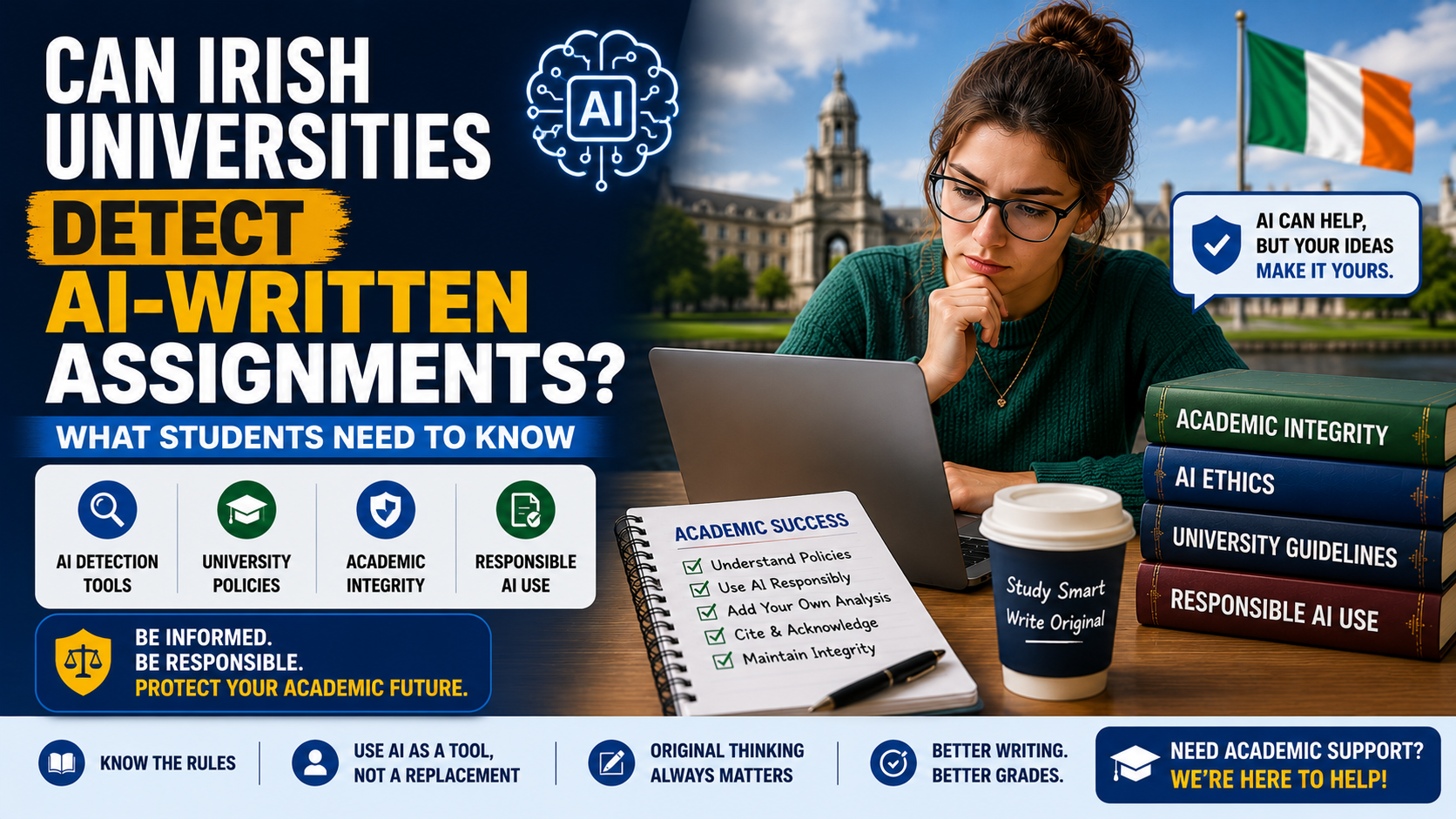
The short answer is that universities are increasingly using a combination of academic review, writing analysis, and institutional procedures to identify work that may not reflect a student's own understanding. At the same time, AI detection technologies are evolving, but they are not considered perfectly reliable on their own. Universities generally do not rely solely on automated AI detection scores when making academic integrity decisions.
Whether you're studying at Trinity College Dublin (TCD), University College Dublin (UCD), University College Cork (UCC), Dublin City University (DCU), University of Galway, University of Limerick (UL), Maynooth University, Technological University Dublin (TU Dublin), or another Irish institution, understanding how AI is viewed in higher education can help you use these tools responsibly.
How Irish Universities View AI
Most Irish universities have updated or are updating their academic integrity guidance to address the use of generative AI.
In general, universities expect students to:
Submit work that reflects their own understanding.
Follow module-specific AI guidance.
Acknowledge AI use where required.
Maintain academic honesty.
Demonstrate independent critical thinking.
Policies can differ between universities, faculties, and even individual modules, so students should always check their institution's current guidance.
Can Universities Detect AI-Written Work?
Universities may identify AI-generated or AI-assisted work through several methods, including:
Review by academic staff familiar with your writing style.
Comparison with previous assignments.
Inconsistencies in language, analysis, or subject knowledge.
Oral presentations or viva examinations.
Requests to explain or defend your work.
AI detection software used as one source of information.
Importantly, AI detection tools can produce false positives and false negatives, so they should not be treated as definitive proof on their own.
What AI Detection Tools Can and Cannot Do
AI detection tools attempt to estimate whether text may have been generated by AI based on linguistic patterns.
However, they have limitations:
They may:
Flag highly formulaic writing.
Identify repetitive sentence structures.
Suggest sections for further review.
They cannot reliably:
Prove that AI was used.
Determine who wrote a document.
Assess your understanding of the content.
Replace human academic judgement.
This is why universities generally combine software with human review.
Acceptable Uses of AI in Academic Work
Many universities permit certain uses of AI when they align with course policies.
Examples may include:
Brainstorming ideas.
Creating study plans.
Explaining difficult concepts.
Improving grammar and readability.
Generating practice questions.
Organising notes.
Students should always verify AI-generated information and follow any disclosure requirements set by their university or lecturer.
Uses That May Breach Academic Integrity
Depending on institutional policies, the following practices may be unacceptable:
Submitting AI-generated work as entirely your own.
Fabricating references or research.
Using AI to complete assessments where prohibited.
Misrepresenting your own understanding.
Ignoring module-specific AI rules.
Always consult your university's academic integrity policy before using AI in assessed work.
Best Practices for Responsible AI Use
If your course permits AI assistance:
Use AI as a learning aid rather than a replacement for your thinking.
Verify facts using reliable academic sources.
Read and understand everything before submission.
Add your own analysis and critical evaluation.
Follow referencing or disclosure requirements where applicable.
Keep records of your research and drafting process if required.
Responsible use supports learning while protecting academic integrity.
Common Mistakes Students Make
Students sometimes:
Rely entirely on AI-generated text.
Submit inaccurate or fabricated information.
Skip fact-checking.
Ignore university policies.
Remove citations or references.
Assume AI-generated content is automatically original or acceptable.
These mistakes can affect both grades and academic integrity.
How AssignmentCart Can Help
AssignmentCart provides ethical academic support to help students improve the quality of their own academic work.
Our services include:
Academic editing.
Proofreading.
Referencing assistance.
Formatting reviews.
Literature review guidance.
Dissertation editing.
Academic writing feedback.
Research organisation support.
Our goal is to help students improve clarity, structure, and presentation while respecting university academic integrity policies.
Why Students Choose AssignmentCart
Students choose AssignmentCart because we provide:
Experienced academic professionals.
Subject-specific specialists.
Confidential support.
Affordable pricing.
Fast turnaround.
Detailed quality reviews.
Flexible revision options.
Responsive customer support.
We help students strengthen their academic writing without compromising originality.
Responsible AI Use Checklist
Before submitting your assignment, ensure you have:
✔ Read your university's AI policy.
✔ Verified all facts and references.
✔ Written the analysis in your own words.
✔ Added your own critical thinking.
✔ Followed disclosure requirements where applicable.
✔ Checked formatting and referencing.
✔ Proofread the final document carefully.
Ethical Use of Academic Support
Academic support should enhance your learning rather than replace it.
AssignmentCart helps students:
Improve academic writing.
Strengthen clarity.
Review grammar.
Improve structure.
Refine referencing.
Receive constructive academic feedback.
Students should always ensure that their final submissions comply with their university's academic integrity policies.
Final Thoughts
AI tools are becoming a normal part of higher education, but they should be used responsibly. While universities may use AI detection software as part of their review process, these tools are not perfectly accurate and are typically considered alongside human judgement and institutional procedures.
The safest approach is to use AI as a study aid, verify all information, contribute your own analysis, and follow your university's academic integrity requirements. Doing so helps you produce authentic, high-quality academic work while reducing the risk of academic misconduct.
If you need guidance with editing, proofreading, formatting, referencing, dissertation preparation, or improving the clarity of your own writing, AssignmentCart provides ethical academic support to help students succeed responsibly.
Frequently Asked Questions
Everything you need to know about our services
Related Posts

Turnitin Similarity Too High? Here's What to Do

Academic Editing vs Proofreading: Which Service Do You Need?
