Turnitin Similarity Too High? Here's What to Do
Introduction
Seeing a high Turnitin similarity score just before your assignment or dissertation deadline can be stressful. Many students immediately assume they've committed plagiarism, but that's not always the case. A high similarity percentage simply indicates that portions of your document match content already found in Turnitin's databases—it does not automatically mean academic misconduct.
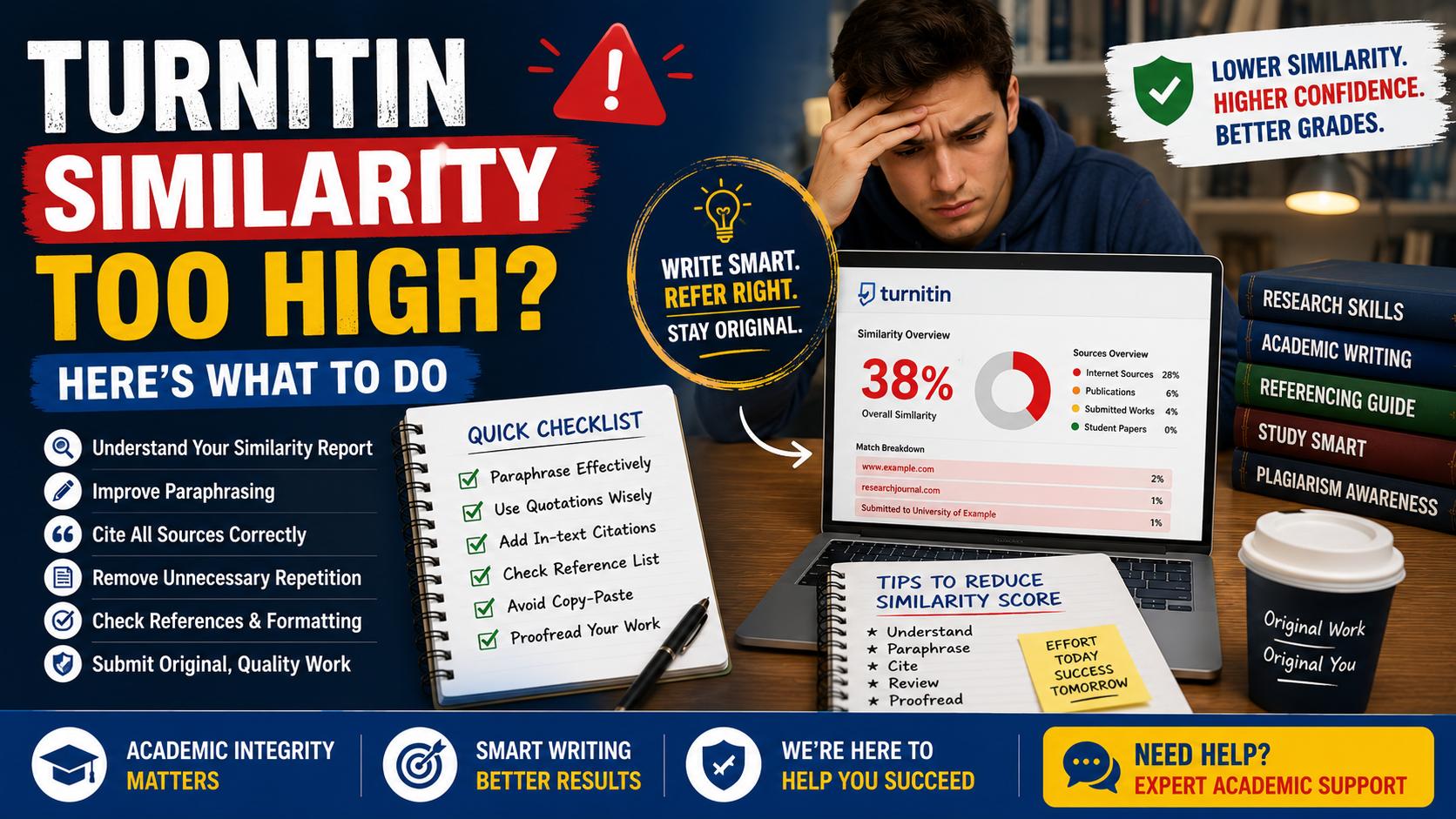
Understanding why your similarity score is high and knowing how to reduce it ethically can help you submit stronger academic work while complying with your university's academic integrity policies.
Whether you're studying at Trinity College Dublin (TCD), University College Dublin (UCD), University College Cork (UCC), Dublin City University (DCU), University of Galway, University of Limerick (UL), Maynooth University, Technological University Dublin (TU Dublin), or another university, this guide explains what a high similarity score means and how to improve your document responsibly.
What Is a Turnitin Similarity Score?
A Turnitin similarity score represents the percentage of text in your document that matches material already available in Turnitin's databases.
These databases include:
Academic journals
Books
Student papers
Internet sources
Institutional repositories
Published research
The score highlights matching text but does not determine whether plagiarism has occurred.
Does a High Similarity Score Mean Plagiarism?
Not necessarily.
A document may receive a relatively high similarity score because of:
Properly quoted material
Reference lists
Common academic phrases
Assignment questions included in the submission
Standard methodology descriptions
Technical terminology
Universities review the similarity report alongside the context before making academic integrity decisions.
Common Reasons for High Similarity
Students often receive higher similarity scores because they:
Copy large sections directly from sources.
Use quotations excessively.
Paraphrase too closely to the original text.
Forget quotation marks.
Reuse previous assignments without permission.
Include lengthy templates or appendices.
Use common definitions repeatedly.
Make referencing mistakes.
Understanding the cause is the first step toward reducing unnecessary similarity.
How to Reduce Your Similarity Score Ethically
Improve Your Paraphrasing
Instead of changing only a few words, rewrite ideas completely in your own academic voice while preserving the original meaning.
Effective paraphrasing involves:
Changing sentence structure
Using your own wording
Demonstrating genuine understanding
Providing proper citations
Cite Every Source Correctly
Whenever you use someone else's ideas, statistics, or findings, include an appropriate citation.
Common referencing styles include:
Harvard Referencing
APA 7th Edition
IEEE
OSCOLA
Chicago
Always follow your department's required style.
Use Quotations Sparingly
Direct quotations should only be used when the original wording is essential.
Most academic assignments benefit from thoughtful paraphrasing supported by accurate citations.
Remove Unnecessary Repetition
Repeated phrases and duplicated sections can increase similarity.
Review your document for repetitive wording and rewrite where appropriate.
Check Your Reference List
Ensure that:
Every citation appears in the reference list.
Every reference is formatted correctly.
Sources are complete and consistent.
Poor referencing can contribute to higher similarity and lower marks.
Avoid Self-Plagiarism
Submitting substantial portions of previous work without permission may violate university policies.
If building upon earlier research, consult your supervisor and cite previous work where required.
What You Should Not Do
Avoid practices such as:
Using automatic text spinners
Replacing words with inaccurate synonyms
Hiding characters or symbols
Manipulating formatting to fool detection software
Copying AI-generated content without reviewing and revising it
Removing citations
These methods are unethical and may breach university regulations.
What Similarity Percentage Is Acceptable?
There is no universal "safe" percentage.
Acceptable similarity varies depending on:
University policies
Assignment type
Subject area
Use of quotations
Reference lists
Many institutions focus on the nature of the matched content rather than a specific percentage.
Students should always follow their department's academic integrity guidelines.
How AssignmentCart Can Help
AssignmentCart provides ethical academic support to help students improve the quality and originality of their academic writing.
Our services include:
Academic editing
Proofreading
Referencing assistance
Citation reviews
Paraphrasing guidance
Dissertation editing
Formatting reviews
Academic writing feedback
Our goal is to help students improve clarity, organisation, and academic presentation while respecting university academic integrity policies.
Why Students Choose AssignmentCart
Students choose AssignmentCart because we provide:
Experienced academic editors
Subject-specific specialists
Confidential support
Affordable pricing
Fast turnaround
Detailed quality reviews
Flexible revision options
Responsive customer support
We help students prepare polished academic documents while promoting responsible research and ethical writing.
Turnitin Similarity Reduction Checklist
Before submitting your assignment, ensure you have:
✔ Paraphrased ideas in your own words.
✔ Added citations for every borrowed idea.
✔ Used quotations only where necessary.
✔ Checked your reference list.
✔ Removed repetitive wording.
✔ Reviewed formatting consistency.
✔ Proofread the final document carefully.
Ethical Use of Academic Support
Academic support should strengthen your writing skills while preserving the originality of your work.
AssignmentCart helps students:
Improve academic writing
Strengthen paraphrasing
Review referencing
Improve document clarity
Enhance formatting
Receive constructive academic feedback
Students should always ensure that their final submissions comply with their university's academic integrity policies.
Final Thoughts
A high Turnitin similarity score is not automatically a sign of plagiarism, but it is a signal to review your work carefully. By improving your paraphrasing, citing sources correctly, reducing unnecessary repetition, and following your university's referencing guidelines, you can produce more original and professionally presented academic work.
If you need guidance with editing, proofreading, paraphrasing, referencing, formatting, or dissertation preparation, AssignmentCart provides ethical academic support to help students submit high-quality work with confidence.
Frequently Asked Questions
Everything you need to know about our services
Related Posts

Academic Editing vs Proofreading: Which Service Do You Need?

Best Research Proposal Writing Help in Ireland
