Results Chapter Writing Help for Irish Dissertations
Introduction
The results chapter is one of the most important sections of your dissertation because it presents the findings of your research in a clear, organised, and objective manner. Whether your study involves surveys, interviews, experiments, or secondary data analysis, this chapter demonstrates the evidence gathered during your research without interpreting its meaning—that task belongs to the discussion chapter.
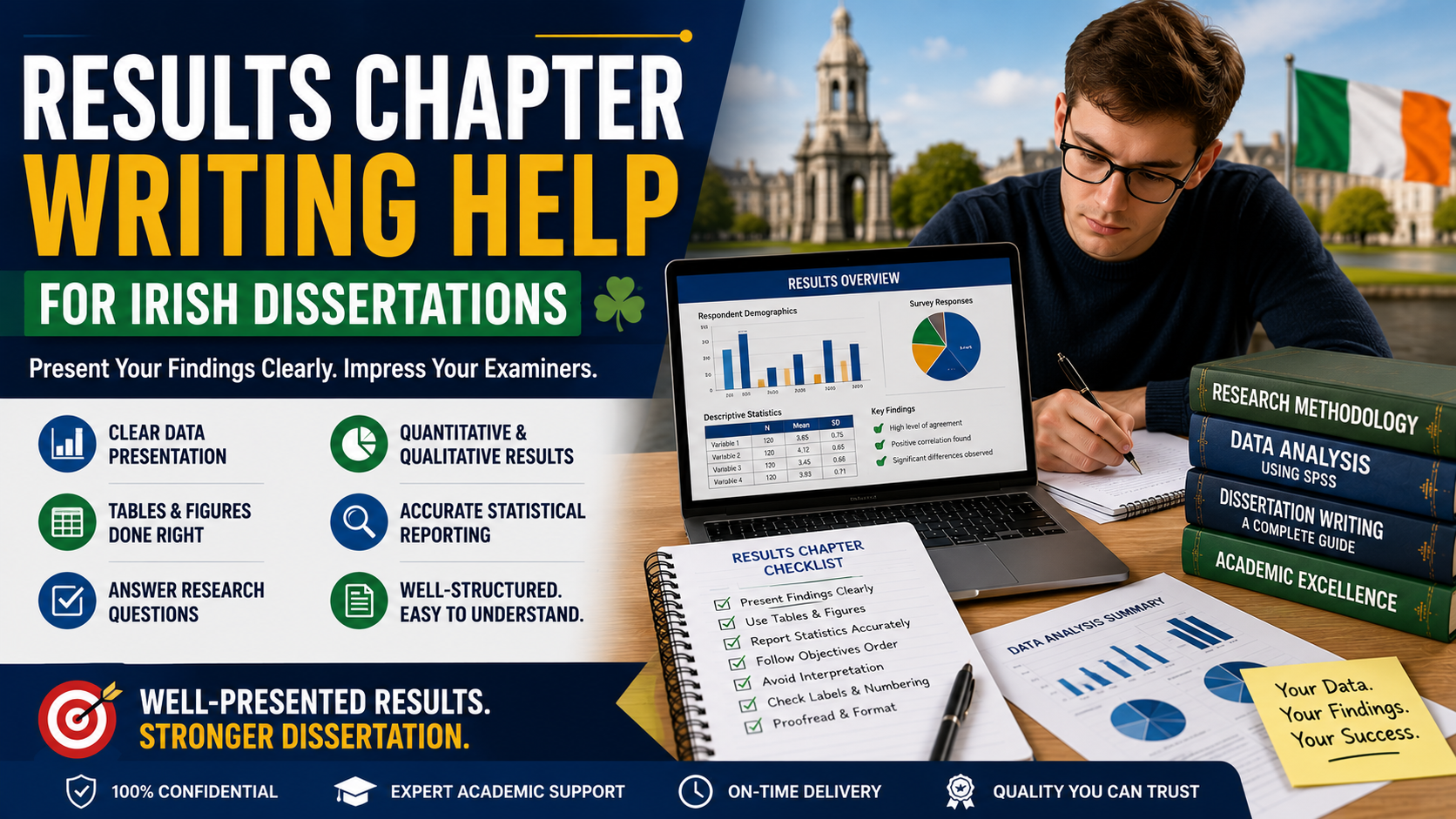
Many students across Irish universities find the results chapter challenging because they are unsure what information to include, how to organise it, and how to present statistical or qualitative findings effectively. A well-written results chapter helps examiners understand your research outcomes and lays the foundation for a strong discussion chapter.
Whether you're studying at Trinity College Dublin (TCD), University College Dublin (UCD), University College Cork (UCC), Dublin City University (DCU), University of Galway, University of Limerick (UL), Maynooth University, Technological University Dublin (TU Dublin), or another Irish institution, following a clear structure can improve the quality of your dissertation.
This guide explains how to write an effective results chapter and how AssignmentCart provides ethical academic support throughout your dissertation journey.
What Is the Results Chapter?
The results chapter presents the evidence collected during your research.
Its purpose is to:
Present research findings objectively
Answer the research questions through data
Organise results logically
Display evidence using tables and figures
Prepare readers for the discussion chapter
Unlike the discussion chapter, the results section should focus on what the data shows, not why it happened.
Why the Results Chapter Matters
Examiners evaluate whether you have:
Presented findings clearly
Organised data logically
Used appropriate tables and figures
Reported results accurately
Answered your research objectives
Followed appropriate research methods
A clear results chapter strengthens the credibility of your dissertation.
What to Include in the Results Chapter
Brief Introduction
Begin with a short introduction explaining:
The purpose of the chapter
How results are organised
Which research questions are addressed
This prepares readers for the information that follows.
Participant Information (If Applicable)
If your study involved participants, include relevant details such as:
Sample size
Demographic information
Response rate
Participant characteristics
Present this information using simple tables where appropriate.
Findings by Research Objective
Organise your findings according to your research objectives or research questions.
For each objective:
Present the relevant data
Include supporting tables or figures
Summarise key findings
Avoid interpretation
This structure improves readability.
Presenting Quantitative Results
For quantitative research, include:
Descriptive statistics
Frequency tables
Mean and median values
Standard deviation
Correlation analysis
Regression analysis
Hypothesis testing
SPSS outputs (where appropriate)
Always explain what each table or figure shows without discussing its broader implications.
Presenting Qualitative Results
For qualitative studies, organise findings into themes.
Include:
Major themes
Sub-themes
Participant quotations
Coding summaries
NVivo outputs (if used)
Present evidence objectively while allowing readers to understand the emerging patterns.
Using Tables and Figures
Tables and figures should:
Be numbered sequentially
Include descriptive titles
Be referenced within the text
Remain easy to read
Support—not replace—the written explanation
Every visual element should add value to your findings.
Reporting Statistical Results
When presenting statistical findings:
Include:
Test used
Sample size
Statistical values
Significance level (if applicable)
Report results accurately without exaggerating their importance.
Common Mistakes in Results Chapters
Students frequently lose marks because they:
Interpret findings instead of presenting them
Repeat the same information in tables and text
Include unnecessary raw data
Use poorly labelled figures
Present findings without linking them to research objectives
Omit important results
Use inconsistent formatting
Avoiding these mistakes improves clarity and professionalism.
Tips for Writing a High-Quality Results Chapter
Follow Your Research Questions
Present findings in the same order as your objectives.
This creates a logical flow for readers.
Be Objective
Avoid opinions or explanations.
Focus only on reporting what your research found.
Use Clear Visuals
Choose tables or charts that make the findings easier to understand.
Avoid unnecessary graphics.
Label Everything Correctly
Ensure that:
Tables are numbered correctly.
Figures have captions.
Charts are readable.
All visuals are referenced in the text.
Consistency improves presentation.
Check Accuracy
Review:
Numerical values
Labels
Percentages
Statistical outputs
Participant numbers
Accuracy is essential for research credibility.
Software Commonly Used for Results Analysis
Students frequently use:
SPSS
NVivo
Microsoft Excel
R
Python
Stata
Tableau
Power BI
The software you use should match your research methodology.
How AssignmentCart Can Help
AssignmentCart provides ethical academic support for students preparing dissertation results chapters across a wide range of disciplines.
Our services include:
Results chapter guidance
Academic editing
Proofreading
SPSS guidance
NVivo guidance
Data presentation reviews
Referencing assistance
Formatting reviews
Academic writing feedback
Our objective is to help students improve the clarity, organisation, and presentation of their academic work while respecting university academic integrity policies.
Why Students Choose AssignmentCart
Students choose AssignmentCart because we provide:
Experienced academic professionals
Subject-specific expertise
Confidential support
Affordable pricing
Fast turnaround
Detailed quality reviews
Flexible revision options
Responsive customer support
We help students prepare professional, well-organised dissertation chapters that effectively present their research findings.
Results Chapter Checklist
Before submitting your dissertation, ensure you have:
✔ Presented findings objectively.
✔ Organised results by research objectives.
✔ Used clear tables and figures.
✔ Labelled visuals correctly.
✔ Reported statistical results accurately.
✔ Avoided interpretation.
✔ Checked formatting consistency.
✔ Proofread the chapter carefully.
Ethical Use of Academic Support
Academic support should strengthen your research presentation while preserving the originality of your findings.
AssignmentCart helps students:
Improve chapter organisation
Refine academic writing
Review formatting
Strengthen presentation
Improve clarity
Receive constructive academic feedback
Students should always ensure that their final submissions comply with their university's academic integrity policies.
Final Thoughts
A strong results chapter presents your research findings in a clear, logical, and objective manner. By organising your results around your research objectives, using well-designed tables and figures, and reporting data accurately, you create a solid foundation for the discussion chapter and improve the overall quality of your dissertation.
If you need guidance with results chapter writing, SPSS analysis, NVivo analysis, proofreading, editing, formatting, or referencing, AssignmentCart provides ethical academic support to help students across Irish universities prepare high-quality dissertations with confidence.
Frequently Asked Questions
Everything you need to know about our services
Related Posts

Dissertation Proofreading Checklist Before Submission

Why Students Choose Professional Dissertation Editing Services
