Assignment Writing Tips for International Master's Students
Introduction
Studying for a master's degree abroad is an exciting opportunity, but it also presents unique academic challenges. Many international students arrive with strong subject knowledge yet struggle to adapt to new academic writing standards, referencing styles, critical analysis expectations, and university assessment criteria.
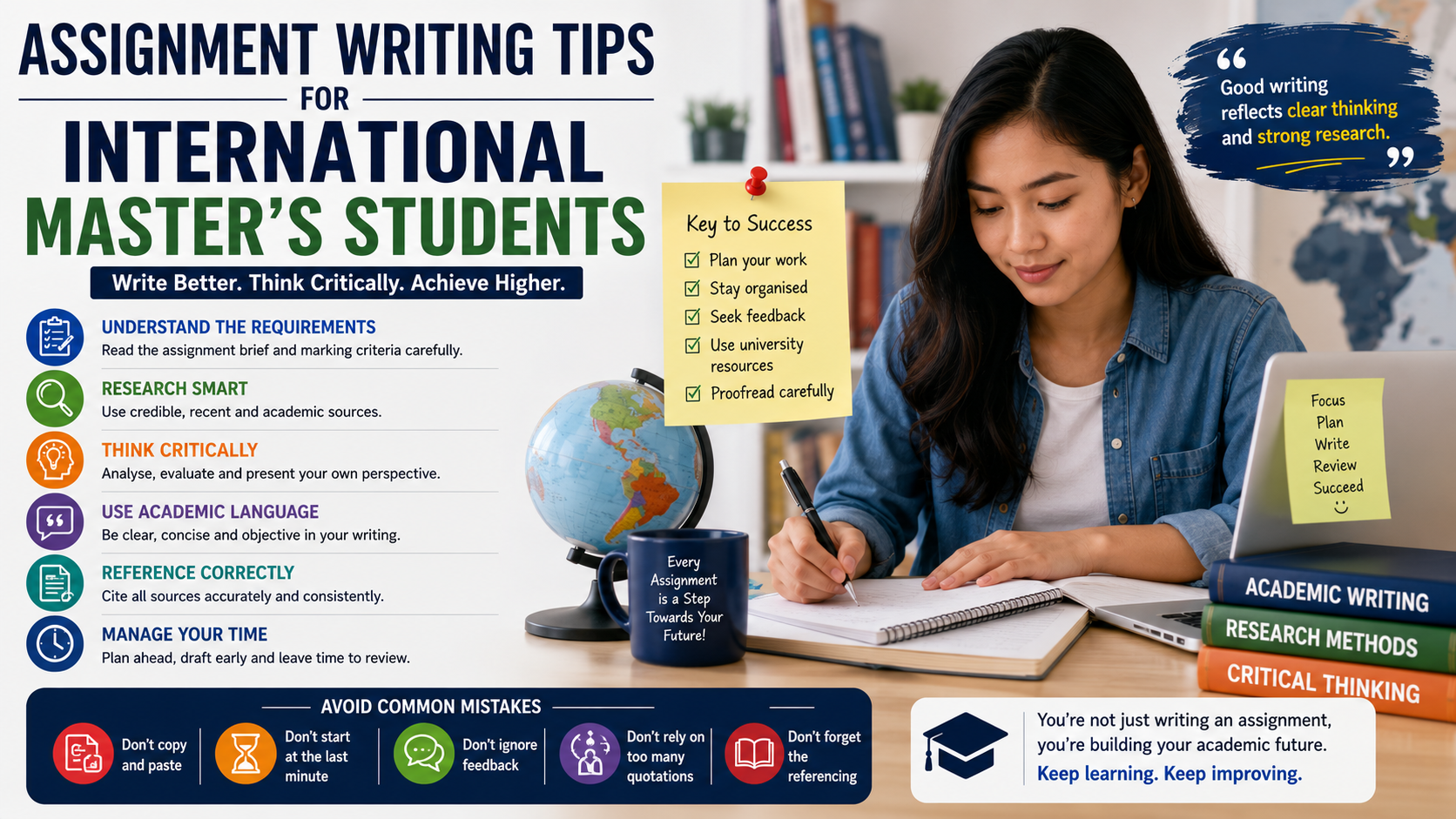
Unlike many undergraduate programmes around the world, master's assignments in countries such as the UK and Australia emphasise independent thinking, evidence-based arguments, critical evaluation, and academic integrity. Adjusting to these expectations can take time, especially if English is not your first language.
This guide provides practical assignment writing tips to help international master's students improve their academic writing, understand university expectations, and achieve higher grades.
In this guide, you'll learn:
Why Master's Assignments Can Be Challenging for International Students
Many international students encounter difficulties because academic expectations vary across countries.
Common challenges include:
Writing in academic English
Understanding assignment briefs
Critical analysis
Referencing styles
Academic integrity
Time management
Confidence in expressing independent opinions
Recognising these challenges is the first step towards overcoming them.
Understand Your University's Expectations
Every university provides detailed assignment guidance.
Before starting your work:
Read the assignment brief carefully.
Review the marking rubric.
Identify learning outcomes.
Understand submission requirements.
These documents explain exactly what lecturers expect.
Learn the Difference Between Description and Critical Analysis
Many international students lose marks because they describe information instead of analysing it.
Description answers:
What happened?
Critical analysis asks:
Why?
How?
What are the strengths?
What are the weaknesses?
Is the evidence convincing?
Master's assignments require analysis rather than simple summaries.
Improve Your Academic English
Academic writing differs from conversational English.
Use language that is:
Formal
Objective
Clear
Precise
Avoid:
Slang
Contractions
Informal expressions
Personal opinions without evidence
Reading academic journal articles helps improve writing style.
Read the Assignment Question Carefully
Do not begin writing immediately.
Instead:
Highlight command words.
Identify key topics.
Understand the required scope.
Clarify any uncertainty with your lecturer.
Understanding the question prevents unnecessary work.
Conduct High-Quality Academic Research
Strong master's assignments rely on credible evidence.
Use sources such as:
Peer-reviewed journals
Academic books
Government publications
Industry reports
University library databases
Avoid relying on general websites or unverified online content.
Use Recent Sources
In subjects such as:
Business
Healthcare
Technology
Education
Recent research is often preferred.
Aim to use current academic literature whenever appropriate.
Understand Referencing Requirements
Universities commonly require:
Harvard
APA
Always:
Cite every source.
Include complete references.
Reference consistently.
Incorrect referencing may result in plagiarism concerns.
Avoid Plagiarism
Academic integrity is taken very seriously.
Avoid plagiarism by:
Writing in your own words.
Citing every source.
Using quotation marks when quoting directly.
Keeping detailed research notes.
Never copy text without attribution.
Plan Before You Write
Create a simple outline before drafting.
Include:
Introduction
Main arguments
Evidence
Analysis
Conclusion
Planning improves organisation and coherence.
Structure Your Assignment Clearly
Most master's assignments include:
Introduction
Explain:
Topic
Objectives
Scope
Main Body
Present:
Evidence
Analysis
Discussion
Academic sources
Use headings where appropriate.
Conclusion
Summarise findings.
Do not introduce new evidence.
Develop Critical Thinking
Instead of accepting every source, ask:
Is this evidence reliable?
What are the limitations?
Does another author disagree?
Can the findings be applied to my topic?
Questioning evidence demonstrates postgraduate thinking.
Compare Different Perspectives
Strong assignments rarely rely on one author.
Instead:
Compare studies.
Identify similarities.
Discuss disagreements.
Explain why differences exist.
Comparison strengthens academic discussion.
Manage Your Time
Many international students underestimate assignment preparation.
Allow time for:
Research
Reading
Drafting
Editing
Referencing
Proofreading
Start assignments early whenever possible.
Proofread Carefully
Before submitting:
Check:
Grammar
Spelling
Referencing
Formatting
Sentence clarity
Word count
Reading your assignment aloud often helps identify awkward sentences.
Use University Support Services
Most universities provide:
Academic writing centres
Library workshops
Referencing support
English language assistance
Study skills advisers
These services are designed to help students succeed.
Build Academic Vocabulary
Improve your writing by learning useful academic phrases.
Examples include:
This study suggests…
The findings indicate…
However…
In contrast…
Evidence demonstrates…
It can therefore be concluded…
Academic vocabulary improves professionalism.
Common Mistakes International Students Make
Students frequently:
Describe instead of analyse.
Use too few academic sources.
Reference incorrectly.
Ignore the marking rubric.
Start too late.
Write without planning.
Depend heavily on quotations.
Avoiding these mistakes improves grades significantly.
Practical Assignment Checklist
Before submission:
✔ Have I answered the assignment question?
✔ Have I demonstrated critical analysis?
✔ Have I used recent academic sources?
✔ Is every source referenced correctly?
✔ Is my structure logical?
✔ Have I proofread carefully?
✔ Does my conclusion summarise the discussion?
Tips for Achieving Higher Grades
Successful international students:
Read widely.
Plan early.
Ask questions.
Attend academic workshops.
Seek feedback.
Improve academic English continuously.
Practice critical thinking.
Progress comes through consistent improvement.
Key Takeaways
Understand university expectations before writing.
Develop critical analysis skills.
Use credible academic research.
Improve academic English.
Reference accurately.
Avoid plagiarism.
Plan assignments carefully.
Proofread before submission.
Conclusion
Writing master's assignments as an international student can initially seem challenging, particularly when adapting to new academic standards, critical thinking expectations, and referencing requirements. However, these skills improve steadily with practice, preparation, and the effective use of university support services.
By understanding assessment criteria, conducting high-quality research, writing critically, and managing your time effectively, you can produce stronger assignments and confidently meet postgraduate academic expectations. These skills will not only improve your grades but also prepare you for professional and research-based careers after graduation.
Frequently Asked Questions
Everything you need to know about our services


