How to Get a Distinction in a Master's Assignment
Introduction
Achieving a distinction in a master's assignment is the goal of many postgraduate students, but it requires far more than simply meeting the word count or citing numerous academic sources. Universities expect master's students to demonstrate advanced research skills, critical analysis, independent thinking, and professional academic writing that goes beyond undergraduate standards.
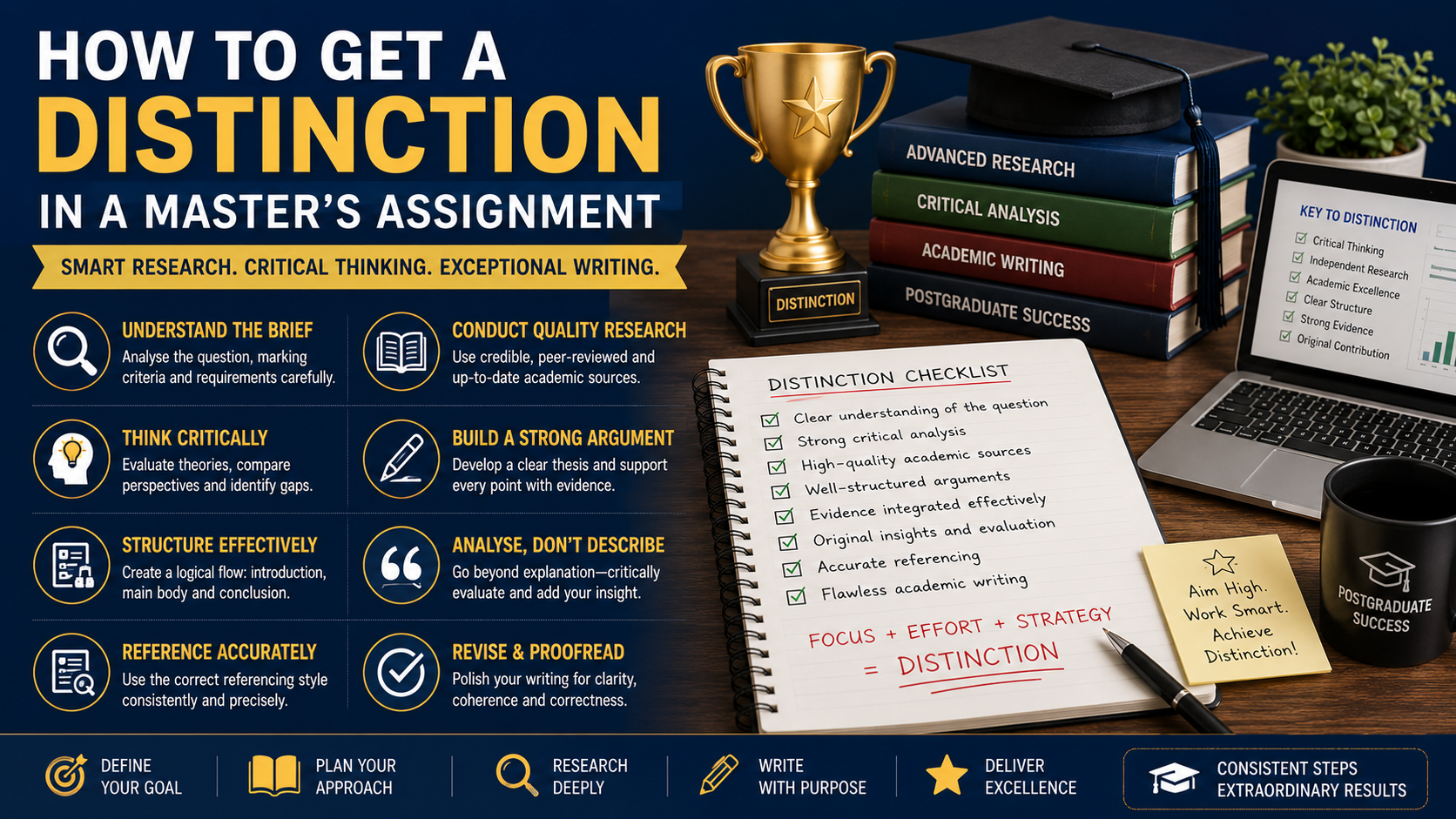
Many capable students lose marks because they misunderstand what lecturers actually assess. Distinction-level work is not about writing longer assignments—it is about producing higher-quality academic arguments supported by credible evidence.
This guide explains exactly what lecturers expect and provides practical strategies to help you consistently produce distinction-level master's assignments.
In this guide, you'll learn:
What Is a Distinction in a Master's Assignment?
In many UK and Australian universities, a distinction usually represents academic work that demonstrates outstanding postgraduate performance.
Although grading systems vary between institutions, distinction-level assignments generally show:
Exceptional understanding
Critical evaluation
Independent judgement
Extensive academic research
Professional academic writing
Rather than simply answering the question, distinction assignments provide sophisticated analysis supported by strong scholarly evidence.
What Lecturers Look For
Master's assignments are usually assessed across several key areas.
These commonly include:
Subject knowledge
Critical analysis
Research quality
Independent thinking
Academic writing
Structure
Referencing
Originality
Strong performance across all assessment criteria is necessary for distinction-level work.
Step 1: Understand the Assignment Brief
Every successful assignment begins with understanding exactly what is being asked.
Read the brief carefully and identify:
Learning outcomes
Marking rubric
Word count
Referencing style
Submission requirements
Academic command words
Never begin researching until you fully understand the assignment.
Step 2: Interpret Academic Command Words
Master's assignments often include instructions such as:
Critically evaluate
Analyse
Compare
Discuss
Assess
Justify
Each command requires a different approach.
For example:
Describe
Explains information.
Critically Evaluate
Analyses evidence while discussing strengths, weaknesses, and limitations before reaching a justified conclusion.
Understanding command words prevents one of the most common causes of lost marks.
Step 3: Conduct High-Quality Academic Research
Research forms the foundation of every distinction-level assignment.
Prioritise:
Peer-reviewed journal articles
Academic books
Government publications
Professional reports
Recent scholarly literature
Avoid relying heavily on blogs, Wikipedia, or non-academic websites.
Quality always outweighs quantity.
Step 4: Read Critically
Distinction students do not simply collect references.
Instead, they evaluate every source.
Ask:
Is the evidence reliable?
What methodology was used?
Are there limitations?
Do other researchers agree?
How relevant is this study?
Critical reading produces stronger academic discussion.
Step 5: Develop a Clear Central Argument
Outstanding assignments present one coherent argument throughout.
Each section should support your overall position.
Avoid writing disconnected paragraphs that simply summarise different sources.
A clear argument improves logical flow.
Step 6: Demonstrate Strong Critical Analysis
Critical analysis often receives the highest weighting in postgraduate marking rubrics.
Rather than writing:
"Remote working increases employee flexibility."
Write:
"Although remote working increases flexibility, research suggests productivity improvements depend heavily on organisational support, leadership quality, and employee engagement."
The second example evaluates evidence rather than describing facts.
Step 7: Compare Academic Perspectives
Distinction assignments engage with academic debate.
Compare:
Supporting evidence
Conflicting viewpoints
Alternative theories
Methodological differences
This demonstrates broad reading and mature academic thinking.
Step 8: Support Every Argument with Evidence
Every significant point should be supported using scholarly evidence.
Strong evidence includes:
Journal articles
Academic books
Systematic reviews
Government data
Professional publications
Unsupported opinions weaken academic credibility.
Step 9: Structure Your Assignment Effectively
Introduction
A strong introduction should:
Introduce the topic
Explain its importance
Present your central argument
Outline the assignment
Main Body
Each paragraph should include:
Topic sentence
Academic evidence
Critical discussion
Link back to the assignment question
Logical progression improves readability.
Conclusion
A distinction-level conclusion:
Summarises findings
Reinforces the argument
Answers the assignment question
Avoid introducing new evidence.
Step 10: Write Professionally
Master's assignments require formal academic writing.
Aim for:
Precision
Objectivity
Clarity
Conciseness
Avoid:
Informal language
Emotional opinions
Repetition
Overly complex sentences
Professional writing strengthens your academic voice.
Step 11: Reference Accurately
Most universities require referencing styles such as:
Harvard
APA
OSCOLA
Chicago
Distinction assignments demonstrate:
Consistent citations
Accurate reference lists
Correct formatting
Referencing errors reduce marks unnecessarily.
Step 12: Demonstrate Independent Thinking
Postgraduate students should contribute their own interpretation.
Rather than repeating authors' opinions:
Evaluate them
Challenge assumptions
Explain implications
Reach justified conclusions
Independent judgement distinguishes distinction-level work.
Common Reasons Students Miss a Distinction
Many assignments narrowly miss distinction because they:
Describe rather than analyse
Use weak research
Ignore the marking rubric
Lack a clear argument
Present unsupported opinions
Reference inconsistently
Proofread poorly
Most of these mistakes are avoidable.
Practical Tips for Achieving a Distinction
Start Early
Allow enough time for:
Research
Planning
Drafting
Editing
High-quality assignments cannot be rushed.
Use Recent Research
Where appropriate, prioritise recent scholarly publications to demonstrate awareness of current developments.
Follow the Marking Rubric
Treat the assessment rubric as your roadmap.
If critical analysis receives the highest weighting, ensure it appears throughout your assignment.
Edit Thoroughly
Review your assignment several times.
Check:
Grammar
Structure
Referencing
Argument flow
Clarity
Editing often separates good assignments from distinction-level work.
Distinction Checklist
Before submitting, ask yourself:
✔ Have I answered the assignment question directly?
✔ Have I demonstrated critical analysis?
✔ Have I compared different academic viewpoints?
✔ Is every major point supported by evidence?
✔ Is my argument logical?
✔ Have I referenced consistently?
✔ Have I proofread thoroughly?
If yes, your assignment is much closer to distinction standard.
Key Takeaways
Distinction assignments demonstrate advanced critical thinking.
High-quality academic research strengthens arguments.
Independent judgement is essential.
Every argument should be evidence based.
Logical structure improves readability.
Accurate referencing supports academic integrity.
Editing and proofreading significantly improve assignment quality.
Conclusion
Achieving a distinction in a master's assignment requires much more than hard work—it requires smart academic practice. Students who understand assessment criteria, conduct extensive scholarly research, think critically, and present well-supported arguments consistently perform better than those who simply write longer assignments.
By developing these postgraduate writing habits, you can significantly improve your academic performance while building valuable research and analytical skills that extend far beyond university.
Frequently Asked Questions
Everything you need to know about our services


