Are Employers Still Looking at Degrees?
Introduction
For decades, earning a university degree was considered the golden ticket to a successful career. Parents encouraged their children to attend college, employers required bachelor's degrees for most professional roles, and graduates believed their qualifications would automatically open doors to employment.
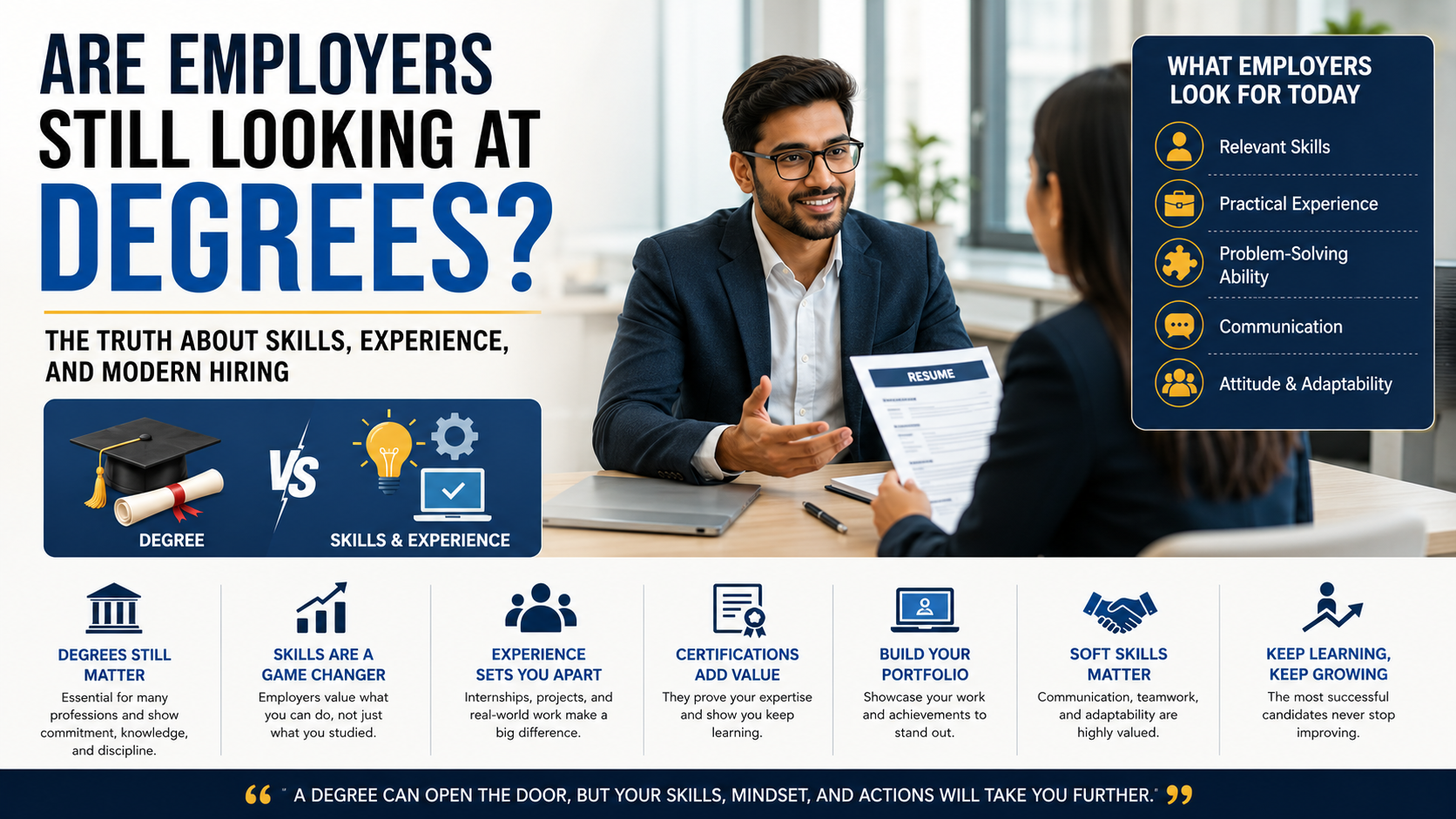
However, the job market has changed dramatically over the last decade. Rapid technological advancements, remote work, artificial intelligence (AI), online certifications, and skills-based hiring have transformed how employers evaluate candidates.
This raises an important question:
Are employers still looking at degrees, or have skills and experience become more important?
The answer isn't as straightforward as a simple yes or no. While degrees continue to matter in many industries, employers are increasingly placing greater emphasis on practical skills, work experience, problem-solving abilities, and continuous learning.
In this guide, we'll explore how employers evaluate candidates today, which industries still prioritize degrees, why skills-based hiring is growing, and how students can remain competitive in an evolving job market.
Quick Answer
Yes, employers still value university degrees, but they are no longer the only factor in hiring decisions. Today, many organizations combine educational qualifications with practical experience, technical skills, certifications, communication abilities, and cultural fit. In several industries, demonstrated skills can outweigh a traditional degree.
Why Degrees Became So Important
Historically, university degrees served several purposes.
They demonstrated that graduates had:
-
Completed structured education
-
Developed subject knowledge
-
Learned research skills
-
Improved communication
-
Built discipline and commitment
For employers, degrees became an easy screening tool.
Instead of interviewing thousands of applicants, recruiters could simply require a bachelor's degree as a minimum qualification.
This system worked well when fewer people attended university and degrees represented specialized knowledge.
Today, higher education is much more accessible, meaning employers receive thousands of applications from graduates with similar qualifications.
As a result, a degree alone no longer guarantees employment.
Why Hiring Practices Are Changing
Modern employers face new challenges.
Businesses need employees who can:
-
Solve real-world problems
-
Adapt quickly
-
Learn new technologies
-
Work remotely
-
Collaborate across teams
-
Use AI tools effectively
These abilities cannot always be measured by academic grades.
Many companies have discovered that practical skills often predict workplace success better than academic qualifications alone.
Consequently, recruitment strategies are shifting toward skills-first hiring.
The Rise of Skills-Based Hiring
Skills-based hiring focuses on what candidates can actually do rather than where they studied.
Instead of asking,
"Which university did you attend?"
Employers increasingly ask,
-
Can you solve this problem?
-
Can you code?
-
Can you analyze data?
-
Can you communicate effectively?
-
Can you work with clients?
-
Can you manage projects?
This approach helps employers identify capable candidates regardless of their educational background.
Why Employers Value Skills
Modern businesses operate in rapidly changing industries.
Technology evolves faster than university curricula.
Someone who graduated five years ago may have outdated knowledge if they haven't continued learning.
Employers therefore value candidates who continuously improve their skills through:
-
Online courses
-
Professional certifications
-
Workshops
-
Bootcamps
-
Personal projects
-
Freelance work
-
Internships
Continuous learning demonstrates curiosity, adaptability, and initiative.
Do Degrees Still Matter?
Absolutely.
Degrees remain essential in many professions where specialized knowledge and legal regulations are involved.
Examples include:
-
Medicine
-
Nursing
-
Pharmacy
-
Law
-
Architecture
-
Engineering
-
Teaching
-
Psychology
-
Accounting
In these fields, employers often require accredited qualifications before candidates can practice professionally.
Without the appropriate degree, obtaining licenses or certifications may be impossible.
Industries Where Skills Often Matter More Than Degrees
Some industries have become increasingly open to candidates without traditional university qualifications.
These include:
Technology
Software development, web development, cybersecurity, UX/UI design, and cloud computing often prioritize technical skills over formal education.
Many successful developers are self-taught.
Digital Marketing
Employers value:
-
SEO
-
PPC advertising
-
Social media marketing
-
Email campaigns
-
Content marketing
-
Analytics
Practical results often outweigh academic qualifications.
Graphic Design
Design portfolios frequently matter more than university transcripts.
Creative ability speaks louder than grades.
Sales
Communication skills, confidence, resilience, and negotiation abilities often determine hiring decisions.
Entrepreneurship
Business owners are judged by results rather than educational credentials.
Many successful entrepreneurs built thriving companies without completing university.
The Growing Importance of Experience
Employers frequently state:
"We can teach technical knowledge, but practical experience is invaluable."
Experience demonstrates that candidates understand workplace expectations.
Valuable experiences include:
-
Internships
-
Volunteer work
-
Freelancing
-
Part-time jobs
-
Research projects
-
Leadership roles
-
Student organizations
These experiences show initiative beyond classroom learning.
The Role of Internships
Internships bridge the gap between education and employment.
Students gain:
-
Industry exposure
-
Professional networking
-
Workplace communication
-
Team collaboration
-
Practical problem-solving
Many companies recruit full-time employees directly from internship programs.
Employers Also Look for Soft Skills
Technical knowledge alone isn't enough.
Recruiters consistently rank soft skills among their top hiring priorities.
These include:
-
Communication
-
Teamwork
-
Leadership
-
Adaptability
-
Critical thinking
-
Emotional intelligence
-
Time management
-
Creativity
-
Professionalism
Strong soft skills often distinguish candidates with similar qualifications.
How AI Is Changing Recruitment
Artificial intelligence now assists employers throughout the hiring process.
AI tools help recruiters:
-
Screen resumes
-
Match candidates
-
Identify relevant skills
-
Analyze experience
-
Schedule interviews
Because AI scans resumes for keywords, candidates should clearly highlight:
-
Skills
-
Certifications
-
Software proficiency
-
Project outcomes
-
Achievements
A well-structured resume improves visibility during automated screening.
Are Online Certifications Valuable?
Increasingly, yes.
Professional certifications demonstrate current knowledge.
Popular platforms include:
-
Google Career Certificates
-
Microsoft Learn
-
AWS Training
-
Coursera
-
LinkedIn Learning
-
edX
-
HubSpot Academy
When combined with practical experience, certifications strengthen job applications.
Does University Reputation Matter?
Prestigious universities may provide networking advantages.
However, most employers focus more on:
-
Relevant skills
-
Work experience
-
Interview performance
-
Portfolio quality
-
Professional attitude
A graduate from a lesser-known university with excellent practical experience often outperforms candidates relying solely on institutional prestige.
What Employers Actually Look For
Today's recruiters evaluate candidates across multiple areas.
Today's recruiters evaluate candidates using a combination of educational qualifications, practical experience, and personal attributes rather than relying on a degree alone. Relevant skills and practical experience are often considered the most important factors, as they demonstrate a candidate's ability to perform the job effectively from day one. While a university degree still carries significant value—especially in regulated professions—it is typically viewed alongside other qualifications rather than as the sole deciding factor. Employers also place a high emphasis on communication skills, problem-solving abilities, adaptability, and a strong portfolio that showcases real-world projects and accomplishments. Additionally, cultural fit is increasingly important, as organizations seek individuals who align with their values and work environment. Professional certifications can further strengthen a candidate's profile by demonstrating continuous learning and up-to-date industry knowledge, while references from previous employers or mentors provide additional credibility. Ultimately, the strongest candidates are those who combine a solid educational background with practical skills, relevant experience, and a willingness to learn and grow.
The strongest candidates perform well across several of these categories.
Common Hiring Mistakes Students Make
Many graduates unintentionally reduce their employability.
Common mistakes include:
-
Relying solely on academic grades
-
Ignoring internships
-
Building no portfolio
-
Avoiding networking
-
Learning outdated software
-
Writing weak resumes
-
Neglecting LinkedIn profiles
-
Failing to practice interviews
Employability depends on more than classroom performance.
How Students Can Increase Employability
Regardless of your degree, consider these strategies:
Build a Portfolio
Show real projects rather than simply listing skills.
Gain Experience Early
Volunteer, intern, freelance, or participate in competitions.
Learn Industry Tools
Master software commonly used in your field.
Develop Communication Skills
Practice presentations, teamwork, and professional writing.
Network
Attend career fairs, webinars, and industry events.
Keep Learning
Technology changes rapidly.
Continuous learning keeps you competitive.
The Future of Hiring
Experts predict hiring will become even more skills-focused.
Employers are expected to rely increasingly on:
-
Skills assessments
-
Work simulations
-
Portfolio reviews
-
AI-assisted recruitment
-
Practical interviews
-
Project-based evaluations
Degrees will remain valuable but will become one part of a broader assessment process.
Pros and Cons of Degrees in Today's Job Market
Final Thoughts
So, are employers still looking at degrees?
The answer is yes—but degrees are no longer enough on their own.
A university qualification remains an important foundation for many careers, especially in regulated professions. However, employers increasingly seek candidates who can demonstrate practical skills, adaptability, communication, and real-world experience.
Students who combine a degree with internships, certifications, personal projects, and continuous learning are far more likely to stand out in today's competitive job market.
The future belongs to lifelong learners—people who continue developing their skills long after graduation.
Instead of asking whether degrees matter, students should ask a more important question:
"What skills can I demonstrate that prove I'm ready to succeed?"
Frequently Asked Questions
Everything you need to know about our services

