A Student Had Three Weeks Left—Here's What Changed
Introduction
Three weeks before a dissertation deadline can feel terrifying.
Perhaps you've spent months researching but haven't written enough. Maybe unexpected personal commitments interrupted your schedule. Or perhaps you underestimated how long each chapter would take. Whatever the reason, looking at an unfinished dissertation with only 21 days remaining can make the task seem impossible.
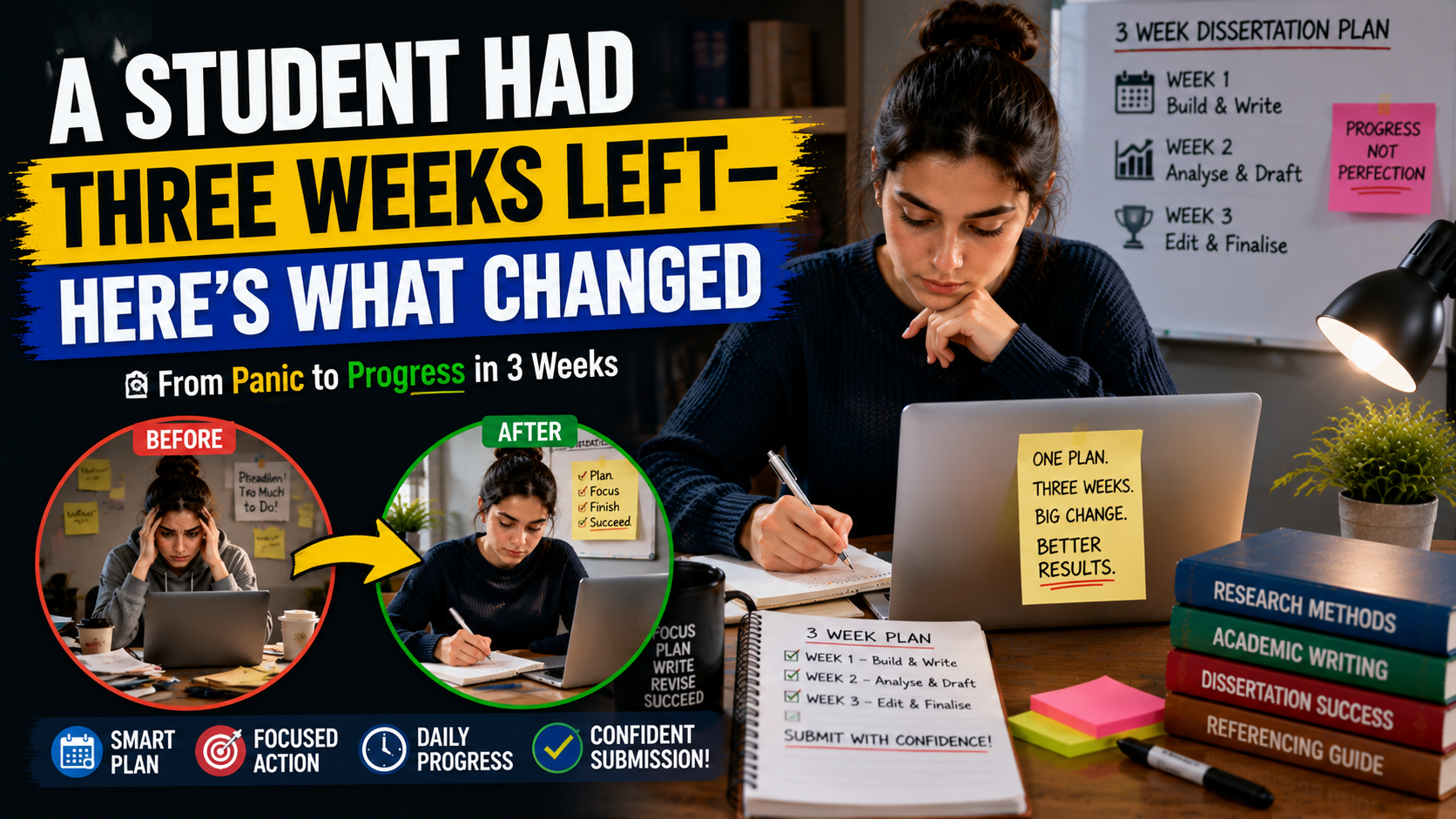
The truth is that many students find themselves in this position. While three weeks is certainly not ideal, it doesn't automatically mean failure. What often makes the biggest difference is not the amount of time remaining—it's how that time is used.
This article follows a fictional but realistic student scenario to illustrate how a structured recovery plan can help transform panic into progress. The lessons apply to undergraduate, postgraduate, and master's students facing tight dissertation deadlines.
Meet Alex: Three Weeks Until Submission
Alex, a master's student, checked the calendar one Monday morning and realised the dissertation deadline was only three weeks away.
The situation looked worrying:
Research notes scattered across multiple folders
Literature review only half complete
Methodology drafted but unfinished
No results chapter
Discussion chapter not started
References incomplete
Growing stress and declining motivation
Alex's first reaction was panic. The second was to create a realistic plan.
That decision changed everything.
Week One: Stop Panicking and Assess the Situation
Instead of immediately writing random sections, Alex spent the first morning understanding exactly what remained.
A simple checklist revealed:
✔ Research question already approved
✔ Most academic sources collected
✔ Basic dissertation structure created
✔ Methodology partially written
The biggest problem wasn't missing information—it was organisation.
Lesson
Before writing more, understand what you already have.
Many students possess far more material than they realise.
Creating a Recovery Plan
Rather than focusing on the entire dissertation, Alex divided the remaining work into manageable tasks.
Week 1
Finish literature review
Complete methodology
Organise research findings
Week 2
Write results chapter
Draft discussion
Complete conclusion
Week 3
Edit
Proofread
Check references
Format dissertation
Final review
Breaking the workload into smaller milestones made the project feel achievable.
Eliminating Distractions
Alex noticed that several hours disappeared every day because of:
Social media
Constant phone notifications
Watching study videos instead of writing
Reorganising notes repeatedly
These activities felt productive but delayed real progress.
A simple rule helped:
Writing first. Everything else later.
Writing Before Editing
Previously, Alex spent twenty minutes writing and forty minutes editing the same page.
The new approach was different:
Write the complete section.
Ignore grammar temporarily.
Edit during a separate session.
Productivity improved almost immediately.
Using Existing Research More Effectively
Instead of searching for hundreds of new journal articles, Alex focused on understanding the sources already collected.
This reduced unnecessary reading and increased writing time.
The goal shifted from finding more information to using existing evidence effectively.
Working in Focused Sessions
Rather than attempting twelve-hour study days, Alex used shorter periods of concentrated work.
A typical day looked like this:
Morning: Literature review
Afternoon: Results chapter
Evening: Reference updates
Regular breaks helped maintain concentration without causing burnout.
Supervisor Feedback Became a Priority
Instead of postponing feedback until the end, Alex reviewed every supervisor comment carefully.
Recurring suggestions included:
Improve critical analysis
Strengthen chapter transitions
Clarify research findings
Addressing these larger issues early reduced the amount of editing required later.
References Were Updated Daily
One lesson became obvious:
Leaving references until the final day would create unnecessary stress.
Alex therefore:
Added citations immediately
Updated the bibliography daily
Checked formatting consistently
The final week became much less stressful.
Confidence Slowly Replaced Panic
By the start of the third week:
Every chapter had a complete draft.
Editing had already begun.
References were mostly complete.
Formatting required only minor adjustments.
The dissertation wasn't perfect.
But it was progressing steadily.
That consistency created confidence.
The Final Week
Rather than writing new chapters, Alex focused on quality.
The priorities became:
Proofreading
Improving clarity
Checking arguments
Reviewing references
Formatting tables and figures
Reading the dissertation from start to finish
The final submission felt organised instead of rushed.
What Actually Changed?
The deadline never moved.
The workload remained challenging.
The biggest transformation occurred in Alex's approach.
Instead of:
Panicking
Multitasking
Constantly researching
Waiting for motivation
Alex focused on:
Planning
Daily progress
Prioritisation
Structured revision
Consistent writing habits
That mindset created momentum.
Lessons Every Student Can Apply
If you're facing a similar situation, remember these principles:
1. Assess before acting
Know exactly what remains to be completed.
2. Divide the workload
Small milestones are less overwhelming than one huge deadline.
3. Stop chasing perfection
Complete your first draft before worrying about minor wording improvements.
4. Protect focused writing time
Limit distractions during dedicated study sessions.
5. Leave time for editing
Your dissertation deserves proper revision before submission.
Maintain Academic Integrity
Even under time pressure, academic standards remain essential.
Always:
Cite every source accurately.
Follow your university's guidance on the acceptable use of AI tools.
Distinguish your own analysis from published research.
Review your institution's academic integrity policies before submitting.
Planning efficiently should never compromise academic honesty.
A Three-Week Recovery Checklist
Week | Main Priority |
|---|---|
Week 1 | Finish core chapters and organise research |
Week 2 | Complete remaining writing and strengthen analysis |
Week 3 | Edit, proofread, reference, format, and prepare for submission |
Final Thoughts
Having only three weeks left before your dissertation submission can feel overwhelming, but it doesn't have to define the outcome of your project. As Alex's fictional journey illustrates, the most important change isn't finding more hours in the day—it's changing the way you approach the work.
By assessing your progress honestly, setting realistic priorities, working consistently, and leaving time for revision, you can make meaningful progress even under tight deadlines. A calm, organised plan is often far more effective than panic-driven marathon study sessions. If you're three weeks away from submission, today is the best time to start making those changes.
Frequently Asked Questions
Everything you need to know about our services
Related Posts

The Final Two Weeks Before Submission: What Really Matters

Why Most Students Underestimate Dissertation Writing Time
