XNXP Personality Traits: Meaning, Types, Strengths, Weaknesses & Careers
Introduction
If you are curious, creative, open-minded, and constantly exploring new ideas, you may have come across the term XNXP personality while researching the Myers-Briggs Type Indicator (MBTI).
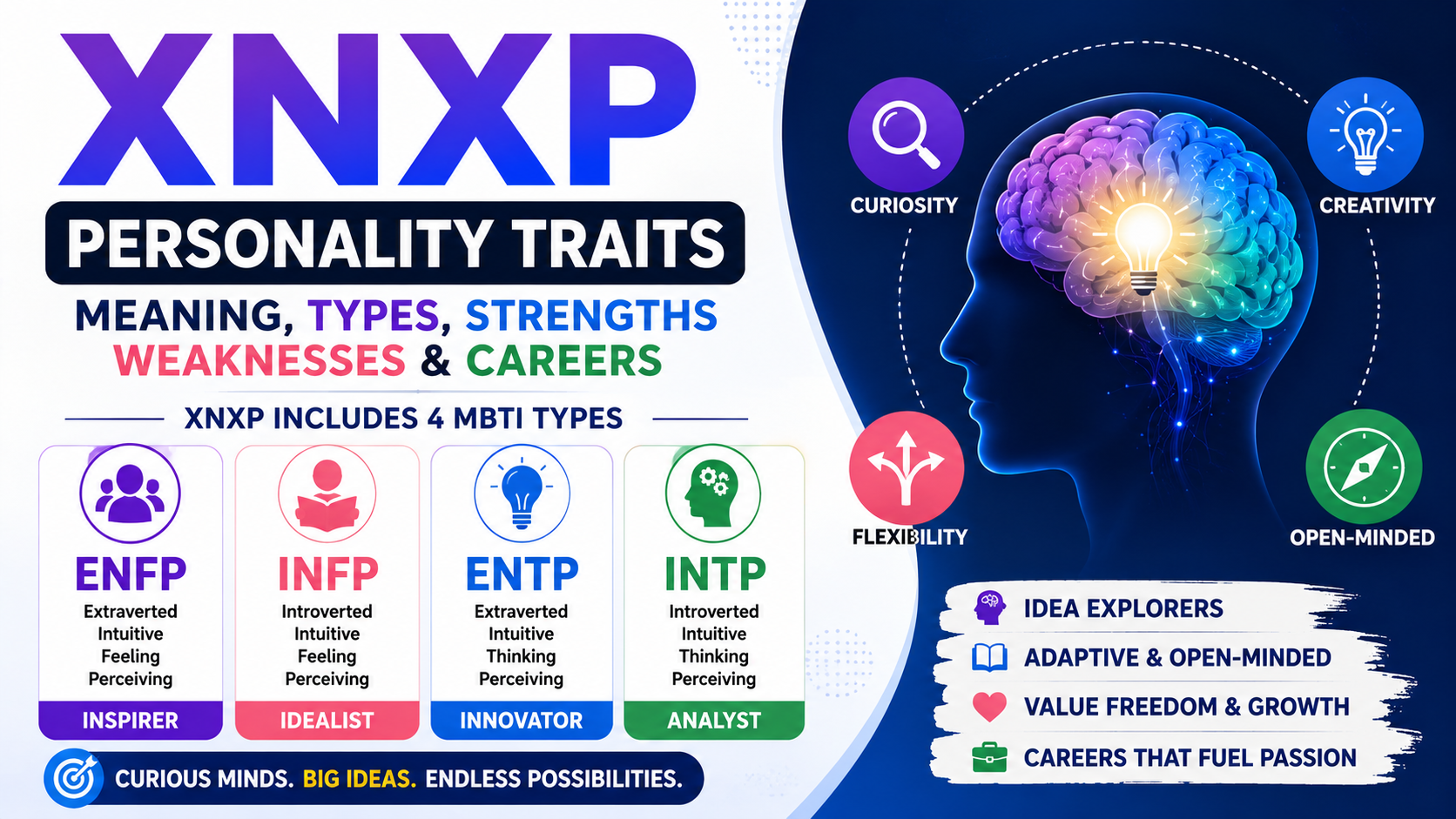
XNXP is not a separate MBTI personality type. Instead, it is a shorthand used to group four MBTI types that share the N (Intuition) and P (Perceiving) preferences: ENFP, INFP, ENTP, and INTP. The “X” indicates that either preference in that position can apply.
These four personalities can differ significantly in social energy, decision-making, and communication style, but they often share an interest in possibilities, ideas, flexibility, and exploration.
What Does XNXP Mean?
The term XNXP can be understood by looking at the four letters individually:
X = either Extraversion (E) or Introversion (I)
N = Intuition
X = either Thinking (T) or Feeling (F)
P = Perceiving
The official MBTI framework uses four preference pairs:
Extraversion (E) / Introversion (I)
Sensing (S) / Intuition (N)
Thinking (T) / Feeling (F)
Judging (J) / Perceiving (P)
Combining one preference from each pair produces 16 MBTI personality types.
Therefore, XNXP represents:
E/I + N + T/F + P
This produces four combinations:
XNXP Type | Full Type | General Description |
|---|---|---|
ENFP | Extraverted, Intuitive, Feeling, Perceiving | Imaginative and enthusiastic |
INFP | Introverted, Intuitive, Feeling, Perceiving | Reflective and values-driven |
ENTP | Extraverted, Intuitive, Thinking, Perceiving | Innovative and debate-oriented |
INTP | Introverted, Intuitive, Thinking, Perceiving | Analytical and theoretical |
The descriptions above are broad type preferences, not fixed predictions of how every person will behave.
Is XNXP an Official MBTI Personality Type?
No. XNXP is not one of the 16 official MBTI personality types.
It is better understood as a convenient grouping of four types that share the N and P preferences.
The four XNXP types are:
ENFP + INFP + ENTP + INTP
The official MBTI framework identifies 16 types created from combinations of four preference pairs.
This distinction matters because two XNXP individuals can have very different personalities.
For example, an ENFP and an INTP both have N and P, but they differ in their preferences for Extraversion versus Introversion and Feeling versus Thinking.
What Are the Common XNXP Personality Traits?
Although XNXP includes four distinct personality types, they share two important MBTI preferences: Intuition (N) and Perceiving (P).
1. Curiosity
XNXP personalities are often interested in exploring ideas, possibilities, and alternative explanations.
Instead of accepting an idea immediately, they may ask:
Why does this work?
What if we tried something different?
Could there be another explanation?
What might happen in the future?
This curiosity can make them enthusiastic learners and creative problem-solvers.
2. Openness to Possibilities
The Intuition preference focuses on patterns, possibilities, and the bigger picture rather than concentrating exclusively on immediate facts.
An XNXP student might therefore enjoy subjects that allow them to connect concepts, develop theories, or investigate hypothetical situations.
3. Flexibility
Perceiving is associated with keeping options open, adapting to new information, and maintaining flexibility rather than seeking immediate closure.
This can be helpful when a project changes direction or when unexpected information appears.
4. Creativity
XNXP personalities are commonly associated with generating possibilities and exploring unconventional approaches.
They may enjoy:
Brainstorming
Creative writing
Research
Innovation
Debates
Problem-solving
Entrepreneurship
Design
Exploring new technologies
5. Independent Thinking
Some XNXP individuals prefer to investigate an idea independently before accepting conventional explanations.
This can be particularly useful in academic environments where students need to compare theories, evaluate evidence, and develop their own arguments.
The Four XNXP Personality Types
The four XNXP types share N and P but differ in other preferences.
ENFP Personality
ENFP = Extraversion + Intuition + Feeling + Perceiving
ENFPs are often described within the MBTI framework as enthusiastic, imaginative, spontaneous, and interested in possibilities. The official type description emphasizes their ability to make connections between information and their preference for flexibility and improvisation.
An ENFP student might enjoy:
Group discussions
Creative projects
Presentations
Brainstorming
Social activities
Exploring different career options
Their challenge may be maintaining attention when a project becomes repetitive or highly routine.
INFP Personality
INFP = Introversion + Intuition + Feeling + Perceiving
INFPs are generally associated with reflection, personal values, curiosity, flexibility, and an interest in understanding people and possibilities.
An INFP student may enjoy assignments involving:
Literature
Psychology
Creative writing
Philosophy
Social issues
Personal reflection
Human behavior
They may prefer working independently and having time to think deeply about an idea.
ENTP Personality
ENTP = Extraversion + Intuition + Thinking + Perceiving
ENTPs are described in the MBTI framework as resourceful, inventive, outspoken, and interested in solving new or challenging problems. They may enjoy generating conceptual possibilities and analyzing them strategically.
An ENTP may enjoy:
Debates
Entrepreneurship
Technology
Business strategy
Problem-solving
Innovation
Competitive discussions
They may become less interested when work becomes highly repetitive.
INTP Personality
INTP = Introversion + Intuition + Thinking + Perceiving
INTPs are associated with analytical thinking, theoretical ideas, independent investigation, and solving complex problems within areas of interest.
An INTP student might spend significant time investigating how a system works before attempting to explain it.
They may enjoy:
Mathematics
Computer science
Physics
Philosophy
Programming
Research
Data analysis
XNXP Strengths
The shared characteristics of XNXP types can provide several potential strengths.
Creative Problem-Solving
XNXP individuals may approach problems from multiple directions rather than immediately accepting the first available solution.
Adaptability
Their preference for keeping options open can help them adjust when circumstances change.
Curiosity
They may naturally ask questions and investigate subjects beyond the minimum requirements.
Conceptual Thinking
The Intuition preference is oriented toward patterns, possibilities, and the bigger picture.
This can be useful when studying theoretical subjects.
Innovation
Their interest in possibilities can encourage experimentation and unconventional ideas.
XNXP Challenges
Every personality grouping has potential challenges, and XNXP should not be interpreted as a list of guaranteed behaviors.
Some people who identify with XNXP may experience difficulties with:
Procrastination
Keeping many possibilities open can sometimes make it difficult to decide where to begin.
Finishing Projects
Generating new ideas can be easier than completing every project already started.
Routine
Highly repetitive work may feel less stimulating to someone who strongly prefers exploring new possibilities.
Time Management
Flexible working styles can become problematic when deadlines are ignored or underestimated.
Overthinking
Having many possible interpretations can sometimes make decision-making slower.
These are not inevitable characteristics of XNXP people. Individual behavior depends on many factors beyond a personality-type framework.
XNXP and Academic Performance
Personality preferences can provide a framework for thinking about how someone approaches learning, but they should not be used to predict academic ability.
An XNXP student might find learning more engaging when they can:
Explore concepts rather than memorize isolated facts
Connect different subjects
Ask questions
Discuss alternative viewpoints
Work on creative projects
Investigate real-world applications
Choose between different approaches to a problem
For example, instead of simply memorizing a theory, an XNXP learner may prefer understanding why the theory exists, how it connects with other ideas, and how it could be applied differently.
At the same time, academic success still requires practical skills such as planning, revision, research, and meeting deadlines.
XNXP Study Strategies
If you identify with one of the XNXP types, you can use your interest in ideas to make studying more engaging.
Use Concept Maps
Connect related ideas visually instead of writing only linear notes.
Turn Topics Into Questions
Instead of asking only “What do I need to memorize?”, ask:
Why does this happen?
How are these concepts connected?
What would happen if the conditions changed?
Use Short Study Goals
Large projects can feel overwhelming. Break them into smaller outcomes.
For example:
Research topic → find sources → create outline → write introduction → draft sections → revise → proofread
Build Flexible Structure
You do not necessarily need an extremely rigid timetable. A flexible weekly plan can provide structure while leaving room for exploration.
Set Completion Deadlines
Creative exploration is useful, but every academic project eventually needs to be completed.
A useful rule is:
Explore → Decide → Execute → Review
This prevents endless research from replacing actual progress.
XNXP Personality Types and Careers
Personality type should not determine a career by itself. Career decisions should also consider skills, interests, qualifications, experience, financial goals, and personal circumstances.
However, people interested in XNXP characteristics may enjoy careers involving creativity, analysis, communication, research, or innovation.
Potential areas include:
Writing
Marketing
Entrepreneurship
Research
Software development
Design
Consulting
Psychology
Education
Journalism
Product development
Strategy
Technology
The same career can suit very different personality types, so these examples should be treated as possibilities rather than recommendations.
XNXP vs. XNXJ
One useful comparison is between XNXP and XNXJ.
The key difference is the final preference:
P = Perceiving
J = Judging
The MBTI framework describes Perceiving as a preference for flexibility, spontaneity, and keeping options open, while Judging is associated with structure, planning, and closure.
XNXP | XNXJ |
|---|---|
Prefers flexibility | Prefers structure |
Often keeps options open | Often seeks closure |
May adapt plans as information changes | May prefer established plans |
Can enjoy spontaneity | Can enjoy organization |
May explore multiple possibilities | May focus on implementing a direction |
These are preference descriptions rather than rules about individual behavior.
Is XNXP the Same as Being an Intuitive Person?
Not necessarily.
Within MBTI terminology, N represents Intuition, but MBTI preferences are part of a broader four-letter type.
Every XNXP type has N and P, but the other preferences differ.
For example:
ENFP: E + N + F + P
INFP: I + N + F + P
ENTP: E + N + T + P
INTP: I + N + T + P
Therefore, identifying as XNXP does not tell you everything about a person's personality.
Is XNXP a Scientific Personality Diagnosis?
No. MBTI is a personality-typing framework rather than a clinical diagnosis.
The American Psychological Association's Dictionary describes the MBTI as a personality assessment based on preferences across four contrasting categories, while also noting that its scientific credibility has been questioned by research psychologists.
The Myers & Briggs Foundation also emphasizes that MBTI results are based on responses to a self-report assessment and that understanding one's best-fit type involves more than simply receiving four letters.
For this reason, personality-type descriptions are best used for self-reflection and understanding preferences, rather than making medical, psychological, hiring, or other high-stakes decisions.
How Can You Find Your XNXP Type?
If you think you may be XNXP, start by looking at the four possible types:
ENFP
INFP
ENTP
INTP
You can then explore how each type describes the four MBTI preference pairs.
The official framework explains that MBTI results reflect how someone responded to the assessment at the time it was taken, and the organization recommends a best-fit process rather than treating the result as an immutable label.
Learn about the official Myers-Briggs framework
Final Thoughts
XNXP personality is best understood as a convenient grouping of four MBTI types: ENFP, INFP, ENTP, and INTP.
The four types share Intuition (N) and Perceiving (P) preferences, which are associated within the MBTI framework with focusing on possibilities and maintaining flexibility. However, the four types differ in their preferences for Extraversion versus Introversion and Thinking versus Feeling.
Rather than treating XNXP as a fixed description of who someone is, it can be more useful as a starting point for thinking about how different people approach information, decisions, learning, communication, and change.
Personality type is only one lens for understanding individual differences. Your interests, experiences, abilities, environment, and personal choices all contribute to who you are.
Frequently Asked Questions
Everything you need to know about our services

