Factor Calculator: Factor Numbers, Polynomials and Quadratic Expressions Online
Introduction
A factor calculator is an online math tool that helps you find the factors of numbers and algebraic expressions quickly. Instead of working through every possible factor pair manually, you can enter a number or mathematical expression and use the calculator to identify its factors or simplified factored form.
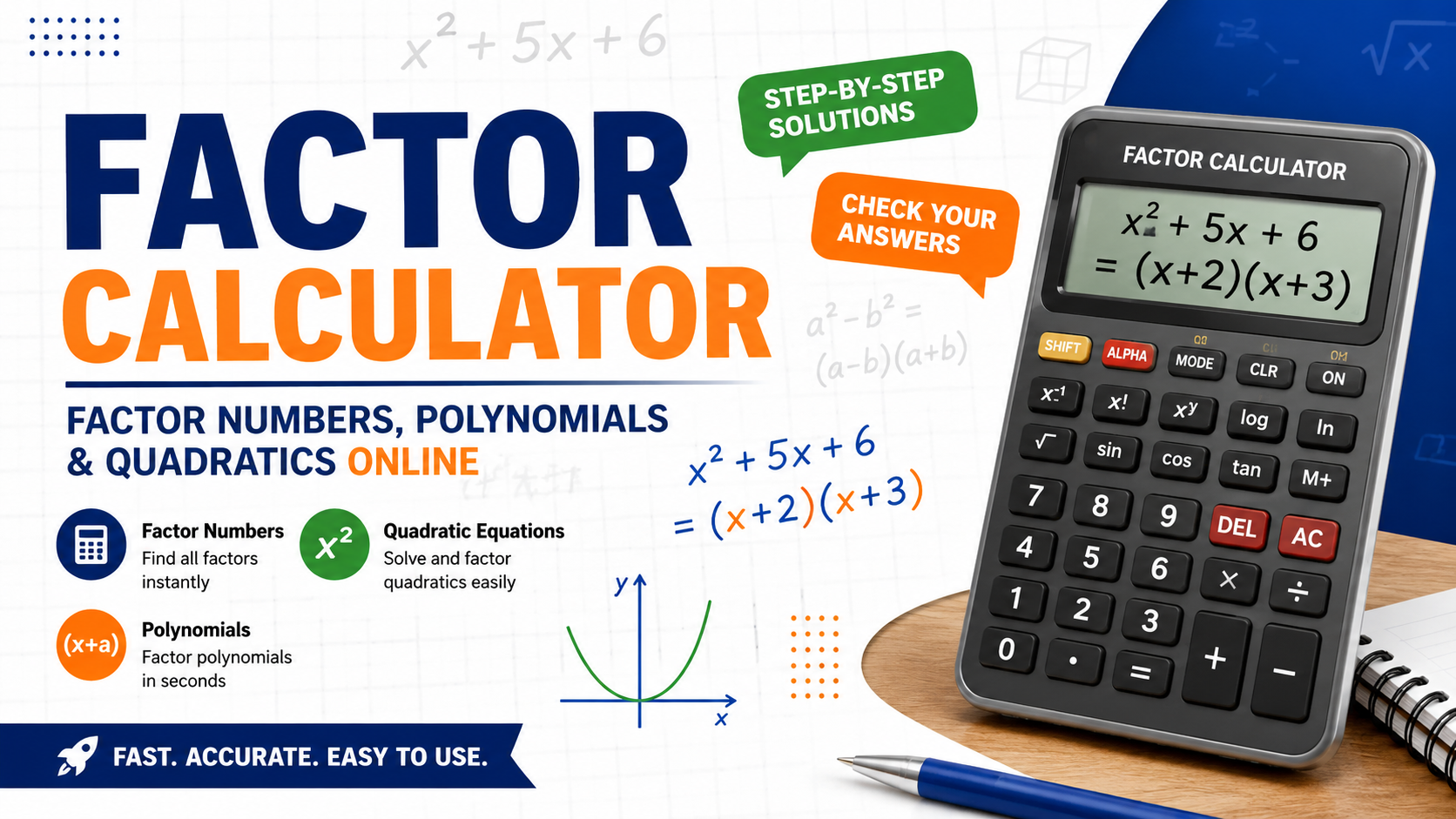
Whether you are working with whole numbers, quadratic equations, trinomials, or other polynomial expressions, a factor calculator can make checking your work much faster.
What Is a Factor?
A factor is a number or algebraic expression that divides another number or expression exactly, without leaving a remainder.
For example:
12 = 3 × 4
Therefore, 3 and 4 are factors of 12. Other positive factors of 12 include 1, 2, 6, and 12.
In algebra, the same idea applies to expressions. For example:
x² + 5x + 6 = (x + 2)(x + 3)
The expressions (x + 2) and (x + 3) are factors of the original polynomial.
Factoring is essentially the reverse of expanding an expression. It is one of the most important skills used when solving algebraic equations.
What Is a Factor Calculator?
A factor calculator is an online calculator that automates the process of finding factors.
Depending on the calculator, you may be able to enter:
Whole numbers
Prime numbers
Quadratic expressions
Trinomials
Polynomials
Expressions with common factors
Differences of squares
Cubic expressions
Algebraic expressions
For example, entering:
x² + 5x + 6
produces:
(x + 2)(x + 3)
Modern factoring calculators can also provide additional information such as roots, discriminants, standard form, or intermediate steps.
How to Use a Factor Calculator
Using an online factor calculator is usually straightforward.
Step 1: Enter your expression
Type the number or algebraic expression you want to factor.
For example:
x² + 7x + 12
Step 2: Select the factoring option
If the calculator provides multiple modes, choose the option for factoring or factorization.
Step 3: Calculate
Click the Factor, Calculate, or Factorize button.
Step 4: Check the result
The calculator will return the factored form of the expression.
For our example:
x² + 7x + 12
becomes:
(x + 3)(x + 4)
Step 5: Verify the answer
Multiply the factors back together:
(x + 3)(x + 4)
= x² + 4x + 3x + 12
= x² + 7x + 12
The result matches the original expression, confirming the factorization.
Factor Calculator Example
Let's look at a simple quadratic expression:
x² + 6x + 8
We need two numbers that:
Multiply to 8
Add to 6
Those numbers are 2 and 4.
Therefore:
x² + 6x + 8 = (x + 2)(x + 4)
You can use a factor calculator online to check this result instantly.
Factoring Quadratic Equations
One of the most common reasons students use a factor calculator is to factor quadratic expressions.
A quadratic normally has the form:
ax² + bx + c
For example:
x² + 5x + 6
The expression can be factored into:
(x + 2)(x + 3)
Once a quadratic equation has been factored, you can often solve it more easily.
For example:
x² + 5x + 6 = 0
becomes:
(x + 2)(x + 3) = 0
Therefore:
x = -2
or
x = -3
A factoring calculator can therefore be useful not only for factorization but also for checking the algebra used when solving quadratic equations.
Factoring by Taking Out the Greatest Common Factor
Another common factoring technique is finding the greatest common factor (GCF).
Consider:
6x² + 12x
Both terms contain 6x.
Therefore:
6x² + 12x = 6x(x + 2)
The factor 6x is the greatest common factor of the two terms.
Identifying the GCF is often the first step when factoring more complicated polynomial expressions.
Difference of Squares
A factor calculator can also help with expressions involving a difference of squares.
The general pattern is:
a² − b² = (a − b)(a + b)
For example:
x² − 25
Since 25 is 5²:
x² − 25 = x² − 5²
Therefore:
x² − 25 = (x − 5)(x + 5)
This method is particularly useful because the expression can be factored immediately once you recognize the pattern.
Factoring Trinomials
Trinomials contain three terms.
For example:
x² + 9x + 20
We need two numbers whose product is 20 and whose sum is 9.
Those numbers are 4 and 5.
Therefore:
x² + 9x + 20 = (x + 4)(x + 5)
For more complicated expressions, factoring manually can take considerably longer. A polynomial factoring calculator can provide a quick way to check whether your factorization is correct.
Factoring When the Leading Coefficient Is Greater Than 1
Consider:
2x² + 7x + 3
This is more difficult to factor mentally than a simple monic quadratic.
The correct factorization is:
2x² + 7x + 3 = (2x + 1)(x + 3)
You can verify this by multiplying:
(2x + 1)(x + 3)
= 2x² + 6x + x + 3
= 2x² + 7x + 3
A factor calculator is particularly useful for checking these more complicated quadratic expressions.
Factor Calculator vs. Factoring by Hand
Both methods have advantages.
Method | Best For |
|---|---|
Factoring by hand | Learning algebra and showing working |
Factor calculator | Quickly checking answers |
Factoring calculator with steps | Understanding the factorization process |
Prime factorization | Breaking numbers into prime factors |
Polynomial calculator | Factoring more complicated algebraic expressions |
A calculator should not necessarily replace understanding the underlying method. For homework, tests, and assignments, you may still need to show the mathematical steps required by your instructor.
Why Use an Online Factor Calculator?
An online factor calculator can be useful for several reasons.
1. Save time
Factoring complicated expressions manually can be time-consuming. A calculator can provide a result much faster.
2. Check your homework
If you have already factored an expression by hand, you can use a calculator to verify your answer.
3. Reduce calculation errors
Sign errors and arithmetic mistakes are common when factoring. Checking your result with a calculator can help identify mistakes.
4. Practice algebra
Students can factor an expression manually and then compare their answer with the calculator's result.
5. Work with complicated expressions
Some online tools support quadratics, cubics, polynomials, GCF calculations, and other factoring methods.
Can a Factor Calculator Factor Polynomials?
Yes. A polynomial factoring calculator can factor many polynomial expressions, depending on the capabilities of the particular tool.
For example:
x³ − 8
can be recognized as a difference of cubes:
x³ − 2³
and factored as:
(x − 2)(x² + 2x + 4)
Other examples include:
x² − 9
x² + 5x + 6
2x² + 7x + 3
x³ − 27
x⁴ − 16
Some advanced online factoring calculators also support different polynomial factoring methods and step-by-step explanations.
Factor Calculator for Prime Factorization
Factorization is not limited to algebra.
You can also factor whole numbers into their prime factors.
For example:
60 = 2 × 2 × 3 × 5
Therefore, the prime factorization of 60 is:
2² × 3 × 5
Prime factorization is useful when working with:
Greatest common factors
Least common multiples
Fractions
Divisibility
Number theory
Simplifying mathematical expressions
What Is the Difference Between Factorization and Simplification?
These terms are related but they are not exactly the same.
Factorization means rewriting an expression as a product of factors.
For example:
x² + 5x + 6 → (x + 2)(x + 3)
Simplification means rewriting an expression into an equivalent form that is easier to work with.
For example:
2x + 3x → 5x
A calculator may support both operations, but the mathematical goal is different.
Factor Calculator for Students
Students studying algebra, mathematics, engineering, economics, computer science, physics, and other quantitative subjects may encounter factorization regularly.
A factor calculator can be useful when:
Checking algebra homework
Practicing quadratic equations
Reviewing before an exam
Checking polynomial factorization
Learning factor pairs
Verifying an assignment answer
Working through mathematical examples
However, if your course requires you to demonstrate your working, use the calculator as a checking and learning tool rather than simply copying the final result.
Try the Factor Calculator
Factoring does not have to be a slow process. If you want to check a number, quadratic, trinomial, or polynomial expression, use the Factor Calculator to quickly check your calculation.
Use the ChatGPT's Factor Calculator →
For students working on larger mathematics problems, checking individual calculations can help catch errors before submitting an assignment.
Conclusion
A factor calculator provides a convenient way to factor numbers and algebraic expressions online. It can help with everything from simple factor pairs and prime factorization to quadratic equations, trinomials, and polynomial expressions.
The best way to use a factoring calculator is to combine it with your own mathematical reasoning. Try solving the problem yourself first, then use the calculator to verify the result and understand where any mistakes occurred.
Frequently Asked Questions
Everything you need to know about our services